
Animal Rebellion protesters splatter paint on London hunting shops
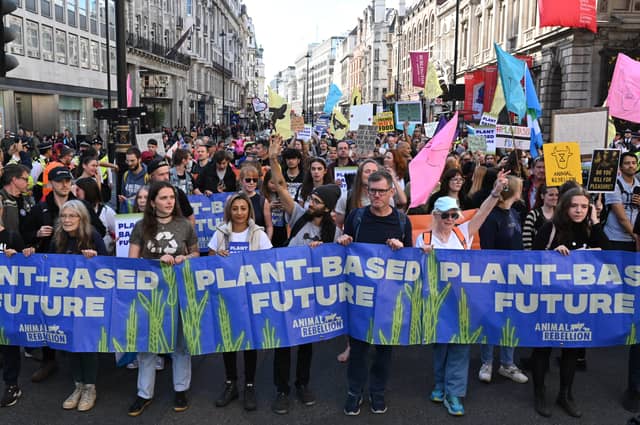

Animal Rebellion (AR) activists vandalised hunting shops with paint as “hundreds” of fellow campaigners protested in central London on Saturday to demand a “plant-based future”.
Campaigners poured red paint inside Farlows, a hunting and fishing shop on Pall Mall, and daubed paint on the windows of William Evans, a shooting supply shop in nearby St James’s Street, while others took and emptied milk from supermarkets.

After putting out a message “calling all vegans to occupy London”, AR said protesters brought London’s West End “to a standstill” as people marched from Green Park to Piccadilly Circus.
They are calling on Prime Minister Liz Truss and Environment Secretary Ranil Jayawardena to tackle what they call the “climate, ecological and cost-of-living crises”.

It comes after two activists from Animal Rebellion targeted Fortnum & Mason and Selfridges and poured milk out in the high-end department stores in central London on Friday.
Dillon Parsons, 21, from Preston, a spokesperson for AR and a film production student at the University for the Creative Arts, said he has been involved with the campaign group for two years.

“We’ve seen through the cost-of-living crisis and the climate crisis that they are not treating the public well and they have their own pockets as their first priorities.

He said he was not present when the shops were vandalised, but added: “If the Government responded to us and gave us a chance of a plant-based future we wouldn’t have to do actions like this but causing this level of disruption, if this is what is going to get us heard, that’s the actions we’ve got to take.”
AR is also calling for governmental support for farmers and fishing communities to transition to a plant-based food system and a programme of rewilding.
A Government spokesperson said: “The right to protest is a fundamental principle of our democracy, but actions of this nature do not encourage sensible debate.
“We are supporting our Great British farmers to ensure that well-managed livestock provides environmental benefits such as supporting biodiversity, protecting the character of the countryside and generating important income for rural communities.”