
Archaeologists discover ‘gore’ trench at Waterloo field hospital site
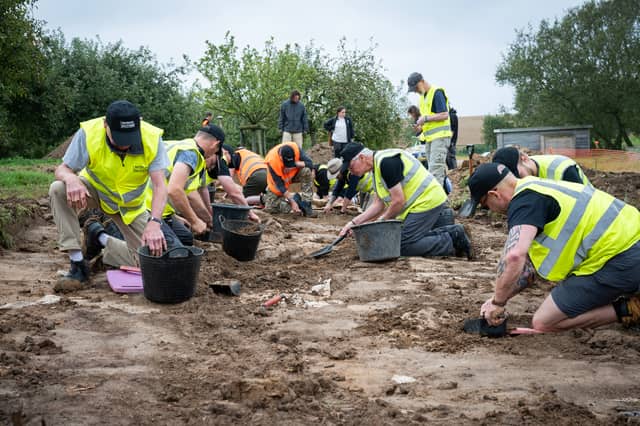

Archaeologists and military veterans have uncovered a “unique” clearance trench on the site of a field hospital on the Waterloo battlefield.
Veteran support charity Waterloo Uncovered is carrying out a targeted excavation at Mont-Saint-Jean farm in Belgium, which served as the Duke of Wellington’s field hospital during the battle in 1815.
A previous excavation at the same site in 2022 found the remains of horses, amputated limbs and a lone soldier laid to rest together in what is now the farm’s orchard.

It contains deposits of human and animal remains separated by a barrier of ammunition boxes stripped from soldiers’ leather satchels.
Archaeological director Professor Tony Pollard, of the University of Glasgow, said: “I can’t think of any other site that has this combination of elements – it’s truly unique, within Napoleonic archaeology and beyond.
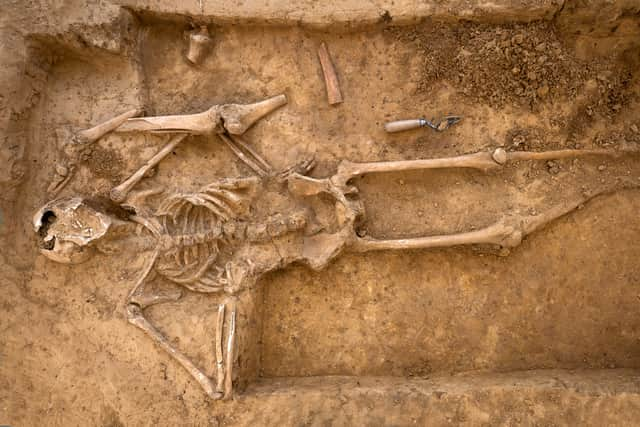
In the north of the trench the team uncovered the remains of an ox and at least seven horses, several of which show possible signs of being butchered, and three of which have been euthanised via a musket ball to the head.
To the south, archaeologists discovered a pile of amputated human limbs, many of which still contain evidence of removal by the surgeon’s saw, laid alongside the complete human skeleton excavated in 2022.
Waterloo Uncovered’s Excavation programme offers veterans the opportunity to take part in cutting-edge archaeology while receiving dedicated wellbeing support.
One of those taking part was Clive Jones, 66, of the Welsh Guards, who was stationed with the Household Cavalry in Knightsbridge during the Hyde Park Bombing of 1982 which killed 11 military personnel and seven cavalry horses.
The veteran said that uncovering the skeletons of seven horses had a big impact on him.
“But everyone here is so supportive. Every beneficiary has a story that has brought them to Waterloo. Away from home and among a group of fellow veterans and wellbeing professionals, they can start to face those memories.
“Our veterans are exploring the aftermath of a battle while dealing with the ongoing aftermath of battles they have fought in – an aftermath which is often going on in their minds.”

After undergoing significant surgery to reconstruct the right side of his head and fighting to regain the ability to walk, he has been slowly rebuilding his independence and confidence.
He said: “This is the first trip I’ve done without a support worker. Normally, I’d refuse to do things like this, but when my regiment contacted me about it, I decided to give it a try, and it’s exceeded all of my expectations.
“The amputated limbs we’re finding don’t bother me – I’ve seen much worse during my service.”
An international team of veterans, serving personnel and archaeologists is involved in the dig at the site of the battle, which saw the defeat of Napoleon.
Abigail Boyle, chief executive of Waterloo Uncovered, said: “It may seem counterintuitive to put injured veterans back on a battlefield, but it’s actually extremely beneficial.”