
Assisted dying could include people with mental illness or diabetes, MSPs told

MSPs have been warned that current proposals to legalise assisted dying in Scotland could eventually include people with mental illnesses or diabetes.
Holyrood’s health committee was told there are concerns around the definition of “terminal illness” in the Assisted Dying for Terminally Ill Adults (Scotland) Bill.
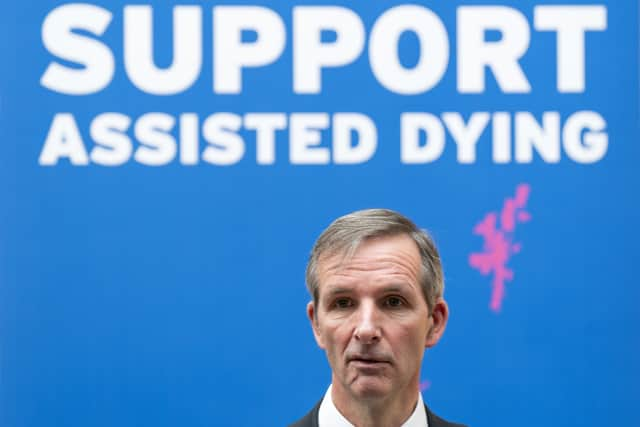
The legislation, proposed by Liberal Democrat MSP Liam McArthur, would give those with a terminal illness, who are 16 or older, the right to request an end to their life.
MSPs were warned on Tuesday that the Bill could be opened up to legal challenges which could expand eligibility.
Dr Mary Neal, a reader in law at Strathclyde University, said: “I think it’s tricky because, on the one hand, the definition of terminal illness in the Bill doesn’t refer to a specific life expectancy, it’s just any illness … from which a person can’t recover.
“There are some mental health issues from which people can’t recover and which might be expected to shorten life.
“So in that sense, there’s a risk that those kinds of conditions could actually form a basis for someone seeking assisted dying under the Bill unless that definition is considerably tightened.
She added: “There is risk baked into the definition of terminal illness in the Bill that someone could foreseeably decide to end their life because they’re unable to recover from a mental condition that’s causing them considerable suffering.”
Dr Stephen Potts, a consultant in liaison psychiatry at NHS Lothian, told the committee that mental illness was common in those with terminal illnesses, including depression.

Tory MSP Dr Sandesh Gulhane, who is also a GP, asked panellists if court challenges could ultimately lead to people with conditions such as diabetes being allowed to access Assisted Dying, in what he said was an “extreme example”.
Dr Murray Earle, Lecturer in Medical Law, Mason Institute for Medicine, Life Sciences and the Law, at the University of Edinburgh, answered: “Yes, I do see that.”
Dr Earle said there was a risk of a “slippery slope” where people with some conditions could argue they should be included in access to assisted dying.
“I think at the moment this Bill is quite tight but what we’ve seen abroad is it has been slippage,” he said.
“There has been the so-called slippery slope, and we’ve seen it because people have claimed a rights basis for their exclusion, or rather their rights being invaded, because they’ve been excluded.
Dr Neale said it was likely that groups would launch court challenges if the Bill was passed to expand assisted dying to more groups.
The health committee also heard about concerns that the Bill may be discriminatory against those with disabilities.
Under the proposals, those seeking the treatment would have to have been a resident in Scotland for at least a year, be registered with a GP in the country, and be mentally competent.
The legislation would require the people receiving the end-of-life treatment to take the medication to end their lives themselves.
However, MSPs were told there could be people who are able to consent to the treatment but are physically unable to administer it.
Dr Earle said: “I do agree with colleagues that it is potentially or actually discriminatory if a person, because of their disability, cannot access essentially a right which has been enacted.
“Then there’s an equalities issue and therefore possibly even a devolution issue.”
Lynda Towers, a member of the public policy committee at the Law Society of Scotland, added: “I think the question of whether or not a person should be able to administer it themselves might well result in questions around discrimination.
“It goes back to the original point that we were talking about that if there is a disability, and that’s so widely defined that it would undoubtedly catch something of that instance, then that person could be discriminated against and there might well be a human rights argument there.”