
Borrowing data offers boost to Chancellor’s tax cut plans


Chancellor Jeremy Hunt’s plans for tax cuts in Wednesday’s autumn statement have been boosted as figures showed Government borrowing was lower than official forecasts in the year to date despite a sharp rise in October.
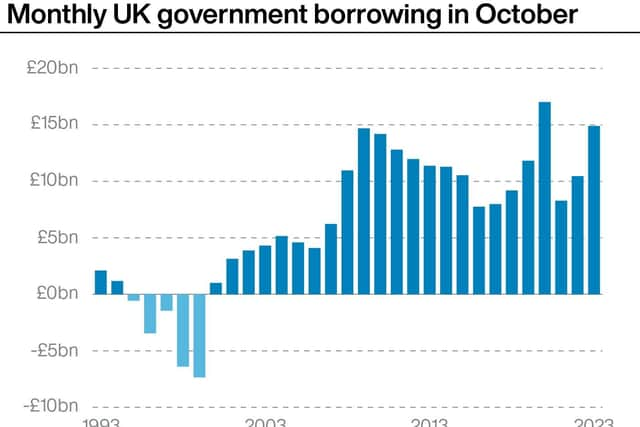
The Office for National Statistics (ONS) said public sector net borrowing stood at £14.9 billion last month, £4.4 billion more than a year earlier and the second-highest October borrowing since monthly records began in 1993.
It was more than most economists had been pencilling in and higher than the £13.7 billion expected by the UK’s fiscal watchdog, the

The ONS also revised up borrowing figures for the first six months of the financial year to £83.4 billion from £81.7 billion previously estimated, due largely to weaker income and corporate tax receipts.
But despite the higher-than-forecast figures, financial year-to-date borrowing is still below official forecasts made last March, standing at £98.3 billion, £21.9 billion more than a year earlier, though less than the £115.2 billion forecast by the OBR.
Mr Hunt said: “We met our pledge to halve inflation, but we must keep on supporting the Bank of England to drive inflation down to 2%.
“That means being responsible with the nation’s finances.
“At my autumn statement tomorrow, I will focus on how we boost business investment and get people back into work to deliver the growth our country needs.”
Prime Minister Rishi Sunak used a speech on Monday to promise tax cuts and pledged to “reward hard work” in what appeared to be a clear signal of intent ahead of the autumn statement.
Pantheon Macroeconomics expert Samuel Tombs said the latest ONS data shows that the task of returning the nation’s public finances to a sustainable footing is “far from complete”.
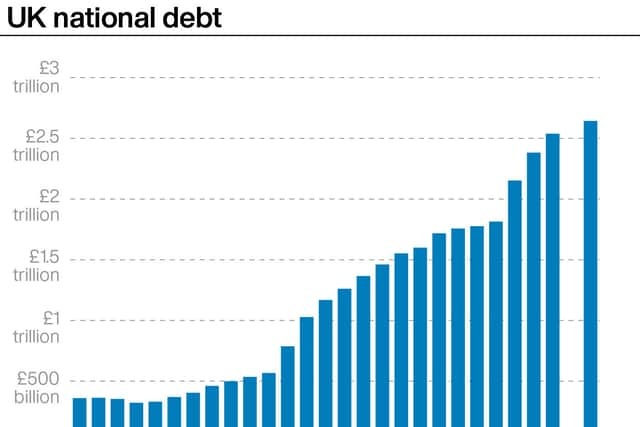
The ONS revealed that net debt stood at £2.64 trillion at the end of October, equalling around 97.8% of UK gross domestic product.
This is 2.3 percentage points higher than the same time last year and remains around the levels last seen in the early 1960s.
The ONS said borrowing was pushed up in October by uprated benefits and cost-of-living payments, as well as £1.1 billion in interest payable on government debt – an October record high, although lower than recent peaks.
These factors offset the ending of energy support payments, which began in October last year.