
Chart shows Iran may have put sea mines in Strait of Hormuz
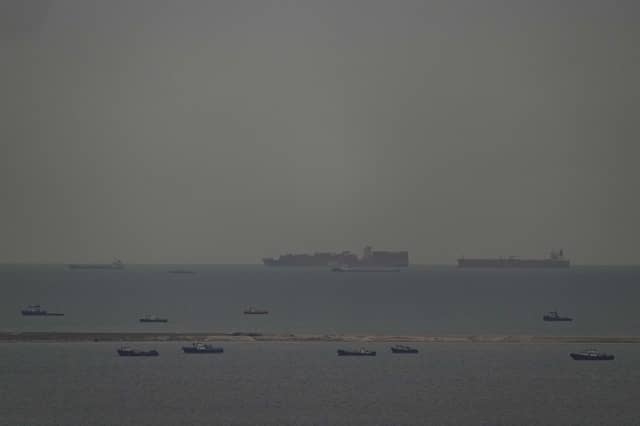

Iran’s paramilitary Revolutionary Guard may have put sea mines in the Strait of Hormuz during the war, a chart published by semi-official news agencies in the country on Thursday suggested.
The message may be intended to pressure the United States as uncertainty hangs over a days-old two-week ceasefire and further negotiations are set to begin in Pakistan.
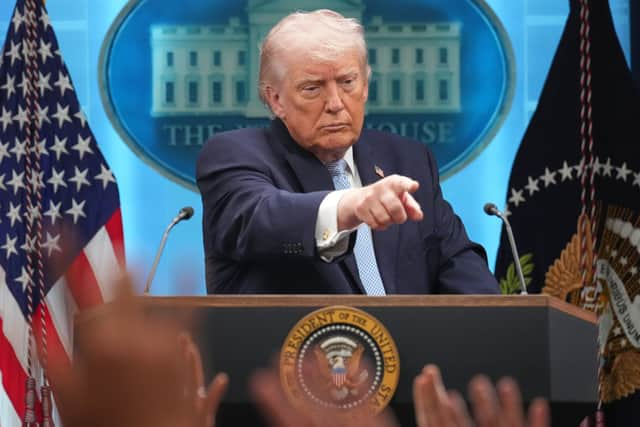
The chart suggested ships travel further north through waters closer to Iran’s mainland near Larak Island, a route that some ships were observed taking during the war.
The charts were dated from February 28 until Thursday April 9, and it was unclear if the Guard had cleared any mining on the route since then.
Iran’s deputy foreign minister Saeed Khatibzadeh said his country will allow ships to pass through the Strait of Hormuz in accordance with “international norms and international law” once the United States ends its “aggression” in the Middle East and Israel stops attacking Lebanon.
Mr Khatibzadeh told the BBC on Thursday that Iran had closed the strait after US ally Israel committed an “intentional grave violation of the ceasefire”.
He added that “we have shown to everybody that energy security is pivotal for Iran, is pivotal for this body of water in the Persian Gulf, and we are going to be abided by the international norms and international law”.
Oil rose again to above 97 US dollars a barrel and Asian stocks were trading lower on Thursday on scepticism over the ceasefire.
Brent crude, the international standard, was up 2.9% to 97.46 dollars per barrel.
Benchmark US crude was 3.7% higher on Thursday at 97.94 dollars per barrel.
Ship-tracking data from Kpler showed that only four vessels with their automatic identification system (AIS) trackers on passed through the Strait of Hormuz on Wednesday, the first day of the ceasefire.
However, that does not include so-called dark fleet vessels, which travel with their AIS trackers turned off.
Many of those dark fleet ships carry sanctioned Iranian crude oil out to the open market.
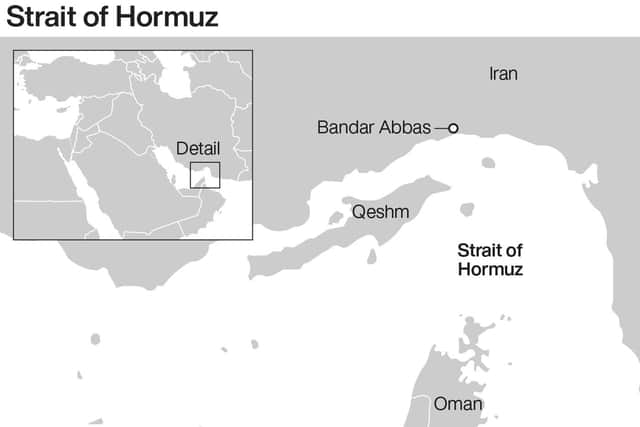
US President Donald Trump posted a statement insisting that his surge of warships and troops will remain around Iran “until such time as the REAL AGREEMENT reached is fully complied with”.
Mr Trump’s comments on his Truth Social platform appeared to be a way to pressure Iran.
“If for any reason it is not, which is highly unlikely, then the ‘Shootin’ Starts,’ bigger, and better, and stronger than anyone has ever seen before,” Mr Trump wrote.

The US and Iran both claimed victory after reaching the ceasefire agreement, and world leaders expressed relief. But more drones and missiles hit Iran and Gulf Arab countries after the deal was announced.
At the same time, Israel intensified its attacks on the Hezbollah militant group in Lebanon, hitting commercial and residential areas in Beirut.
At least 182 people were killed on Wednesday in the deadliest day of fighting there.
First responders searched overnight for missing people still under the rubble after the deadly Israeli strikes.
Israel said on Thursday it had killed an aide to Hezbollah leader Naim Kassem in its air strikes on Beirut.
It identified the man killed as Ali Yusuf Harshi, a secretary and nephew to Mr Kassem.
Hezbollah did not immediately respond to a request for comment.

The Israeli military did not immediately acknowledge the strike.
The violence threatened to scuttle what US vice president JD Vance called a “fragile” deal.
Iran’s parliament speaker said on Wednesday that planned talks were “unreasonable” because Washington had broken three of Tehran’s 10 conditions for an end to the fighting.
In a social media post, Mohammad Bagher Qalibaf objected to Israeli attacks on Hezbollah, an alleged drone incursion into Iranian airspace after the ceasefire took effect and US refusal to accept any Iranian enrichment capabilities in a final agreement.
Iranian foreign minister Abbas Araghchi insisted that an end to the war in Lebanon was part of the ceasefire deal, but Israeli Prime Minister Benjamin Netanyahu and Mr Trump said the truce did not cover Lebanon.
When the deal was announced, the prime minister of Pakistan, who served as a mediator, said in a social media post that it applied to “everywhere, including Lebanon and elsewhere”.
The Soufan Centre said Israel’s strikes on Lebanon on Wednesday added to the risk the deal would fall apart.
“Even if Lebanon was formally outside the deal, the scale of Israel’s strikes was likely to be viewed as escalatory, nonetheless,” it wrote in an analysis published on Thursday.
“Israel’s strikes can be understood both as an effort to drive a wedge between Iran and its proxies and as a response to being allegedly sidelined in the original ceasefire discussions.”
The White House said Mr Vance would lead the US delegation to talks in Islamabad aimed at ending the war, which are set to start on Saturday.
Iran’s ambassador in Islamabad, Reza Amiri Moghadam, wrote on X that Iran’s negotiating team would arrive in the Pakistani capital on Thursday night, but later deleted the post without providing further comment.
His initial post said the talks would be “based on 10 points proposed by Iran”.
Those include Iran enriching uranium, maintaining its control of the Strait of Hormuz and other issues that have been non-starters in the past for Mr Trump.
The White House has repeatedly described the 10 points issued by Iran as false.