
Children from refugee backgrounds ‘have longer wait for school places in NI’

Children from refugee and asylum-seeking backgrounds have a prolonged wait for school places in Northern Ireland, new research has shown.
A report from Queen’s University Belfast has found that newcomer pupils often have a protracted wait for school places in NI due to shortages in areas of high demand.
A newcomer pupil is defined in policy as a child or young person who has enrolled in a school, but who does not have satisfactory language skills to participate fully in the school curriculum and does not have a language in common with the teacher
The report, launched on World Refugee Day on Tuesday, also includes accounts of schools being reluctant to admit pupils from these backgrounds even when spaces do become available.
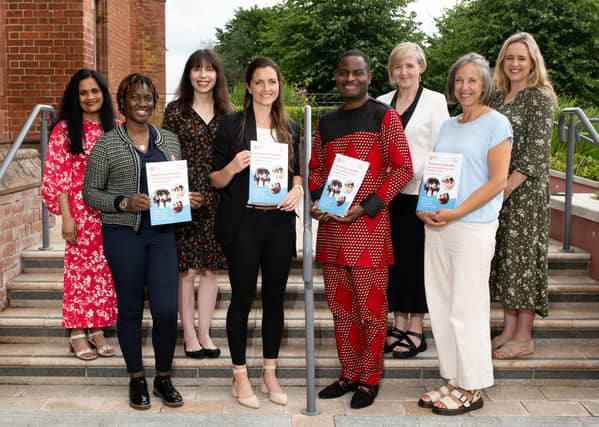
The report, Experiences of Education Among Minority Ethnic Groups in Northern Ireland, was carried out by a team from Queen’s including principal investigator Dr Rebecca Loader, Dr Erika Jimenez; Dr Aisling O’Boyle and Professor Joanne Hughes.
Dr Loader said: “The composition of Northern Ireland’s pupil intake has changed over the past 20 years, with 6.1% of pupils now from a minority ethnic background, and 5.5% are newcomer pupils.
“Providing an equitable educational experience for minority ethnic and migrant children and their families is a legal and social obligation, but there has been little previous research examining to what extent policy and practice are serving their needs.”
She added: “Most parents feel comfortable contacting their child’s school with concerns or questions. However, some experience barriers including a lack of confidence about communicating in English, anxieties about seeming ‘difficult’ or working patterns.”
There were a number of findings indicating how migrant and refugee children, as well as their parents, were disaffected by the education system.
For example, experiences of verbal and physical racist bullying, as well as direct and indirect discrimination, were widely reported by families.
While racist bullying negatively impacts children’s mental health and wellbeing, the research showed that racist incidents are often inadequately addressed by schools.
The transfer test for grammar school admissions was flagged in the report as a particular challenge for migrant families, particularly those arriving in Northern Ireland in the upper years of primary school, with some migrant parents saying they felt that their children had been disadvantaged in admissions decisions.
The research project took place between September 2021 and June 2023 and was funded by the Nuffield Foundation.
The research focused on four main topics: school admissions and transfer, school life and peer relationships, curriculum issues including representation of diversity and English language learning, and home-school relationships.