
Education workers ‘struggling’ due to lack of pay as thousands go on strike


Education workers on picket lines have said they are “struggling” due to lack of pay as thousands took part in strike action on Thursday.
The action over pay and grading comes after Unite members, including bus drivers, classroom assistants, cooks and clerical staff, started a 48-hour walkout on Wednesday.
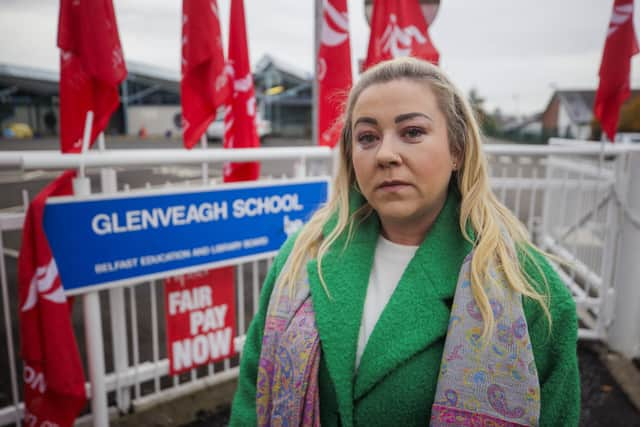
Nula McCarthy, a classroom assistant of 19 years, was on the picket line on Thursday.
“This is running on from last year, we were also out on strike with no resolution, so we’re back out again,” she said.
“Due to pay and grading, the pay is going nowhere, the workload is getting heavier and the pay is staying the same.
“There’s a cost-of-living crisis, mortgages going up, a lot of things going up – except the wages.”
Ms McCarthy said she was forced to take on an additional role in her school as well as a weekend job to make ends meet.
“I work as a classroom assistant, but also had to take on an extra role as a bus escort to make the wages go up, we weren’t getting paid enough,” she said.
“I also had to take on a part-time job at the weekend to again make the wages go up.
Ms McCarthy said education workers were “working hard” for their wages.
“The staffing turnaround is getting worse because staff don’t want to stay. They’re not getting the pay that they deserve for the work that they’re doing,” she said.
She added: “Nobody wants to be here. We want to be in the classrooms.
“I mean, we’re coming up to Christmas. We would normally be getting ready for Christmas shows, a lot of festivities.
“The kids don’t know what’s happening. ‘Are we in school? We’re not in school?’ So we understand the families are frustrated, nobody wants to be here.”
Kieran Ellison, regional officer of Unite, said their members were on strike “because of the failure of the Department of Education”.
“Our members are currently on low pay, it is absolutely affecting the retention issues, which has a knock-on effect for the children, particularly children from an SEN background who have a revolving door of classroom assistants who it’s hard to bond with when they continually change,” he said.
Mr Ellison said the pay and grading review “needs to be implemented”.
“Unite and other trade unions in the Education Authority spent a lot of hard time bargaining this agreement, and really, the Department of Education needs to find the money and implement this to change the retention problem,” he said.
With more than a thousand schools impacted by the strikes, Mr Ellison accepted that children would be affected, but said the current situation with pay and staff retention was unsustainable.
“I would be really grateful if the parents can see beyond the impact that it’s having on their children today and see that these people who care for their children in a caring, compassionate and professional manner on a daily basis are out here for a reason,” he said.
“And if they can help support instead of finding fault then that is more likely to deliver the result that’s needed, and overall, that will impact their children in a more positive way as they move through their life.”
Alan Law, Nipsa assistant secretary and lead trade union secretary, said the action is over four points: pay and grading review, job evaluation, pay differentials and education cuts.
“Nipsa is picketing in almost 150 locations on Thursday,” he said.
“This demonstrates how angry and frustrated our members are with the Department of Education and Education Authority.
“We have been overwhelmed with our membership’s response to the strike action.
“The scale of the picketing is amongst the largest we have organised and indicates our members’ determination to win this dispute.
“I have been impressed by the scale of our picketing locations following our call for industrial action, and we have also been flooded with 1,000 new membership applications in recent days.
“The message could not be clearer: education workers are determined to fight and win.”
Alan Perry, GMB senior organiser, said the strike is “just the start”.
“Enough is enough – GMB members are among the lowest paid across the education sector,” he said.
“Given the current cost-of-living crisis, they just can’t cope anymore.
“This is just the start. There will be strikes across the authority until our members’ concerns and right to fair pay are addressed.”
Last week, Department of Education permanent secretary Mark Browne said the strike action “will undoubtedly cause significant disruption to services right across the education sector and have a major impact on parents and pupils, including our most vulnerable children and young people”.
He described the move as “disappointing”, saying a pay award, which covers non-teaching staff, was agreed on November 1 for 2023-24.
He said it has been provided to the Education Authority to allow the award to be implemented as soon as possible.
“I would urge everyone concerned to reconsider, in light of the serious ramifications of this strike and the severe disruption that will be caused,” Mr Browne added.