
First patients undergo robotic surgery which can avoid need for radiotherapy
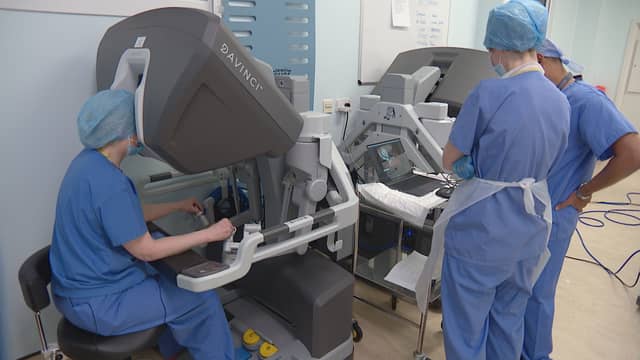

The first patients in Scotland have undergone pioneering robotic surgery to treat certain types of throat cancer – which in some patients can see them avoid the need for radiotherapy.
Transoral Robotic surgery (Tors) started at the Queen Elizabeth University Hospital in Glasgow this week, and is a high tech procedure to remove throat cancers in which a surgeon uses a sophisticated, computer-enhanced system to guide surgical tools and examine cancerous tissues.
Jenny Montgomery and Stuart Robertson, consultants in ENT head and neck surgery at the hospital, performed the first operation on Monday after six months of intensive training.

“With Tors, we’re able to avoid going in through that route and, as such, patients have better function of their throat afterwards. Carefully selected patients may be able to avoid radiotherapy altogether.”
The robot allows the surgeon to perform highly precise surgery – allowing for movements in tiny spaces and gives access to areas in the throat previously only possible with open procedures.
With Tors, the consultant guides the surgical tools from a remote console which does not necessarily have to be in the same theatre, meaning the surgery could be performed in a different room if needed.
And, compared with more traditional procedures, Tors aims to result in quicker recovery and fewer procedures.
Ms Montgomery said: “We hope that Tors will play a crucial role in complementing existing treatments in helping improve patient outcomes within Scotland.”
NHS Greater Glasgow and Clyde hopes to perform about 30 operations in the first year and, while the main aim will be to remove cancers, the health board said there is scope for the service to be expanded to other services in the future.
The Health Secretary, Humza Yousaf, said the state-of-the-art technology was being rolled out across the country.
He said: “This first Transoral robotic surgery is a welcome achievement for NHS Greater Glasgow and Clyde, particularly in light of World Cancer Day on Friday, and shows the innovations we are putting into practice across Scotland to make a real difference to the lives of those being treated for cancer.”