
Former PMs join Prince of Wales and Queen in solemn Accession Council ceremony


It was a deeply solemn occasion behind the walls of St James’s Palace as the Accession Council proclaimed the new King as Sovereign.
Utter silence fell as the Prince of Wales, followed by the Queen Consort, entered the Picture Gallery and stepped onto the low red dais.
William put out a guiding hand behind his stepmother Camilla, who now bears the style Her Majesty, as she gingerly navigated the step up onto the platform, moving into the spotlight in the opulent room packed with some 200 Privy Counsellors.
The prince – now heir to the throne – cast his eyes down as Lord President of the Privy Council Penny Mordaunt opened the proceedings, discharging her “sad duty” to inform those gathered of the passing of Her “Most Gracious Majesty Queen Elizabeth II”.
Camilla, dressed in black and wearing a three-strand pearl necklace, stared straight ahead, surveying the scene, as six former prime ministers, the entire Cabinet, and religious and political leaders past and present listened intently to the ceremony.
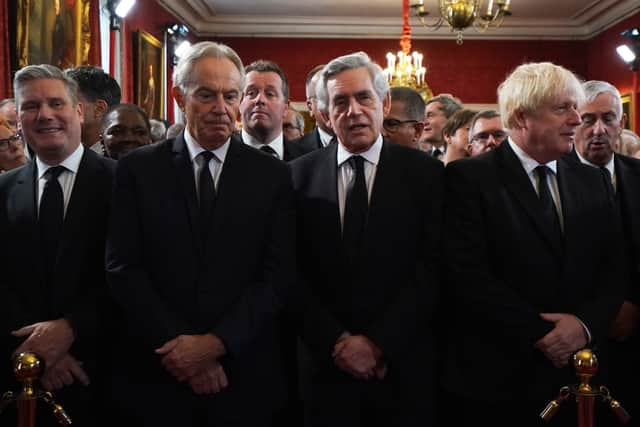
Yet the grandeur and importance of the first part of the Accession Council was in stark contrast to the scene just moments before when the room had buzzed with noise and the loud chatter of conversations.
Before the arrival of the royals and the platform party, the politicians and other Counsellors, who were stood shoulder to shoulder packed in a busy crowd, greeted known allies and past political rivals, in what could have been a celebratory event, save for the black mourning clothes.
There was a slight temporary hush in the room as Sir Tony Blair entered leading a pack of five more former PMs – Gordon Brown, Boris Johnson, David Cameron, Theresa May and Sir John Major – before the chatter quickly rose up once again.
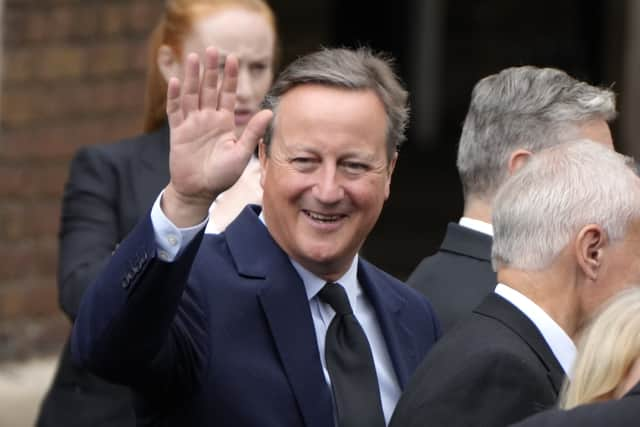
Mr Cameron looked cheery as he entered the room, saying: “Morning, how are you?” to Commonwealth High Commissioners watching from the left of the dais.
Newly departed prime minister Mr Johnson proceeded with his head slightly down and appearing a tad sheepish, before later striking up an animated conversation with Mr Brown. Mrs May and Sir John Major were deep in conversation.
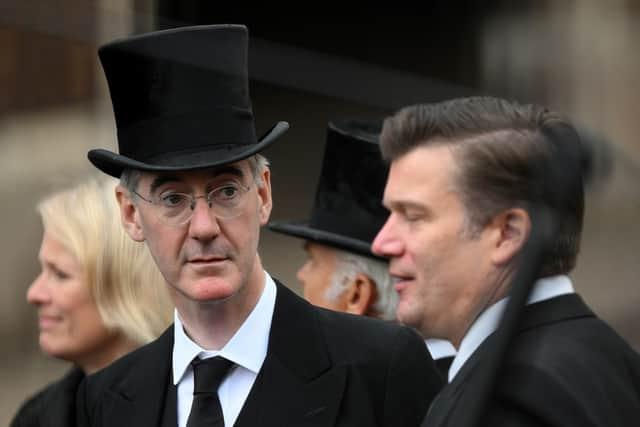
Among the Privy Counsellors, who stood throughout the Council as is custom, were Jacob Rees-Mogg.
So much has changed, as he witnessed the former Mrs Parker Bowles become Queen, and Charles being proclaimed King Charles III.
William was the first to sign the Proclamation, carefully stepping forward to pick up the pen with his left hand before placing his signature on the historic record, as he replaced the lid and set down the pen.

The prince moved back and forward just a touch as he stood there with his hands clasped, with the grieving pair both solemn but in control of their emotions.
As the order of business for the proclamation was set out, William gazed upwards at the ceiling surveying the grand surroundings – in the palace he knew well as a child.

Moments before Part I of the Accession Council began, Cabinet Secretary Simon Case briefly took to the dais, declaring: “The meeting will begin shortly. Please make sure mobile phones are switched off.”
It was just one reminder of how times had changed since the late Queen acceded to the throne more than 70 years ago.
Another reminder came in the form of the two television cameras broadcasting the proceedings from either side of the Gallery, as the ceremony was televised for the first time.
Mrs May said as she waited the start of the Council: “It’s a very solemn very historic occasion and a very sad occasion but we’re here to celebrate a new King.”
She added: “One of the great benefits of out constitution is continuity which gives great reassurance.”
Mr Cameron, stood next to her, added: “A great privilege of this job was the weekly audience with the Queen”, adding that he “drew a lot of strength” from the monarch’s loyal service.
Mr Johnson spoke of a time of renewal and hope.
He said: “It’s a very sad time but it is also one of renewal and hope.
“It’s an absolute privilege to be here.
“Everybody is conscious that nothing like this has happened for seven decades and they are witnessing history, full of hope and confidence.”