
GCSE grades down from 2021 record high, but remain above pre-pandemic levels


Top grades for GCSEs are down on last year – but remain higher than pre-pandemic levels, as UK students received their results on Thursday.
In 2021, the proportion of GCSE entries awarded top grades surged to an all-time high after exams were cancelled for the second year in a row due to Covid-19 and pupils were given results determined by their teachers.
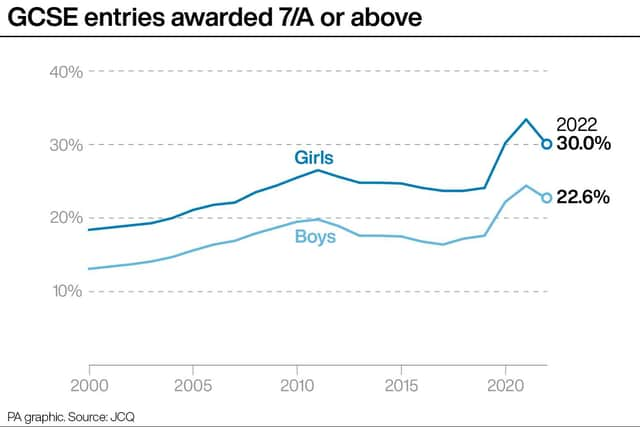
Figures published by the Joint Council for Qualifications (JCQ) – covering GCSE entries from students predominantly in England, Wales and Northern Ireland – showed top grades of 7/A have fallen from 28.9% in 2021 to 26.3% this year, a drop of 2.6 percentage points.
But this remains higher than the equivalent figure for 2019 of 20.8%.
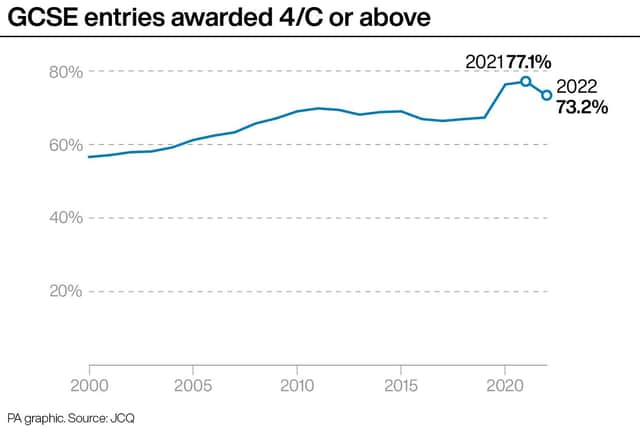
The proportion of entries receiving a 4/C – considered a pass – dropped from 77.1% in 2021 to 73.2% this year, a fall of 3.9 percentage points, but higher than 67.3% in 2019.

Girls continued their lead over boys this year, with 30.0% of entries achieving a 7/A, compared with 22.6% for males.
The gap has closed slightly from last year, when 33.4% of female entries were awarded 7/A or above compared with 24.4% for males, a lead of 9.0 percentage points.
The top 10 subjects at GCSE, which sees pupils having to take a number of compulsory subjects as well as some optional choices, remained the same this year.
While Spanish remains the second-most popular modern foreign language after French, its entries have fallen by 1.7% for the first time since 2018.
Separate figures, published by exams regulator Ofqual, showed that 2,193 16-year-olds in England got grade 9 in all their subjects – including 13 students who did at least 12 GCSEs.
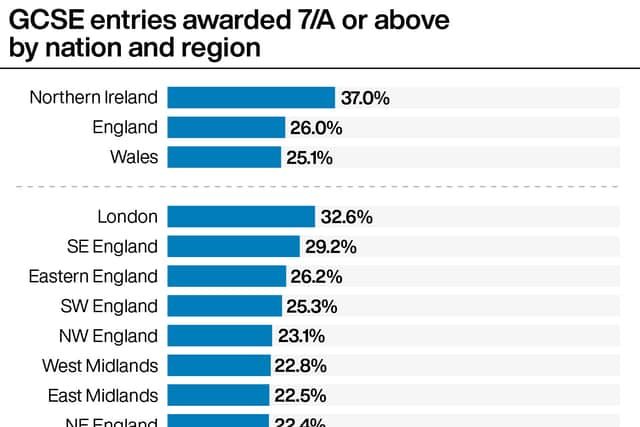
Both the North East and Yorkshire and the Humber were at the bottom of the table when it came to top grades this year, some 10.2 percentage points below London.
While 22.4% of students achieved a 7/A or above in the two northern regions, the figure was 32.6% for London.
This is almost unchanged from last year, which saw a gap between London and the North East of 10.0 percentage points.
Every region in England saw a fall in the proportion of pupils getting a 7/A or above.
Mr Quince told Times Radio: “Ensuring that wherever you live up and down our country that you have access to a world-class education, and you have the same opportunity – whether you live in Bournemouth or Barnsley – is really important to us, and every year up until the pandemic we’ve been closing the attainment gap.”
While traditional A*-G grades are used in Northern Ireland and Wales, in England these have been replaced in with a 9-1 system, where nine is the highest.
Kath Thomas, interim chief executive officer of JCQ, congratulated students getting their results “after lots of hard work and all the challenges of the pandemic”.
She said: “We’re pleased that exams are back, as they’re the fairest way to assess students and give everyone the chance to show what they know.
“This is the first time in three years that results have been based on formal exams and coursework, so it’s a welcome step back towards normality.
“These results will help them progress to the next stage of their education and make some important decisions about their future.

Dr Jo Saxton, Ofqual’s chief regulator, said the results are “a testament to students’ hard work and resilience”.
She said on her visits to colleges and schools across England “the overwhelming message” from students and staff was that they wanted exams and formal assessments to take place, with pupils keen for “a chance to prove themselves”.
Meanwhile, exam board Pearson warned this week that thousands of students could miss out on being issued BTec (Business and Technology Education Council) results on Thursday.
It said that changes this year, made in order to take into account disruption to teaching and learning during the pandemic, had “added more complexity to the process” and that without full information they are unable to award students their results.