
Greenpeace drops boulders onto seabed to block ‘destructive fishing’
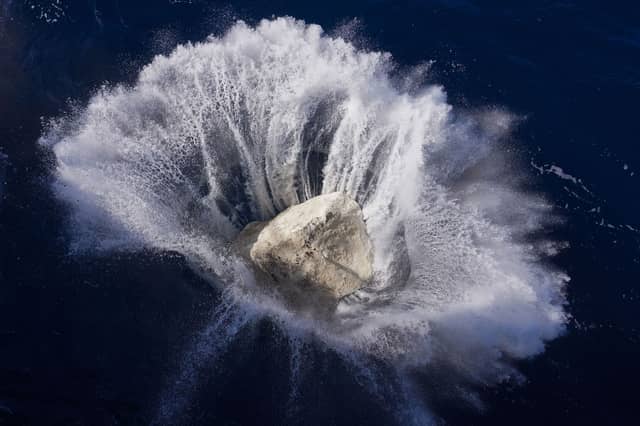

Greenpeace has placed a number of boulders on an area of seabed off the coast of Cornwall in an attempt to block what it describes as “destructive industrial fishing”.
The protest affects a portion of the South West Deeps (East) Marine Protected Area, 118 miles (190km) off the coast in the Western English Channel.
The Marine Management Organisation (MMO) has said that the action is potentially illegal and has launched an investigation.
The environmental group’s action took place days after UK leaders failed to help secure a Global Ocean Treaty at Intergovernmental Conference 5 in New York.

In the last 18 months, the South West Deeps experienced almost 19,000 hours of industrial fishing, 3,370 hours of which was bottom-trawling, according to Global Fishing Watch data. The majority of industrial fishing vessels in the area were from France (53%) followed by Spain (30%) and the UK (9%).
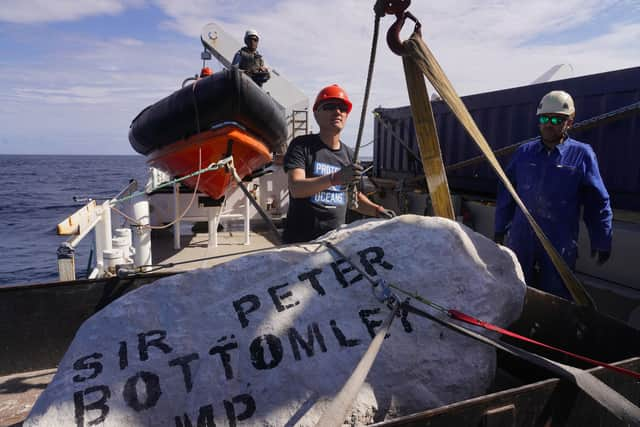
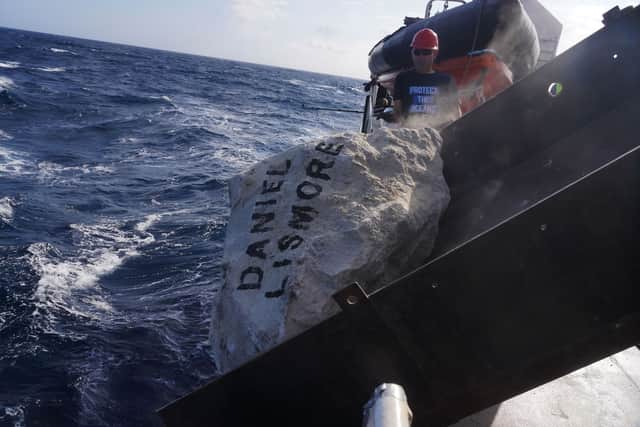
The names of high-profile figures who support the action, including Simon Pegg, Stephen Fry, Conservative MPs Henry Smith and Sir Peter Bottomley, were stencilled onto the boulders before they were dropped.
“Our new Prime Minister must protect local fishing communities and immediately ban industrial fishing in Marine Protected Areas by tweaking commercial fishing licences.”
A spokesperson from the MMO said: “We are very disappointed that Greenpeace has chosen to take this action to drop boulders to form a barrier as we don’t believe it is justified or will help protect our marine environment.
“It is also a requirement under the Marine and Coastal Access Act that any deposit of construction below high water is required to have a Marine Licence. Greenpeace do not hold, nor have they applied for one, and as such their activity is potentially illegal.
“As unlicensed activity has now taken place, MMO has launched a formal investigation in accordance with its regulatory function around marine licensing enforcement and is gathering evidence before considering its next response.”
Barry Deas, CEO of the National Federation of Fishermen’s Organisations, said that “boulders of that size represent a threat to the crews and the vessels that fish the area”, adding that they could be “a potential threat to life”.