
How the late Queen’s coronation boosted the nation after the Second World War


The 1953 coronation was a carnival of celebration as millions rejoiced in the crowning of their Queen.
For a day, street parties banished the hardship of post-war rationing and shortages, and even atrocious, unseasonal weather could not dampen the enthusiasm.
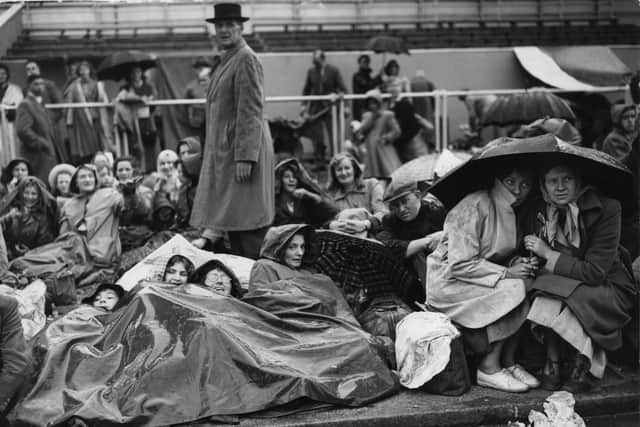
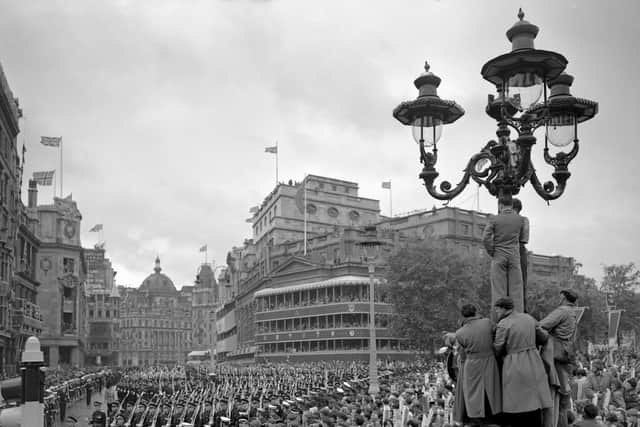
People began to bed down in the streets of London as early as 48 hours before Tuesday June 2 1953, just to make sure they had a standing place to watch the Queen pass by.
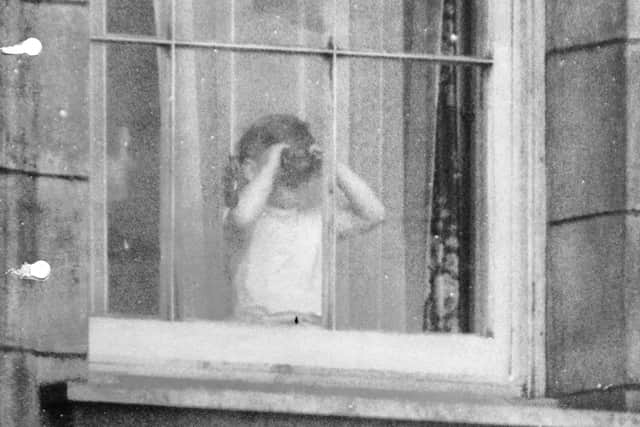
The public were not the only ones making preparations.
In a tribute, Charles – now King – paid to his mother on her 80th birthday, he recalled the night before the big day when he was four years old.
On the day, the joyous atmosphere – “Crowds singing in the rain”, declared one national newspaper – was crowned with the news that climbers from a Commonwealth expedition had conquered Mount Everest, the highest mountain in the world.

The coronation was shared with a wider audience through the relatively new medium of television, which came of age with the screening of the ceremony for the first time.
Despite initial reservations, the Queen eventually agreed to the TV cameras being present in Westminster Abbey to capture the event.

An estimated 27 million people in Britain alone watched the coronation live on their black and white televisions and the images were beamed around the world.
The uncrowned Queen Elizabeth II – she actually wore the George IV Diadem on the journey – set out from Buckingham Palace in the Gold State Coach, escorted by the Yeomen of the Guard, the Household Cavalry and the Royal Bargemaster and Royal Watermen.
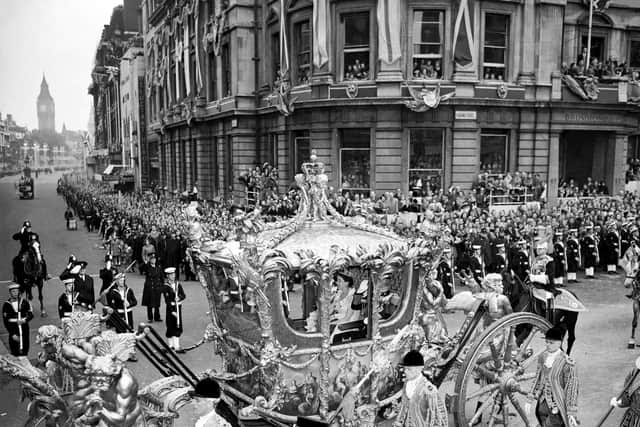
Some 65 years later in a BBC documentary about the day, the Queen recalled how the journey had been “horrible”.
“It’s only sprung on leather,” she said of the coach, adding: “Not very comfortable.”
The Queen and Philip, who was in the full-dress naval uniform of Admiral of the Fleet, departed just after 10.30am pulled by eight grey geldings – Cunningham, Tovey, Noah, Tedder, Eisenhower, Snow White, Tipperary and McCreery.
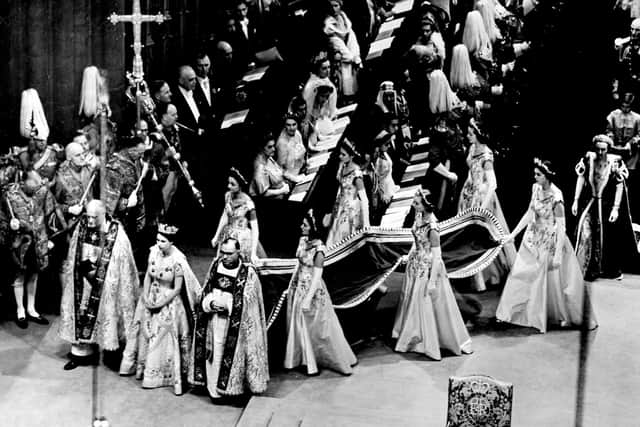
Three bishops carried the paten (Eucharist plate), the chalice and the Bible. Peers carried the regalia from the Crown Jewels and the Lord High Steward carried St Edward’s Crown.
Others in the procession carried two royal maces, three swords symbolising mercy, spiritual justice and temporal justice, the Great Sword of State and St Edward’s Staff.
The Queen recounted many years later how she had a problem getting started in her lengthy coronation robe.
“I remember one moment when I was going against the pile of the carpet and I couldn’t move at all,” she remarked.
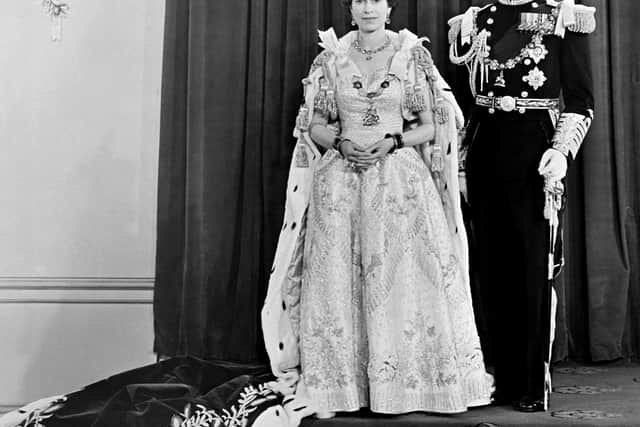
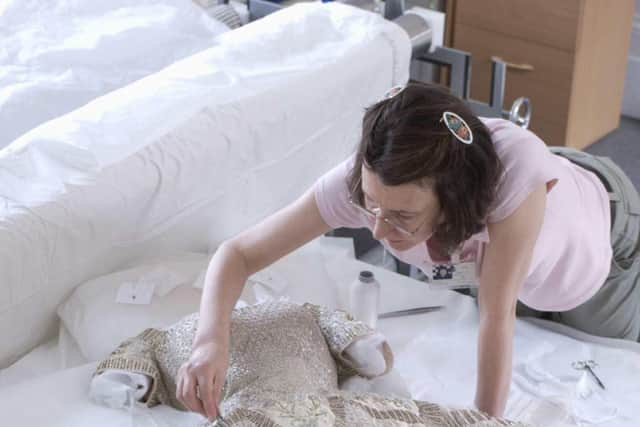
The white satin gown was encrusted with diamonds, gold and silver bullion, seed pearls, crystals, pale amethysts and sequins to create a shimmering effect.
Embroidery in pastel-coloured silks depicted the emblems of the United Kingdom and countries of the Commonwealth.
Her all-white bouquet echoed the symbolic theme of unity with orchids and lily of the valley from England, more orchids from Wales, stephanotis from Scotland, and carnations from Scotland and the Isle of Man.
The Chairs of Estate in which the Queen and Philip were seated during the first part of the coronation ceremony are now on the dais in the Throne Room at Buckingham Palace.
The three-hour service, which took place in front of a congregation of more than 8,000, began with the Archbishop of Canterbury Dr Geoffrey Fisher’s declaration to the assembled bishops: “Sirs, I here present unto you Queen Elizabeth, your undoubted Queen.”
The Queen took the oath, finishing with the words: “The things which I have here before promised, I will perform and keep. So help me God.”
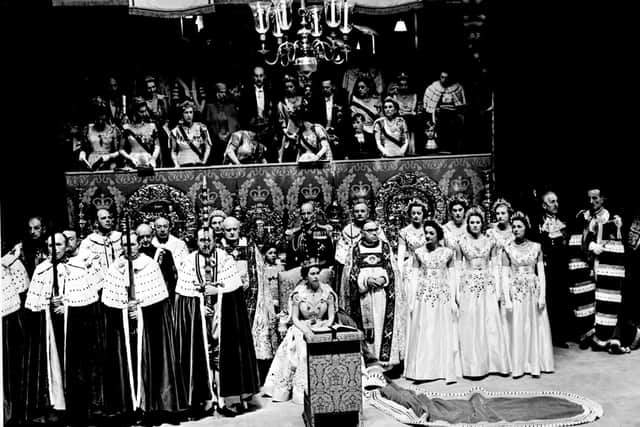
The archbishop made a sign of the cross on her hands, chest and head, saying the words: “Be thy head anointed with holy oil: as kings, priests and prophets were anointed. And as Solomon was anointed King by Zadok and the priest Nathan the prophet, so be thus anointed, blessed and consecrated Queen over the peoples, whom the Lord thy God hath given thee to rule and govern…”
The Queen was anointed, sitting on the Coronation Chair, having shed all her robes and adornments, and wearing a simple white dress.
The anointing had the deepest significance and was the central act of the religious ceremony.
The anointing oil contained oils of orange, roses, cinnamon, musk and ambergris. Usually a batch is made to last a few coronations, but in May 1941 a bomb hit the deanery, destroying the phial containing the existing oil so a new batch had to be made up.
Having been sanctified, the sovereign was “qualified and entitled” for investiture with the ornaments.
She first put on the newly made Colobium Sindonis – a loose linen-lawn garment, and then a robe of cloth of gold – the Dalmatic or Supertunica, which was used by King George VI.
The Lord Great Chamberlain presented the golden spurs, the symbol of chivalry, after which the Archbishop of Canterbury presented a jewelled sword, and then the armills, the golden bracelets of sincerity and wisdom.
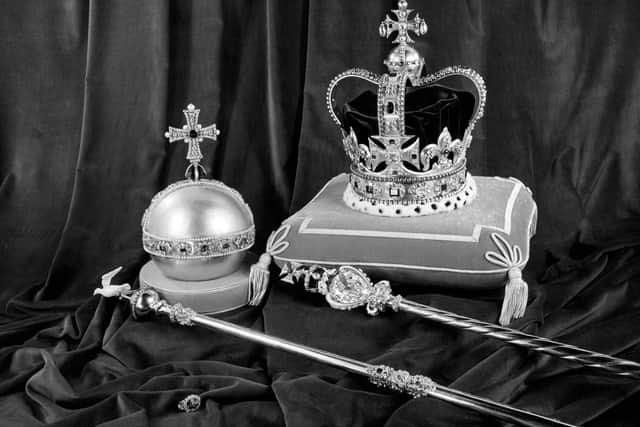
The orb, made in 1661, was the most important part of the regalia after the crown.
It is a globe of gold surrounded by a cross girdled by a band of diamonds, emeralds, rubies, sapphires and pearls with a large amethyst at the summit.

The crown, made in 1661, weighs 4lb 12oz and is made of solid gold.
It was used by Charles II and is believed to have been adapted from one that belonged to Edward the Confessor.
This done, all the princes and princesses, peers and peeresses put on their coronets and proclaimed: “God Save the Queen.”
Trumpets sounded and royal gun salutes were fired at the Tower of London and elsewhere.
Homages from the archbishop, the Duke of Edinburgh and the senior nobility followed with the acclamation: “God Save Queen Elizabeth. Long live Queen Elizabeth. May the Queen live forever.”

Kneeling before her, he put his hands between hers and declared: “I, Philip, Duke of Edinburgh, do become your liege man of life and limb, and of earthly worship; and faith and truth will I bear unto you, to live and die, against all manner of folks. So help me God.”
He stood, touched her crown and kissed her left cheek.
Unlike a Queen Consort, Philip, as the husband of a reigning queen, was not crowned or anointed at the coronation ceremony.
But he did kneel beside her to receive a special blessing from the archbishop.
It had been customary to proclaim a general pardon for criminals read out by the Lord Chancellor.
This was abandoned but, before the coronation, the Queen declared an amnesty for deserters from the armed services.
A further deviation from tradition was that a representative from outside the Anglican Church – the Moderator of the Church of Scotland – was present for the first time.
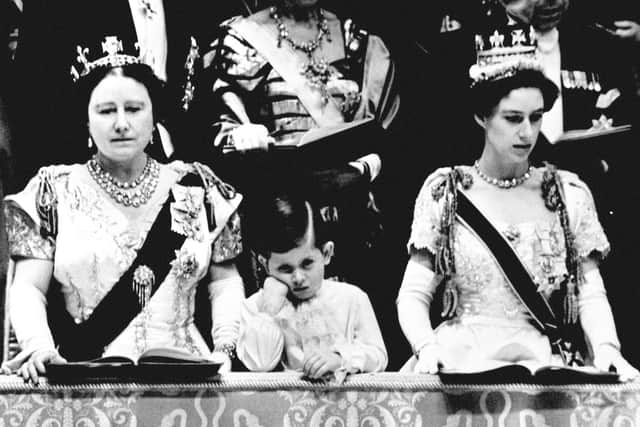
He created history when he became the first child to witness their mother’s coronation as sovereign.
Princess Anne, who was two years old, did not attend because she was considered too young.
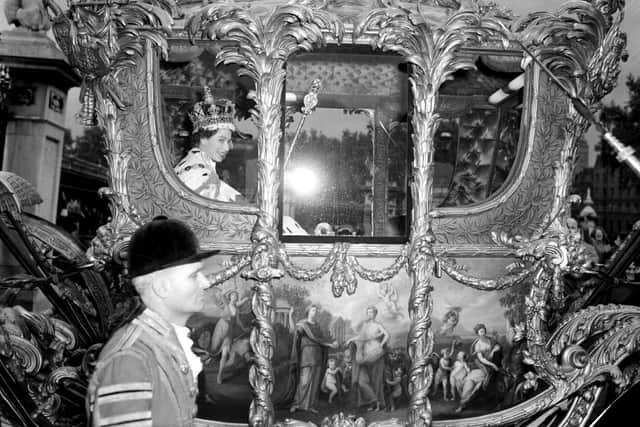
The longer seven-mile return procession was accompanied by 13,000 troops, 29 bands and 27 carriages and took two hours.
Each Commonwealth prime minister had his own carriage and, for the first time, there was a shortage of professional coachmen.
Millionaire businessmen and country squires offered to dress up as Buckingham Palace servants and drive the British and other prime ministers – an offer that could not be refused.

Constance Spry, who also helped with floral arrangements on the day, proposed a recipe of cold chicken in a curry cream sauce with a well-seasoned dressed salad of rice, green peas and mixed herbs – a recipe that won the approval of the Minister of Works.
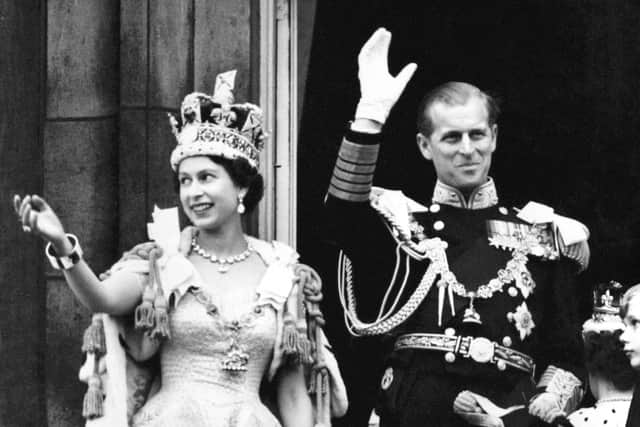
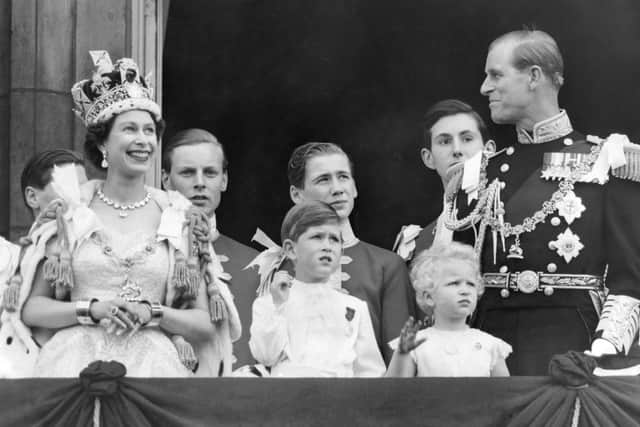
Back at Buckingham Palace, the Queen, wearing her crown, and Philip appeared on the balcony with the other members of the royal family.
Their children, Charles and Anne, were greeted with great excitement by the crowds.
In her broadcast address to the nation the same evening, the young Queen thanked the public for their support.
She added: “I have in sincerity pledged myself to your service, as so many of you are pledged to mine.
“Throughout all my life and with all my heart I shall strive to be worthy of your trust.”
The sixth and final appearance of the Queen and the duke on the balcony was at midnight.
They waved to a huge cheering crowd which was still wild with excitement.
Bowler hats were waved high on umbrellas, balloons were released and streamers festooned the Palace railings.
The night came to an end as hundreds of thousands on Victoria Embankment watched a spectacular coronation fireworks display.