
Hungary at polls in key election that could unseat Orban after 16 years
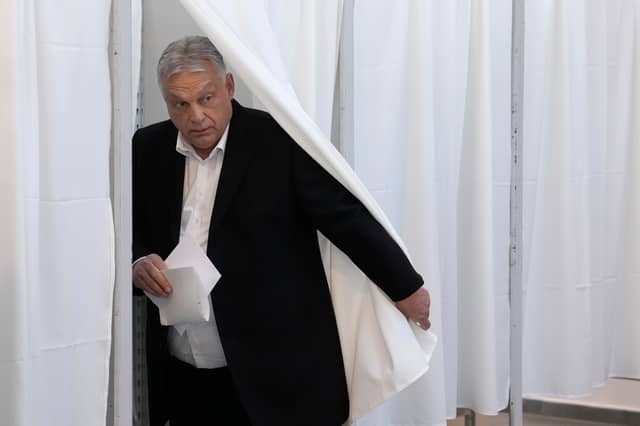

Hungarians are casting ballots in what is widely seen as Europe’s most consequential election this year, setting a record turnout in a vote that could unseat populist Prime Minister Viktor Orban, an ally of US President Donald Trump, after 16 years in power.
It is a key moment for Mr Orban, the European Union’s longest-serving leader and one of its biggest antagonists, who has travelled a long road from his early days as a liberal, anti-Soviet firebrand to the Russia-friendly nationalist admired today by the global far-right.
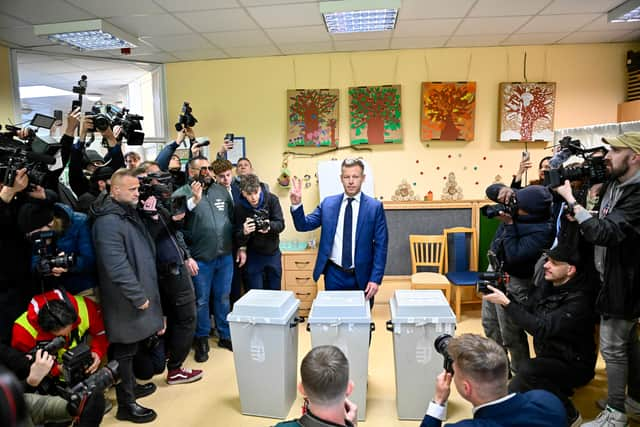
Mr Orban and his top challenger, Peter Magyar, arrived at separate polling stations in Budapest on Sunday at nearly the same time to cast their votes.
Speaking to reporters outside, Mr Orban, 62, said the campaign had been “a great national moment on our side” and thanked activists and supporters for their work.
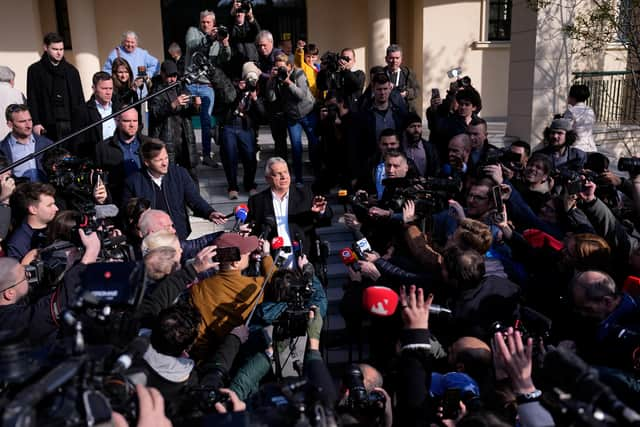
Turnout after the first 11 hours of voting was more than 74%, according to the national election office, a record number in any election in Hungary’s post-Communist history. With time still left before polls closed, 140,000 more voters had cast their ballot than during the entirety of 2022 elections.
After casting his vote, Mr Magyar told reporters the election is “a choice between East or West, propaganda or honest public discourse, corruption or clean public life”.
He added: “I urge all Hungarian citizens to exercise their right to vote.”
The election is being closely watched in countries around Europe and beyond, which is a testament to the outsize role Mr Orban occupies in far-right populist politics worldwide.
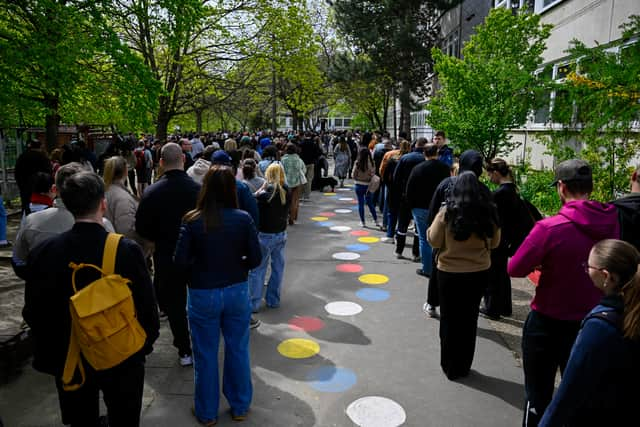
Casting her ballot in Budapest early on Sunday, retiree Eszter Szatmari, 62, said the election is “basically our last chance to see anything vaguely resembling… democracy in Hungary”.
She added: “We all have to make real effort to show to the world that we are not who people thought we were in the past five to 10 years.”
Marcell Mehringer, 21, said he was voting “primarily so that Hungary will finally be a so-called European country, and so that young people, and really everyone, will do their fundamental civic duty to unite this nation a bit and to break down these boundaries borne of hatred”.
Turnout after the first five hours of voting was 66%, according to the National Election Office. That is a record in Hungary’s post-communist history, with around 900,000 more voters having cast their ballot by 3pm than during the 2022 election.
He also has heavily strained Hungary’s relationship with the EU, seeming to revel in using his veto power to stymie the 27-member bloc’s important decisions. Most recently, he blocked a 90-billion euro EU loan to Ukraine, prompting his partners to accuse him of hijacking the critical aid.
Yet after winning four consecutive elections with a two-thirds majority for his party in Parliament, signs have emerged that Mr Orban’s absolute control over Hungary’s politics may be reaching its end.
Mr Magyar has rapidly risen to become Mr Orban’s most serious challenger. The 45-year-old leader of the centre-right Tisza party, which is leading in independent polls, campaigned on issues affecting ordinary voters, including the faltering public health care and transportation sectors and what he describes as rampant government corruption.
A former insider within Mr Orban’s Fidesz, Mr Magyar broke with the party in 2024 and quickly formed Tisza.
Since then, he has toured Hungary relentlessly, holding rallies in settlements big and small in a campaign blitz that recently had him visiting up to six towns daily.
Mr Magyar has said the election is a “referendum” on whether Hungary continues on its drift towards Russia under Mr Orban, or can retake its place among the democratic societies of Europe.