
‘I thought my family were making plans without me – it turned out I couldn’t remember and had early onset Alzheimer’s’


A dad of three who thought his family were making plans without him later found out he had just been forgetting their conversations as he was diagnosed with early onset Alzheimer’s aged just 55 – causing him to medically retire, lose touch with “32 years of friends” and contemplate suicide.
Gerry King, 60, a retired council worker who lives in Fife, Scotland, with his wife, Trisha, 50, a care worker, began getting warning signs for early onset Alzheimer’s in 2016 when he was asking his partner “the same questions maybe 30 or 40 times a day” and becoming “argumentative” as he thought his family were organising things without telling him.
The dad of three, to Cieran, 24, Daniel, 21, and Stephanie, 19, and grandfather of two, to Myles, three, Hudson, three months, was diagnosed with the condition at age 55 after numerous tests, causing “quite a dramatic effect” on himself and his whole family.
Gerry quickly became medically retired, causing his household income to drop by between 50% and 60%, and he “lost 32 years’ worth of friends and work colleagues” as none of them visited him – which he thinks is because of the “stigma surrounding dementia”.
He contemplated suicide as he “lost the reasons to get up in the mornings”, however, he has since set up a local support group and a charity called Stand, which he said has had an “amazing” effect on him and given him a new “sense of purpose”.
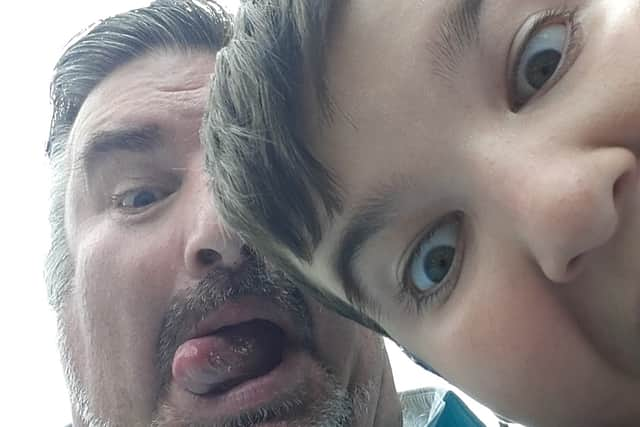
Gerry prefers not to think about his future, but is “very grateful” for his family’s continued support and the network he has built through his charity.
He told PA Real Life: “The diagnosis had quite a dramatic effect on not just myself, but the whole family really – I was only 55 and working full time, the wife was working full time, kids at school.
“Within a few months, I was medically retired, which cut down our income by between 50% and 60% straight away.
“I lost 32 years’ worth of friends and work colleagues – none of them came to visit me, which I think is down to the stigma surrounding dementia because people are afraid of the unknown.
“I lost my self-confidence – I lost the reasons to get up in the mornings – I contemplated suicide and I didn’t want to be a burden on Trisha and my kids.”

He said: “My wife and her dad noticed changes in my personality – I used to be quite a laid-back person, but my wife said I was becoming argumentative, and it wasn’t like me at all.
“I was having problems with my short-term memory – I kept thinking my family were arranging get-togethers without me, but we had discussed it, I just couldn’t remember.
“I’d ask my wife the same questions maybe 30 or 40 times a day.”
After around a month of experiencing these symptoms, Gerry visited his GP.
The doctor thought Gerry may be stressed or depressed, as he was in a demanding role in the architectural department of the council at the time.

Gerry was then referred to a psychiatrist and three months later completed another, more complex memory test and “failed quite drastically”.
He was then put under the care of a neurologist, a psychologist and a specialist nurse, and after numerous scans was diagnosed with early-onset Alzheimer’s 18 months later at age 55.
“Every day is different – I find tasks around the house hard,” Gerry said.
“I’ve always hoovered and tidied around, but I find that too difficult – I’ll do things like start to do the dishwasher, then I get distracted.
“I find that my ability to just walk around is getting a bit more restricted – I trip over quite a lot.”

“Eventually, one Friday afternoon, Trisha and I lined up about 14 couples where one of them has early onset dementia, and within half an hour, it was like we’d known each other for all of our lives – there were tears and laughter,” he said.
“Now, we have a charity to help empower people with dementia and to encourage them to live their best lives – it’s been amazing for me, and really given me a sense of purpose.”
Gerry also wants to help minimise the stigma around Alzheimer’s, he explained: “A lot of people associate Alzheimer’s with people who are at the end stage, and there’s not always a lot of awareness about the beginning and the middle.
“So we’ve done things like make an album of songs written by people with the condition, about our dreams, thoughts and memories.”

“A lot of people with dementia find bold patterns on carpets and walls have a detrimental effect – or if a carpet is black, it feels like the floor is full of holes,” he explained.
“We encourage businesses to use plainer colours and do things like have menus with black writing on a yellow background, as that’s what we find easiest to read.

He is also part of the Scottish Government’s lived experience team to help inform policy on the condition.
“We want people to have a buddy to visit people with early onset Alzheimer’s and get to know them, and almost turn into their carer as they get further down the line, so it’s not as daunting and they can build a better relationship with their support network,” Gerry said.
On how he feels about the future, knowing his memory is going to deteriorate, Gerry said: “I try not to think about it, to be honest – but I know I have my loved ones around me for all the help I need so I am very grateful.”
For support on issues of suicide, visit Samaritans.org, and for more information about Alzheimer’s, go to Alzheimers.org.uk.
Gerry has shared his story to accompany the findings of a new study, commissioned by KYN and led by Innovations in Dementia, into how people talk about those living with dementia and the impact of language surrounding the condition.