
Iran could face further sanctions if Strait of Hormuz remains closed – Cooper


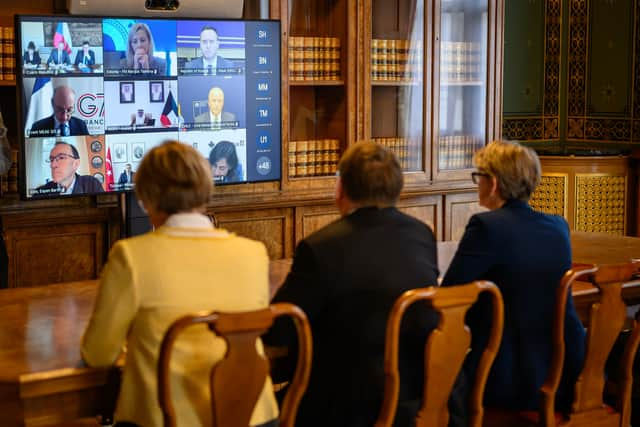
Iran could face further sanctions if the Strait of Hormuz remains closed, the Foreign Secretary has signalled after holding talks with more than 40 nations from across the world.
Yvette Cooper said collective action to increase pressure on Tehran was being discussed as she accused the country of trying to “hold the global economy hostage” with its stranglehold on the key shipping lane.
Iran has throttled the channel in retaliation for the month-long US-Israeli campaign against it, causing global oil prices to soar.
In the face of US President Donald Trump’s repeated criticism of allies over their refusal to take part in his offensive against Tehran, Ms Cooper said that “our job is to take decisions in the UK national interest”.
“Iran’s closure of the Strait of Hormuz is a direct threat to global prosperity,” she said in a statement following the virtual meeting on Thursday.
“Iran is trying to hold the global economy hostage in the Strait of Hormuz.
“They must not prevail. To that effect, partners today called for the immediate and unconditional reopening of the Strait and respect for the fundamental principles of freedom of navigation and the law of the sea.”
Talks focused on the prospect of increasing diplomatic pressure, including through the UN, to push Iran to allow unimpeded transit and to “comprehensively reject” tolls being imposed on vessels seeking to pass through, she said.
Countries also discussed exploring “co-ordinated economic and political measures, such as sanctions, to bear down on Iran if the Strait remains closed,” according to the statement.
Britain is seeking to lead the diplomatic initiative, including countries such as France, Germany and some Gulf nations, after Mr Trump signalled it was up to others to unblock the waterway not relied upon by the US.
She said co-ordinated action was needed as Iran’s “reckless strikes” on international shipping and efforts to “hijack the global economy” were hitting nations “from across the globe who played no part in this conflict”.
“That’s affecting petrol prices and mortgage rates here in the UK, but also jet fuel across the world, fertiliser to Africa, and also gas to Asia.
Ms Cooper evaded a question on whether Washington was still an ally, saying: “We want to see the conflict resolved, concluded, as rapidly as possible, because, frankly, that’s what’s best for the cost of living here in the UK.”
She continued: “And look, our job is to take decisions in the UK national interest. That’s what this Government will do, not based on any other country’s priority or anything in terms of the US or other countries, but actually what’s in the UK’s national interest.”
She said the response to Iranian attacks on the maritime pinch point would include working with the International Maritime Organisation, responsible for regulating international shipping safety.
Another meeting next Tuesday of military planners will consider how to “keep shipping safe for the long-term”, Ms Cooper said, including looking at issues such as clearing mines that have possibly been laid by Tehran to sink ships in the sea passage.
It will be convened by Britain’s Permanent Joint Headquarters, based in Northwood, north-west London, but some international leaders are expected to join virtually.
Mr Trump, in an address to the US people on Wednesday, said countries that rely on the strait should “build up some delayed courage” and “just grab it”, and suggested that after the Iran conflict was over, the critical waterway would “just open up naturally”.
But Prime Minister Sir Keir Starmer has said that unblocking the lane will “not be easy”.
French President Emmanuel Macron went further on Thursday, telling journalists that it was “unrealistic” to reopen the Strait of Hormuz by force and arguing that efforts would need to include “consultation” with Iran.
Former national security adviser Lord Ricketts echoed his remarks, saying in a post on X: “This is the reality. No-one is going to put warships escorting a slow moving convoy through the Strait in the face of Iranian opposition.
“Ergo it has to be on the basis of negotiation, as I have been saying from the outset.”