
Israeli army says Rafah air strike probe finds fire caused by secondary blast
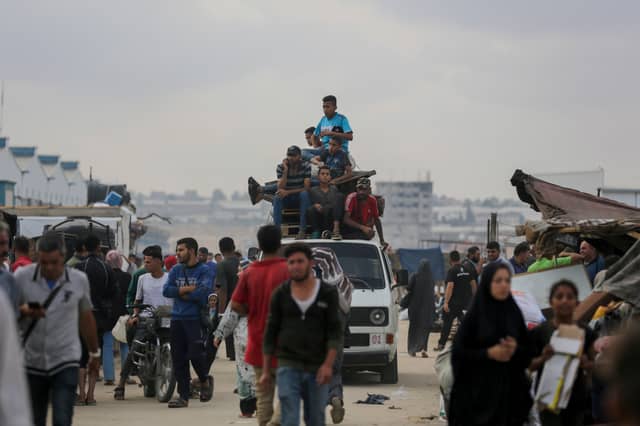

The Israeli military has said an initial investigation into a strike that sparked a deadly weekend fire in a tent camp in the southern Gaza city of Rafah found the blaze was caused by a secondary explosion.
A military official said the military fired two 17-kilogram munitions that targeted two senior Hamas militants.
The official said the munitions would have been too small to ignite a fire on their own and the military is looking into the possibility that weapons were stored in the area.

The strike caused widespread outrage, including from some of Israel’s closest allies. Prime Minister Benjamin Netanyahu said it was the result of a “tragic mishap”.
New Israeli strikes on Rafah on Tuesday killed at least 16 Palestinians, first responders said, as residents reported an escalation of fighting in the city once seen as the territory’s last refuge.
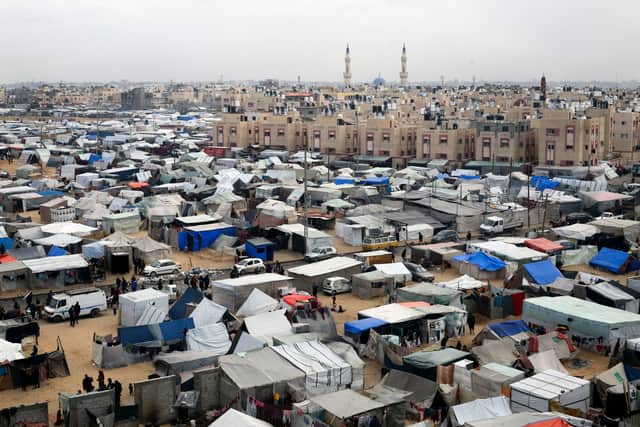
An Israeli incursion launched in early May has caused nearly one million to flee from Rafah, most of whom had already been displaced in the war between Israel and Hamas. They now seek refuge in squalid tent camps and other war-ravaged areas.
The US and other close allies of Israel have warned against a full-fledged offensive in the city, with the Biden administration saying that would cross a red line and refusing to provide offensive arms for such an undertaking.
On Friday, the International Court of Justice called on Israel to halt its Rafah offensive, an order it has no power to enforce.

The latest strikes occurred in the same area where Israel targeted what it said was a Hamas compound on Sunday night. The new strikes killed a total of 16 people in the Tel al-Sultan neighbourhood in north-west Rafah, according to the Palestinian Civil Defence and the Palestinian Red Crescent.
Israel says it is carrying out limited operations in eastern Rafah along the Gaza-Egypt border. But residents reported heavy bombardment overnight in western parts of Rafah as well.
“It was a night of horror,” said Abdel-Rahman Abu Ismail, a Palestinian from Gaza City who has been sheltering in Tel al-Sultan since December. He said he heard “constant sounds” of explosions overnight and into Tuesday, with fighter jets and drones flying over the area.
He said it reminded him of the Israeli invasion of his neighbourhood of Shijaiyah in Gaza City, where Israel launched a heavy bombing campaign before sending in ground forces in late 2023.
“We saw this before,” he said.
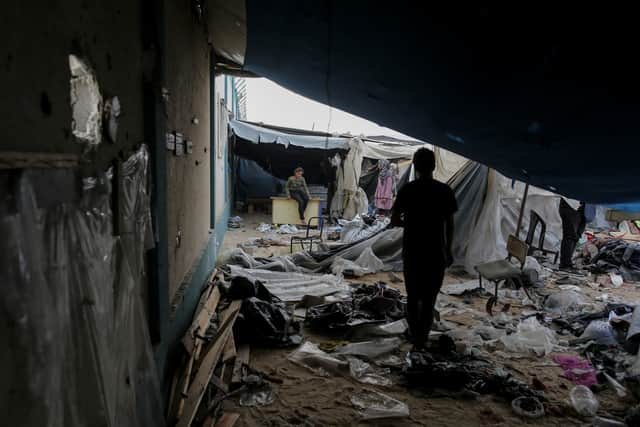
Gaza’s Health Ministry said two medical facilities in Tel al-Sultan are out of service because of intense bombing nearby.
Medical Aid for Palestinians, a charity operating throughout the territory, said the Tel al-Sultan medical centre and the Indonesian Field Hospital were under lockdown, with medics, patients and displaced people trapped inside.
Most of Gaza’s hospitals are no longer functioning. The Kuwait Hospital in Rafah shut down on Monday after a strike near its entrance killed two health workers.
A spokesperson for the World Health Organisation said the casualties from Sunday’s strike and fire “absolutely overwhelmed” field hospitals in the area, which were already running short on supplies to treat severe burns.
“That requires intensive care, that requires electricity, that requires high-level medical services,” Dr Margaret Harris told reporters in Geneva. “Increasingly, we are struggling to even have the high-level skilled doctors and nurses because they’ve been displaced.”
Israel responded to the attack with a massive air, land and sea offensive that has killed at least 36,096 Palestinians, according to Gaza’s Health Ministry, which does not distinguish between fighters and civilians in its count.
Around 80% of Gaza’s population of 2.3 million has been displaced and United Nations officials say parts of the territory are experiencing famine.
The fighting in Rafah has made it nearly impossible for humanitarian groups to import and distribute aid to southern Gaza.
The Israeli military says it has allowed hundreds of trucks to enter through the nearby Kerem Shalom crossing since the start of its operation, but aid groups say it is extremely difficult to access that aid on the Gaza side because of the fighting.
The UN says it has only been able to collect aid from around 170 trucks over the past three weeks via Kerem Shalom. Smaller amounts of aid are entering through two crossings in the north and by sea through a US-built floating pier, but it is nowhere near the 600 trucks a day that aid groups say are needed.