
Kate Forbes: Continued public sector staff growth is ‘not sustainable’
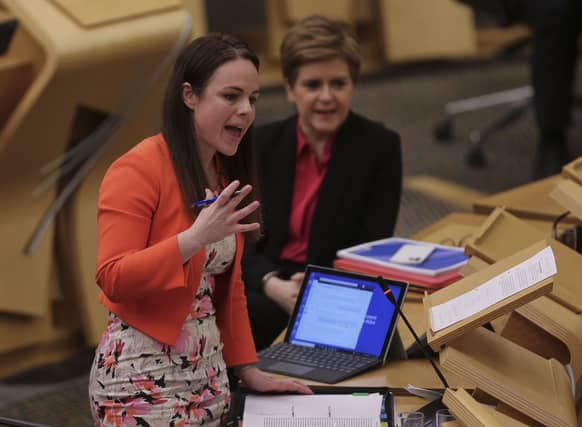

Continued growth to staffing levels in Scotland’s public sector is “not sustainable”, according to a key Government spending plan.
The resource spending review lays out indicative plans for the remainder of this parliamentary term.
The 79-page document was unveiled by Finance Secretary Kate Forbes on Tuesday, as she stressed the public sector would need to “re-shape and re-focus” in the coming years.
Due to the pandemic, public sector staffing has grown to about 440,000 in the past two years rising from about 410,000 in 2016-17.
But growth on the same scale cannot be allowed to continue, the review said.
However, the Scottish Government proposes to cut the workforce using “effective vacancy and recruitment management”.
This will allow for an increase in pay, year-on-year, for remaining public sector staff and a renewed focus on wellbeing, with bodies being invited to take part in the four-day working week pilot, as well as continuing to innovate technologically to allow for hybrid or home working.
“While some of this growth relates to the devolution of new functions to Scotland, such as elements of tax and social security, continued growth of the public sector away from frontline services is not sustainable,” the review said.
“This is especially the case if UK Government spending levels – and the related block grant settlements for the devolved administrations – continue to track below inflation.
“If the total size of the workforce continues to grow, this will increasingly squeeze our capacity to maintain services and increase rates of pay in the public sector, at a time of cost-of-living pressures and evidence of growth in private sector pay in some sectors.
“As part of meeting current and future challenges, we need to take an approach that balances investment in systems and processes, with targeted workforce growth in priority areas, investment in our people, and the reform and redesign of services, so that they deliver efficiently and effectively.”
“Seeking to work collectively, with common purpose, breaking down delivery silos and efficiently using the totality of available resources within the constraints we face.”
The Scottish Government will now consult with the sector, trade unions and workers to “navigate the challenge of a post-Covid-19 pandemic reset”.
The review outlines increases in spending on health, including the creation of the new national care service and social security, which will continue to be devolved to the Scottish Parliament throughout this parliamentary term.
Health spending is due to rise from £17.1 billion to £19 billion, while funding for benefits will increase from £3.9 billion to £6.3 billion in cash terms.
In other portfolios, spending looks to stagnate – the equivalent of a cut given rising inflation – although the Finance Secretary stressed final funding arrangements would be confirmed in the annual budgeting process.
Local government funding will remain at £10.6 billion for each year of this parliamentary term before rising by £100 million in 2025-26.
The Justice and Veterans portfolio is due an increase from £2.84 billion to £2.97 billion.
The overall budget for the Scottish Government is due to increase from £41.8 billion to £47.5 billion.
A spokesman for the UK Government said: “All of Scotland is benefitting from unprecedented UK Government support.
“We are providing the Scottish Government with a record £41 billion per year for the next three years – the highest settlement since devolution, funding our NHS, our schools and other vital services.
“And after supporting one in three jobs in Scotland during the pandemic, we are providing people with a £37 billion UK-wide package to help with fuel bills and support the most vulnerable including pensioners and disabled people.
“We are growing the economy across Scotland through our £2 billion in regional growth deals and levelling up initiatives to create a high-skilled, high-wage economy.”
Scottish Tory finance spokeswoman Liz Smith said hard-pressed families will receive “no comfort” from the spending review.
“The financial shortfall set out in today’s forecast is stark, most especially, the gaping hole between projected public spending and tax revenues in the next few years.
“It’s plain for all to see and is the product of incompetence from an SNP Government that has no idea how to manage public finances – the ferries fiasco being the worst example of that.”
Labour finance spokesman Daniel Johnson criticised the lack of detail contained within the spending review.
He said: “We’ve waited 11 years and yet there is no detail. 11 years ago, the spending review went down to levels three and four giving us insight into what health boards would have to spend.”
And he said the Government was able to find £20 million for a second independence referendum despite freezing spending in other areas.
STUC general secretary Roz Foyer said the review will “ring alarm bells for many public sector workers”.
A Scottish Courts and Tribunals Service (SCTS) spokesman said: “In addition to outlining Scottish Government’s spending plans for SCTS, they have also committed over £50 million in annual funding for both recovery and reform, to support justice partners to address the unavoidable backlog of cases built up during the pandemic, and to deliver system-wide transformations.
“This will form a key part of assessing our annual funding requirements with Scottish Government.”