
King given first notes featuring his face by Bank of England chief


The King has been presented with the first banknotes bearing his portrait by the Governor of the Bank of England.
He praised the notes as “very well designed” and expressed his surprise at being only the second monarch to feature.

It was a milestone moment for the monarch, who is undergoing treatment for an undisclosed cancer, to see his image on the new polymer notes, just over a year and a half since the start of his reign.
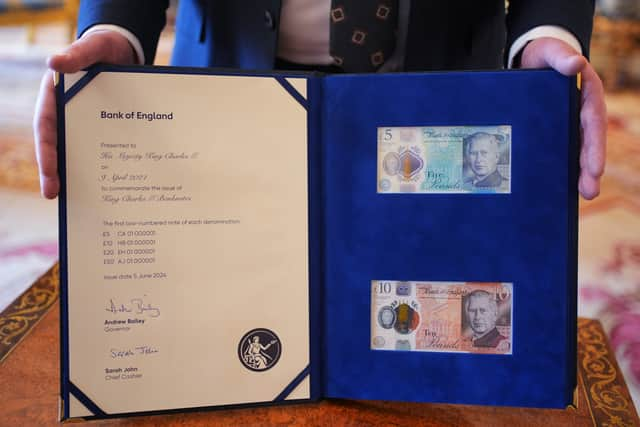
Charles inspected the four £5, £10, £20 and £50 notes – the first low-numbered note of each denomination with 01 000001 serial numbers – and pointed and smiled at the details as Mr Bailey turned the pages, showing the front and back.
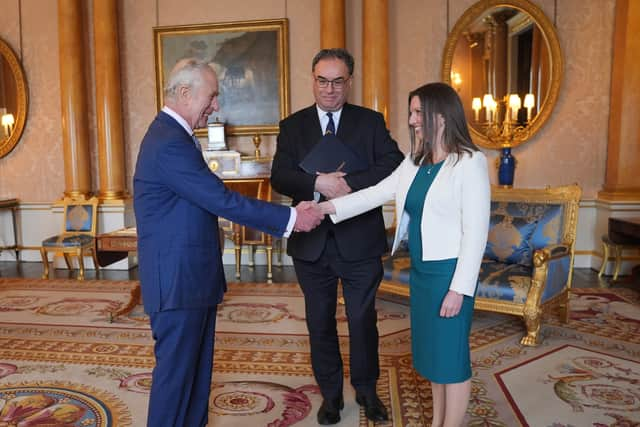
They were joined by Sarah John, the Bank of England’s Chief Cashier, whose signature appears on the currency, and the King gave a broad grin as he greeted his guests in the 1844 Room.
Although notes began to be issued from the late 17th century, Charles’s mother, Queen Elizabeth II, was the first British sovereign to be given the honour in 1960 on a £1 paper note.
Before this, Britannia was the only character to have appeared.
Mr Bailey said as he prepared to hand over the book: “We have come to present you with your bank notes.”
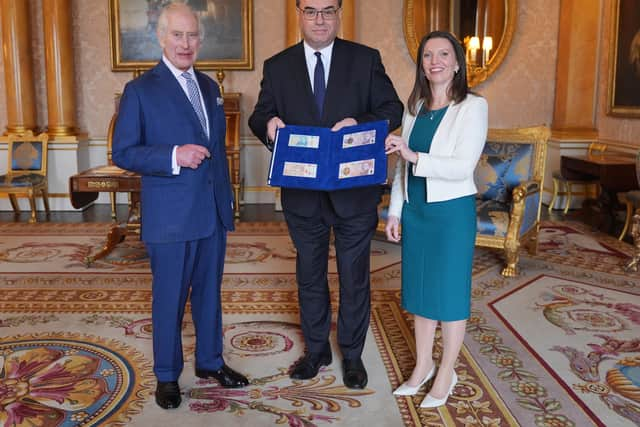
Mr Bailey told him: “This is quite a big moment because we’ve never changed the sovereign on the bank notes because the Queen was the first sovereign to be on the bank notes.”
Charles replied: “This is what is so surprising. You would think that it goes back.”
The King inspected the notes and praised the intricate features incorporated to prevent counterfeits, saying: “A lot trouble taken in on the security side.”
The money will be issued gradually into circulation from June 5 – with Charles’s portrait featuring on the front of the banknotes, as well as in cameo in the see-through security window, visible on the front and back.
The reverse side characters remain unchanged from previous editions – with Sir Winston Churchill on the £5, Jane Austen on the £10, JMW Turner on the £20 and Alan Turing on the £50.
Charles expressed his admiration of the artistry, saying of the £5: “It’s a very good photograph of Sir Winston.”
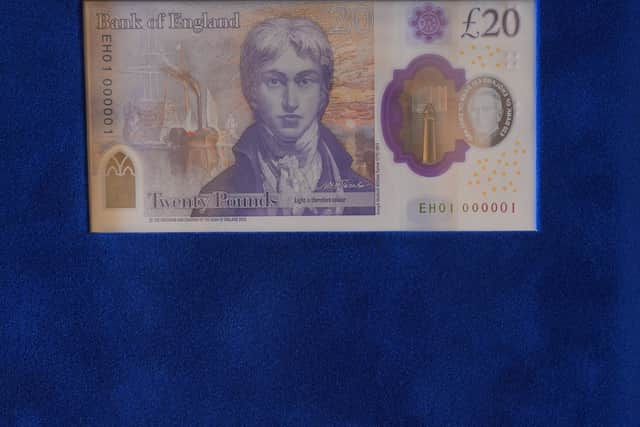
“They’re very elegant these ones, I must say,” he said.
Existing notes featuring the portrait of the late Queen will continue to be legal tender, so the Elizabeth II and King Charles III notes will co-circulate.
New notes will only be printed to replace worn-out ones and to meet any overall increase in demand in order to minimise the environmental and financial impact of the change – in keeping with the Royal Household’s request.

“Good morning Governor. I’m sorry it’s a bit delayed this. I hope it isn’t too delayed,” Charles said.
But Mr Bailey replied: “Not at all. We’re still in advance of launching them.”
Charles remarked: “Oh you are? Great.”

The King replied: “I wondered how it would come out.”
Tuesday marked both happy and sad anniversaries for the King, falling on his and the Queen’s 19th wedding anniversary, and the third anniversary of the death of his father, Prince Philip, the late Duke of Edinburgh.
It was also the 22nd anniversary of the funeral of Charles’s grandmother, the Queen Mother.
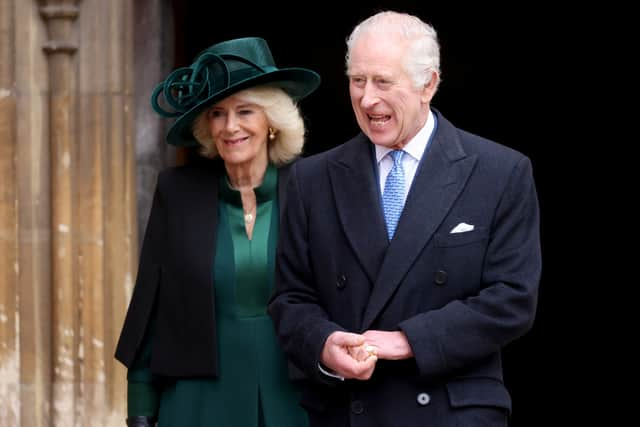
Charles and Camilla married on April 9 2005 in a private civil ceremony at Windsor’s Guildhall, followed by a televised blessing in St George’s Chapel.
Their nuptials were postponed by a day just four days beforehand when their ceremony clashed with Pope John Paul II’s funeral in Vatican City, which Charles had to attend to represent his mother.

Camilla was blamed for the breakdown of his marriage to Diana, Princess of Wales, and, when news of their affair first came to light, she faced vitriolic criticism.
She gradually took on a more prominent position within the royal family over the years, including riding next to Elizabeth II in her Diamond Jubilee carriage procession.
Charles, 75, made a rare outdoor appearance on Easter Sunday, attending church with the Queen and greeting crowds of well-wishers.