
Ministers face court challenge over decision to take legal action against PSNI


Two Stormont ministers will face a court challenge this week over the lawfulness of a failed legal action against the police.
Last summer, Infrastructure Minister Nichola Mallon and Communities Minister Deirdre Hargey launched proceedings against the Police Service of Northern Ireland (PSNI) over its decision not to take action against a contentious “Eleventh Night” bonfire in a loyalist area of north Belfast.

The ministers’ bid to compel the police to act was thrown out by a High Court judge at an emergency late-night hearing in July.
Contractors were unable to remove the bonfire without PSNI protection and the pyre was lit as planned days later.
Lawyers for the ministers are now set for a return to court on Wednesday to defend a legal challenge against their decision to take legal action against the PSNI.
Loyalist activist Jamie Bryson represented the Tiger’s Bay Bonfire Group during last summer’s dispute.
He is pursuing judicial review proceedings against the two ministers, contending that they should have secured the approval of the wider Stormont Executive before taking legal action against the PSNI.

Issues that cut across the responsibilities of multiple departments should also be brought to the Executive under the terms of the ministerial code.
Mr Bryson argues that taking the PSNI to court over the bonfire was significant, controversial and cross-cutting and that the ministers were therefore acting unlawfully by proceeding without first securing the approval of other ministerial colleagues.
Before July’s High Court hearing, DUP Agriculture Minister Edwin Poots wrote to Ms Hargey and Ms Mallon warning that they would be in breach of the ministerial code if they did not secure Executive approval.
Mr Bryson’s case will be presented at Wednesday’s leave hearing by former attorney general for Northern Ireland John Larkin QC.
Ms Mallon and Ms Hargey took the emergency legal action in July after citing concerns raised by nationalist residents that they were living in fear and had been attacked by missiles thrown by loyalist bonfire builders.

While focused on separate matters, the case touches on the same issues involved in Mr Bryson’s successful recent challenge against Mr Poots over Brexit checks being carried out at Northern Ireland ports.
Mr Bryson argued that Mr Poots had not secured the approval of the wider Executive to carry out the Northern Ireland Protocol checks, which he argued were both significant and controversial.
Conceding the legal challenge before it materialised into a judicial review, Mr Poots said he would bring a paper to the Executive asking for approval to continue the checks.
Such a move would raise the potential for the DUP to wield a veto to deny authority for the checks.
However, the matter is unlikely to ever reach the Executive for debate, as Sinn Fein is set to use its veto to block it from getting on the agenda.
If Sinn Fein does prevent the issue reaching the Executive, Mr Poots has signalled an intent to order a halt to the checks, contending that he would not have the legal authority to continue them.
Sinn Fein and the Alliance Party are among those challenging Mr Poots’s stance, insisting the Executive decided some time ago that the responsibility for implementing the checks lay with the Agriculture Minister.
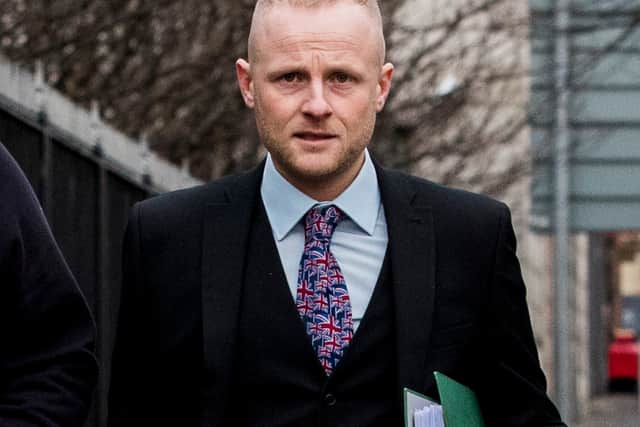
Commenting on the latest challenge, Mr Bryson said he wrote to Ms Mallon before last year’s legal bid, arguing that she did not have the power to act.
“This is an important case as it goes to the heart of the proper exercise of ministerial powers,” he said.
Mr Bryson claimed the two ministers’ course of action was “clearly unlawful”.
“However, as neither minister has accepted what in my view is patently obvious illegality, it is necessary for the court to determine the constitutional limits on their powers,” he said.
Mr Bryson added: “As Minister Poots and other DUP ministers supported my interpretation in July, and Sinn Fein and the SDLP took a different approach, there is a fundamental disagreement between Executive ministers as to the operation of this key provision.
“Accordingly, this case is of immense constitutional significance.”
The ministerial involvement in the bonfire case was linked to properties owned by their departments.
The road on Adam Street where the Tiger’s Bay bonfire was built is owned by the Department of Infrastructure, while an adjacent piece of land where building materials were collected is owned by the Department for Communities.
The ministers’ departments both said it would “not be appropriate” to comment on the legal case at this time.