
MPs told of sick teacher forced to use food banks in ‘cost-of-living emergency’
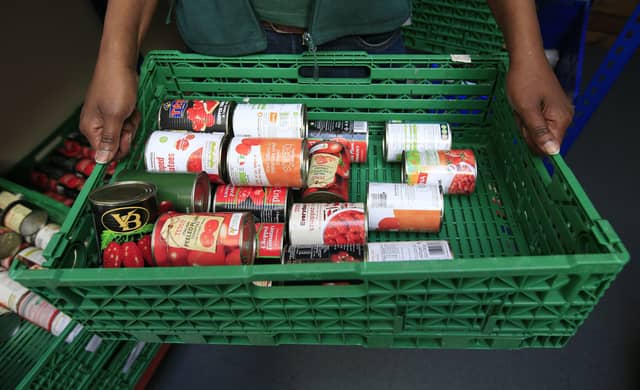

A teacher who is off work sick after recovering from breast cancer surgery was forced to use a food bank, MPs were told.
Cara Hilton, senior policy and public affairs manager with the Trussell Trust, gave the case as just one example of the growing number of people who are having to rely on help from charities to put food on the table.
Aother expert told MPs on the Scottish Affairs Committee that issues such as austerity, the Covid-19 pandemic and high levels of food inflation had created a “perfect storm”.
Professor Mary Brennan of Edinburgh University, who is also chair of the Scottish Food Coalition, told the committee: “The cost-of-living crisis has come in off the back of other issues that have resulted in budgets being constrained at local authorities, austerity measures, individual households having less financial buffers and backing.”
She added: “It, of course, has also come off the back of the incredible difficulties some households suffered during Covid-19.
“I think it’s a perfect storm when you then take into consideration the level of food inflation that is being experienced.”
Ms Hilton, meanwhile, told how 62,000 people in Scotland needed the help of the Trussell Trust for the first time last year – more than enough to fill Hampden Stadium in Glasgow.
Between April 1 2022 and March 31 2023 the charity gave out a record 259,744 emergency food parcels to people in Scotland – up by 30% from the previous year.
This included 87,968 parcels for children.

She told the MPs: “We’re seeing more people who are having to use food banks for the first time – 62,000 Scots had to use one of our food banks for the first time last year, that is more than you could fit into Hampden Stadium.”
With the committee looking at food poverty in rural Scotland, she spoke out about some of the reasons why people in Aberdeenshire were turning to food banks.
Ms Hilton said: “We had a teacher who was off on long-term sick following breast cancer, unable to work due to complications from surgery, and forced to use a food bank.
“We’re speaking to more and more workers who are having to use food banks because if they didn’t use food banks they wouldn’t be able to put petrol in their car to get work, and we know that a car is an absolute essential in rural Scotland.”
Ms Hilton went on to tell the MPs that low-income Scots were now facing a “cost-of-living emergency”.
She said: “We’re seeing rising levels of need in every community in every part of Scotland, both rural and urban.
“But, fundamentally, that is because people’s incomes just aren’t enough to cover the cost of essentials, and as a result more and more people are being forced into impossible decisions, whether that is skipping meals so they can feed their children, whether it is missing important medical appointments.
“People are just at absolute breaking point. Unable not just to afford food, but unable to use their cooker, to clothe their children, to pay their bus fare to get to work. People are taking cold showers, turning off their fridges.
“Really it is a cost-of-living emergency for people on low incomes.”
The current high levels of inflation are a “big factor” in this, Ms Hilton said, but she claimed the “key and fundamental factor” was linked to levels of Universal Credit.
“The basic rate of Universal Credit, which so many low-income households depend on, is at its lowest level in real terms for nearly 40 years,” Ms Hilton said.
“So, with inflation at a 40-year high, people have been left with no option but to turn to charity for support.”
She said the trend for rising numbers of people to need food handouts started before the current cost-of-living crisis, and “ultimately reflects the fact we have a social security system that just isn’t providing people with sufficient income to be able to afford life’s essentials”.
Ms Hilton also said: “We have too many people who are working but can’t get enough hours, can’t get enough pay to be able to cover the essential costs. People just don’t have enough money to make ends meet.”
She added that while the cost-of-living crisis was “having a devastating impact on households on the lowest income in Scotland in the last 18 months”, she said problems had been “magnified in rural areas, where the cost of living is already significantly higher”.
A UK Government spokesperson said: “Our welfare system provides a strong financial safety net for millions of people every year and we have increased benefits including universal credit by 10.1%. This is on top of a £94 billion cost-of-living support package worth around £3,300 per household.
“We have given an extra £82 million to help people in Scotland with essential costs and we are committed to halving inflation which will ease pressures and help everyone’s incomes go further.”