
New Pompeii finds highlight middle-class life in doomed city

Discoveries by archaeologists in Pompeii have enriched knowledge about middle-class households in the ancient Roman city that was destroyed in a volcanic eruption.
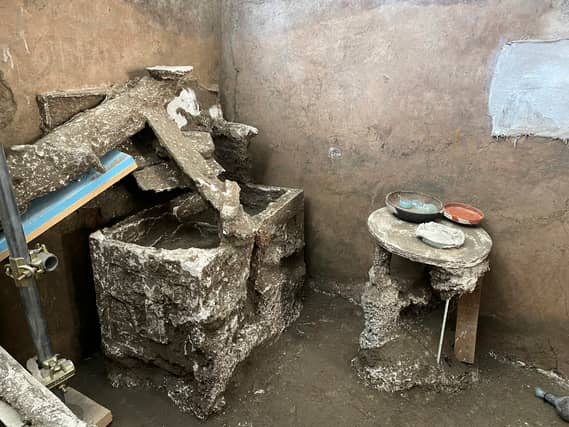
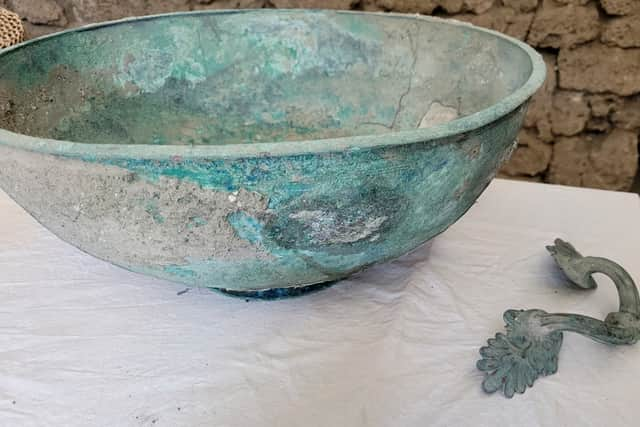
A trunk with its lid left open, a wooden dishware closet, its shelves caved in, and three-legged tables topped by decorative bowls are among the latest finds.
Pompeii’s archaeological park, one of Italy’s top tourist attractions, announced the recent finds.
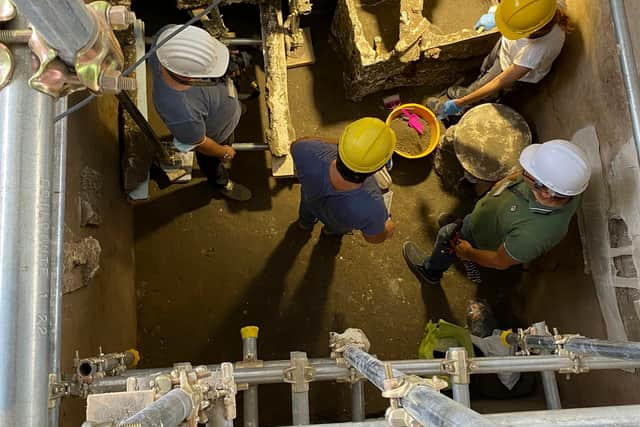
In past decades, excavations largely concentrated on sumptuous, elaborately frescoed villas of Pompeii’s upper-class residents.
But archaeology activity in the sprawling site, near modern-day Naples, has increasingly focused on the lives of the middle class as well as of servants and other enslaved people.
“In the Roman Empire, there was an ample chunk of the population that struggled with their social status and for whom ‘daily bread’ was anything but a given,” Mr Zuchtriegel said. ”A vulnerable class during political crises and food shortages, but also ambitious about climbing the social ladder.”
The finds unveiled on Saturday include furnishings and household objects in the domus, which was dubbed the House of the Larario for an area of a home devoted to domestic spirits known as lares. The home unearthed in 2018 has one in the courtyard.
One room had unpainted walls and an earthen floor apparently used for storage.
In a bedroom, archaeologists found the remains of a bed frame with a trace of fabric from the pillow.
The kind of bed is identical to three, cot-like beds unearthed last year in a tiny room in another residence that archaeologists believe doubled as a storeroom and sleeping quarters for a family of enslaved inhabitants of Pompeii.
Although the weight of beams and ceiling panels that crashed down in the wake of the volcanic explosion heavily damaged the trunk that was found, among the objects inside was an oil lamp depicting the ancient Greek deity Zeus being transformed into an eagle.
Archaeologists believe the closet they found had at least four panel doors and held cookware and dishes for the nearby kitchen. They found a hinge from the enclosure.
Other objects found in the house include a large fragment of what had been a translucent, rimmed plate in brilliant hues of cobalt blue and emerald, and a well-preserved incense burner, shaped like a cradle.