
‘Roman numerals’ found on Stone of Destiny ahead of King’s coronation
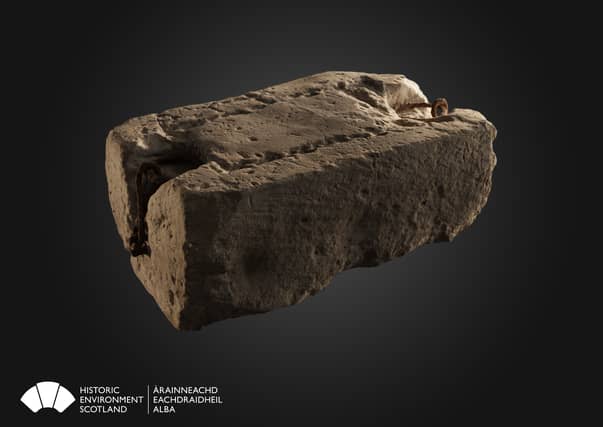

New research has revealed the Stone of Destiny, used for centuries in the coronation of monarchs, has previously unrecorded markings that appear to be Roman numerals.
The details were discovered when a 3D-printed replica of the stone, created as part of preparations for the King’s enthronement next month, was examined by experts.
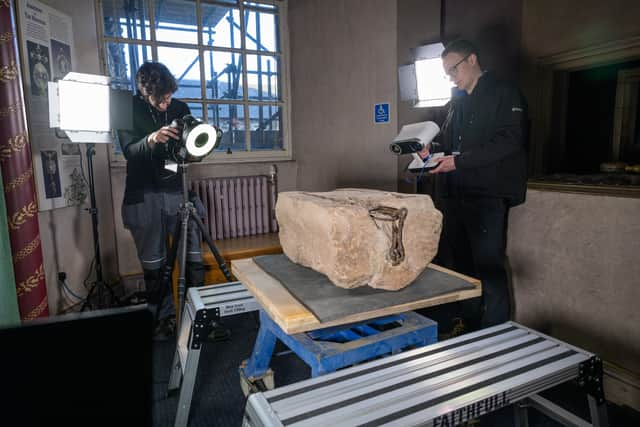
Ewan Hyslop, head of research and climate change at HES, said: “The high level of detail we’ve been able to capture through the digital imaging has enabled us to re-examine the tooling marks on the surface of the Stone, which has helped confirm that the Stone has been roughly worked by more than one stonemason with a number of different tools, as was previously thought.
“The discovery of previously unrecorded markings is also significant, and while at this point we’re unable to say for certain what their purpose or meaning might be, they offer the exciting opportunity for further areas of study.”
The Stone of Destiny, also known as the Stone of Scone, is normally displayed at Edinburgh Castle and plays an important role in Scotland’s history.

The stone is believed to have been used in ceremonies to crown Scottish monarchs from that date until it was seized in 1296 by King Edward I and taken to England.
It was placed in a specially constructed coronation chair which has since remained at Westminster Abbey and will be used for Charles’s enthronement.
The stone made headlines on Christmas Day 1950 when four Scottish students removed it from the abbey, and it was found three months later at the high altar of Arbroath Abbey. It was officially returned to Scotland in 1996.
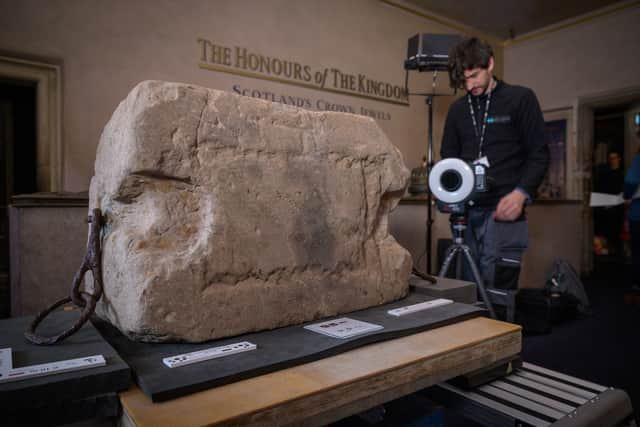
Microscopic traces of gypsum plaster were also found, possibly traces of a cast.
A study in 1998 by the British Geological Survey concluded the artefact was indistinguishable from sandstones of “Scone Sandstone Formation” from the area around Scone Palace near Perth.
The coronation chair has been undergoing restoration work before the crowning of Charles and conservators have found previously unrecorded decorations on the object.
It was made around 1300 for Edward I to house the stone and was constructed from oak, decorated with coloured glass, gilded with gold leaf and painted by Master Walter, the King’s Master Painter.
Monarchs may have sat on the stone itself, with a cushion for comfort, but at some point a seat was constructed within the chair and the 3D model of the stone is being used to help the fitting of the original.