
Scottish Government has powers to act on child poverty, minister told
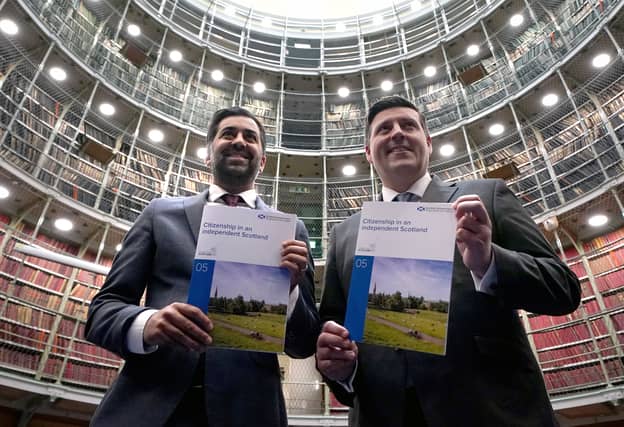

The Scottish Government has been told it already has the powers to further reduce child poverty in Scotland after a minister made the case for independence.
Independence minister Jamie Hepburn was speaking at an SNP fringe event in Aberdeen on how to meet the country’s child poverty targets.
The Scottish Government aims to have fewer than 18% of children living in relative poverty by 2024, down from 24% between 2019 and 2022. It wants to reduce the target to 10% by 2030.
Mr Hepburn told the audience that Government schemes such as the Scottish Child Payment had pushed around 90,000 out of poverty.
But he also said the Scottish Government had spent much of its time having to mitigate policies put in place by Westminster.
“I am proud of our record. But I do recognise and I do understand the need for us to go further,” he said.
“As proud as I am of our record, I am ashamed that we live in a society where there are still far too many people, and children especially, living in poverty.
“Fundamentally, what we are doing is a process of mitigation from decisions being made for Scotland. And I’ve got to tell you, I am tired and I am fed up with taking measures against the actions of other governments.”
Among the policies being mitigated, he said, is the two-child benefit cap, which means families will not receive benefits for third or subsequent children.
Mr Hepburn said the Scottish Government would look at what more it could do, but said additional powers would only come with independence.
However, panellist Lewis Ryder-Jones, an advocacy adviser at Oxfam Scotland, said an “ambitious debate” was needed about tax, including a net wealth tax, to produce additional public revenue to tackle child poverty.
He said: “The answers already exist. It’s not like we’ve not been talking about tax policy for decades. We have been talking about reforming council tax for two and a half decades.
“This is not new stuff. The answers are there. We just need the political will and, I would argue, the confidence to implement changes.”
He said the Government must consider using powers it has to amend local taxes like business rates.
He told Mr Hepburn: “The powers are there. We could, quite possibly, under the current context, introduce new taxes.
“Yes, that would require a conversation with Westminster… but we cannot delay progress. We have to start to make these bold decisions now.”
The panel, chaired by John Dickie, director of the Child Poverty Action Group (CPAG) in Scotland, was supposed to include deputy first minister Shona Robison, who missed conference due to Covid-19, but Mr Hepburn stepped in as a replacement.