
Son-in-law of couple killed urges return of Assembly to address mental health
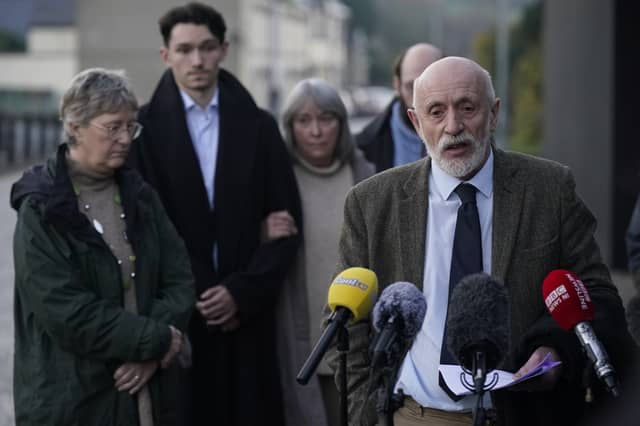

The son-in-law of an elderly couple killed at their home by a man with severe mental illness has called for the urgent return of devolved government to address avoidable deaths.
Charles Little contended the lack of a Stormont executive “kills people” as he argued for a cross-department mental health strategy.
His father and mother-in-law Michael and Marjorie Cawdery, both 83, were stabbed to death at their home in Portadown, Co Armagh, on May 26 2017.

It came after a coroner found that the deaths were “entirely preventable”.
Paranoid schizophrenic Thomas Scott McEntee, who is now in his mid-40s, pleaded guilty to manslaughter on the grounds of diminished responsibility and was given a life sentence in June the following year.
Following the inquest in December, the Belfast and the Southern Health Trusts issued apologies to the family.
“We accept the Coroner’s findings and extend our apologies to the Cawdery family for the failings by the trust, as identified by the Coroner. We are reviewing in detail the Coroner’s written recommendations and will work in partnership with others across the Health and Social Care system (HSC) and with the PSNI,” the Southern Trust said.
Mr Little said the family with happy with the apology from Chief Constable Jon Boutcher, but said the health service and police must work together to avoid anything like this happening again.
“Jon Boutcher was very apologetic. He fully accepted that there had been failings and that we should have had an apology earlier.
“He’s new in post, he’s determined to go forward and improve the situation and get work done to try and prevent these things happening again,” he told the BBC.
In December, coroner Maria Dougan said that, on the balance of probabilities, the deaths could have been avoided if police and health care workers had dealt differently with McEntee in several interactions in the days leading up to the fatal incident.
She identified a series of “omission and missed opportunities” that, if acted on, would have meant McEntee would not have been in the location of the Cawderys’ home on the day he killed them.
Ms Dougan also said she was not satisfied that all the lessons from the incident had been learned by the Police Service of Northern Ireland (PSNI) and the Belfast and Southern health and social care trusts.
Mr Little went on: “It’s not purely the domain of one or the other, both deal with mental health patients on a daily basis, 25% of the people police deal with every day are mental health patients, and both are short of resources, and at the moment both are trying to deal with the problems independently.
“It was quite clear in the inquest that the police officers had no idea what happened to a patient when they took him in to a hospital what sort of assessment he got.
“On the other hand, the health service had no idea how the police were operating, that they were bringing people in who ought to be detained but they hadn’t detained them to prevent antagonising them and they were being treated as a not so serious patient.
“That sort of thing cannot go on, that’s how problems happen.”
Mr Little also urged the return of the Stormont Assembly and Executive to deal with mental health and create a policy which involves all government departments.
“In Northern Ireland mental health has on average 300 avoidable deaths every year, year on year.
“That’s twice the average rate of deaths in the Troubles.
“Nobody is actually doing anything about that, why, because we don’t have a government to do anything about that,” he said.
“The lack of an executive kills people. It’s as simple as that.
“Politicians really need to get their minds round that.
“They need to get together, we need to have an executive, we need to have a real government-wide mental health policy, we need to implement it and number one, we need to address the avoidable deaths.”
In a statement on Wednesday, Mr Boutcher said the PSNI carried out an internal review and established a gold co-ordinating group under assistant chief constable Ryan Henderson to “develop an action plan to address identified shortcomings and develop our engagement with the Department of Health and other partners”.
“It is imperative that we learn the lessons and do everything we can to prevent such a tragedy from happening again,” he added.