
Spanish leader defends amnesty deal for Catalan separatists ahead of vote


Spain’s acting Prime Minister Pedro Sanchez has defended his controversial amnesty deal for Catalonia’s separatists in parliament as part of a debate a day before the Socialist leader seeks the endorsement of the chamber to form a new government.
Mr Sanchez has tied up the public support of six smaller parties to ensure that he can reach the absolute majority of 176 deputies voting in favour of re-establishing his minority coalition government with the left-wing Sumar (Joining Forces) party.

The deal includes former Catalan regional president Carles Puigdemont, who is a fugitive from Spanish law after he fled to Belgium six years ago.
Mr Sanchez told parliament: “We are going to promote a climate of living together in harmony and forgiveness.
“In Catalonia and other regions, there are citizens who believe that they would be do better going their own way. This government believes that a united Spain is a better Spain.”
Mr Sanchez chided the leading opposition Popular Party for its hard-line stance against the separatists, which he said only contributed to pushing more Catalans into the secessionist camp when the conservatives were governing.
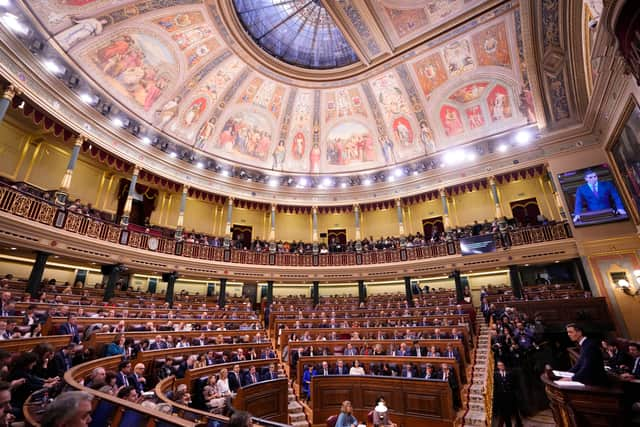
“Dialogue, a generous attitude and forgiveness has worked. That is that our proposal is to continue with the position for the next hour years,” he said, to applause from his party and some jeers from opponents.
Spain’s judges have heavily criticised the proposed amnesty, calling it an intrusion of the legislative branch into the separation of powers. The European Union is also reviewing the proposal.
The amnesty agreement has also sparked protests in Madrid and even in Barcelona, the capital of Catalonia. Spain’s opposition conservative and far-right parties accuse Mr Sanchez of betraying the nation for granting the amnesty just to hold onto power. More protests are expected in Madrid, where the parliament building is under tight security.
“For those who had peacefully protested, I want to show them my respect and acknowledgement,” Mr Sanchez, said before defending the constitutionality of the support he has garnered.

“The only effective barrier to the policies of the far-right is our coalition government,” Mr Sanchez said.
If Mr Sanchez, who has been Prime Minister since 2018 and one of the longest-serving Socialist leaders in Europe, were to lose Thursday’s vote, he would have a second chance on Saturday to win more “yes” than “no” votes.
The formation of a new government would end a period of political uncertainty since inconclusive national elections on July 23 left a highly fractured parliament.
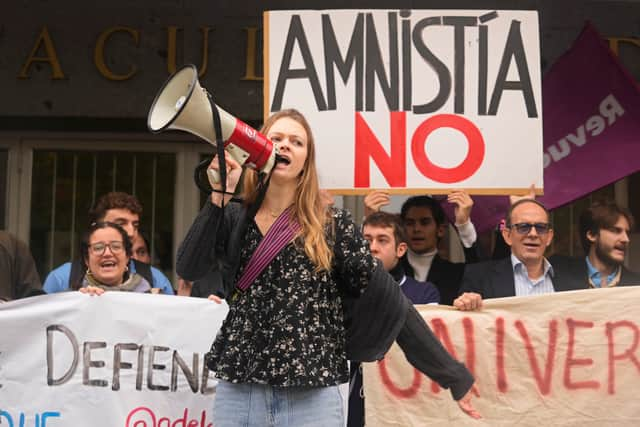
Besides the amnesty, Mr Sanchez had to make more concessions to Puigdemont’s Junts (Together) and rival separatist party Republican Left for Catalonia.
The Socialists agreed with Republican Left of Catalonia to relieve millions of euros of debt for the region and to cede it partial control of commuter train services.
Mr Sanchez’s party then bent to Mr Puigdemont’s pressure to let Catalonia keep more of its tax revenues, and most contentiously, open talks on the possibility of debating a referendum for independence for Catalonia, but within the limits of the Spanish Constitution.
The acting Prime Minister has defended his deals, saying that they will help to continue to normalise the political situation in Catalonia. The separatists’ parties have lost power in recent elections, while Mr Sanchez’s Socialists have surged in the region.
The deal also means that Mr Puigdemont’s party has for the first time in nearly a decade dropped its posture of trying to destabilise the Spanish state and, at least for now, guarantees Mr Sanchez remains in power by agreeing to vote with the government on key bills.