
Still open for business: Exploring Iceland’s Incredible northern coast
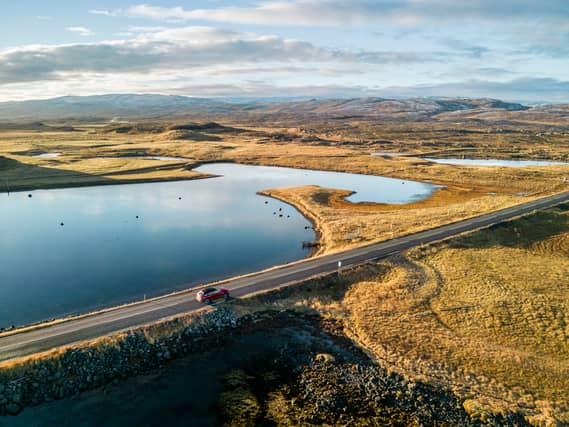

Iceland has hit the headlines once again in recent months after significant seismic activity, earthquakes and the eruption on the Reykjanes peninsula in the southwest of the country on December 18.
The Icelandic Met Office continues to issue fresh warnings of another possible eruption as new cracks were spotted near the town of Grindavik – where its 4,000 residents were evacuated in mid-November.

We’ve been told nearby land has risen by 10cm because of the seismic shifts while the famous Blue Lagoon geothermal waters, only a mile away from the Carbon Recycling International facility we’re looking around, closes on the same day because of volcanic activity. But Icelanders are aware of the risks and monitor things closely – it seems part and parcel of living on an ‘active’ island with around 130 volcanoes.
We’re looking around it for a reason though, as the plant essentially produces e-fuels which can take the place of petrol to sustainably power cars, and we’re with Mazda as it’s something the Japanese firm is a big believer in as it promotes e-fuels as an alternative to the increasing push to electrification. It’s putting a lot of money behind them too.
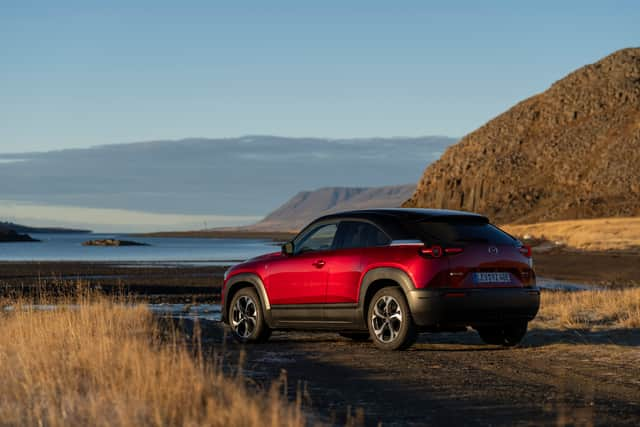
But Mazda now has an answer in the form of the MX-30 R-EV plug-in hybrid, which sees a return of a rotary engine in a Mazda for the first time in more than a decade. The firm has been one of the champions of this kind of engine, which sees the internal components work in a more circular motion, contrasting a conventional engine’s ‘up and down’ action – the benefit is that the engine uses fewer parts and takes up less space.
On the MX-30 R-EV, the engine works as a generator to power the electric motor, enabling a much longer range – with a 50-litre petrol tank allowing scope for many more miles without the need to charge, though Mazda still claims around 50 electric miles is possible once plugged in.

Despite the rugged nature of the island, more than 60 per cent of the population lives around the capital Reykjavik and many don’t travel all that far. That mixed with generous government incentives and impressive charging infrastructure means Iceland has the second highest share of combined plug-in hybrid and electric car sales of any country, only behind Norway.
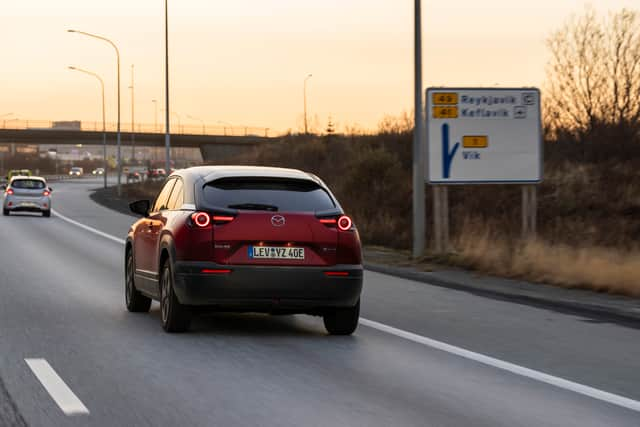
The sun is just starting to show behind the mountains as we drive around Hvalfjörður, a fjord that stretches almost 20 miles inland. It’s a shame it’s almost still dark at this point as the ripples of the water look to be quite the spectacle. We go cross country next, and despite the MX-30 R-EV being a front-wheel-drive crossover, our cars are equipped with studded tyres. They’re pretty noisy on tarmac – at first, it’s as if you’ve got a puncture – but on gravel and icy surfaces, come into their own.
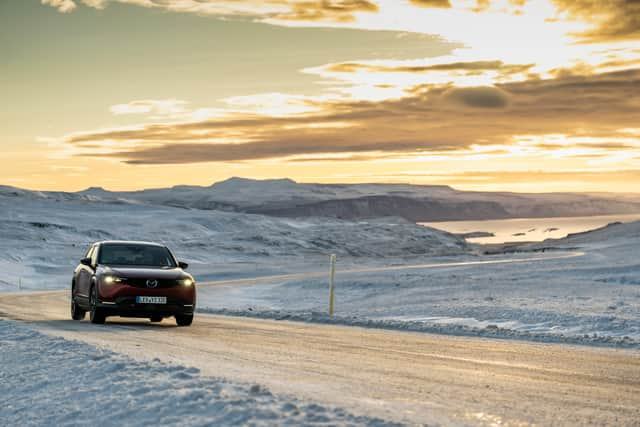
They’re not wrong, and as we leave the main tarmac and turn onto ‘road number 68’, we won’t pass another car for what seems like hours. The road flips from tarmac to dirt tracks with almost no notice and connects the villages of Borðeyri and Hólmavík, which are an incredible 63 miles apart, to give you an idea of how isolated this place is.
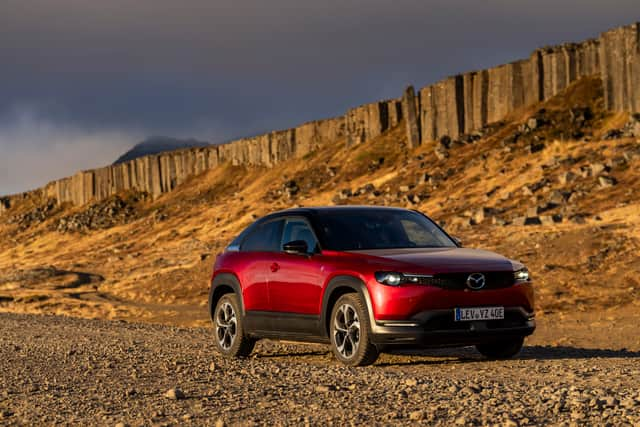
As the miles accumulate, we temporarily leave the coastline and head up into the mountains as the roads get snowier and the temperature drops again – minus 11 is the lowest we saw. With the studded tyres, though, the grip is remarkable. Not that you should, but even if you jump on the brakes, there’s next to no skidding at all. The ride quality from the MX-30, even on less-than-ideal road surfaces is impressive, with plenty of adjustment and padding to the seats ideal for hours behind the wheel.

Road 60 runs us back to the main Ring Road near Bifrost and we stop at an eerily quiet restaurant. We question whether it’s even open as we step inside as we’re quite well off the beaten track still and well outside of tourist season to be greeted by a smiling waitress. We’re the only ones in the place during our whole visit. Not keen to try some of Iceland’s delicacies that include whale, puffin and reindeer (a month before Christmas it doesn’t feel right to be having Rudolph on our plate), we’re stocked up on conventional burgers and back on the road.
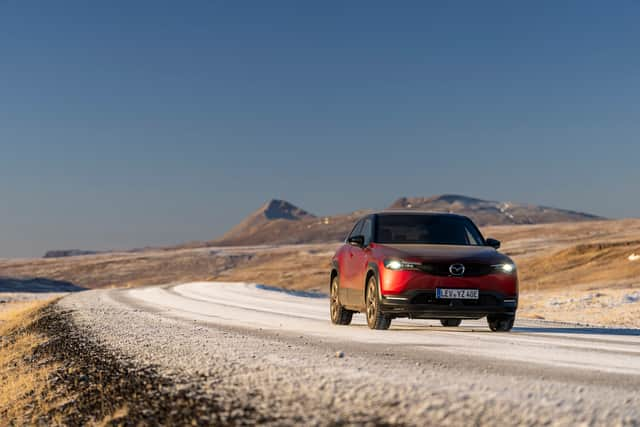
As we arrive back in Reykjavik, we look back at what has been an exceptional day of driving into some of the most spectacularly isolated places we’ve ever been. Even as the country continues to face more earthquakes and volcanic activity, it’s only a small southwestern region that is affected with Reykjavik and the rest of Iceland not impacted at the time of writing and still open for tourists, though it’s worth checking travel advice first.
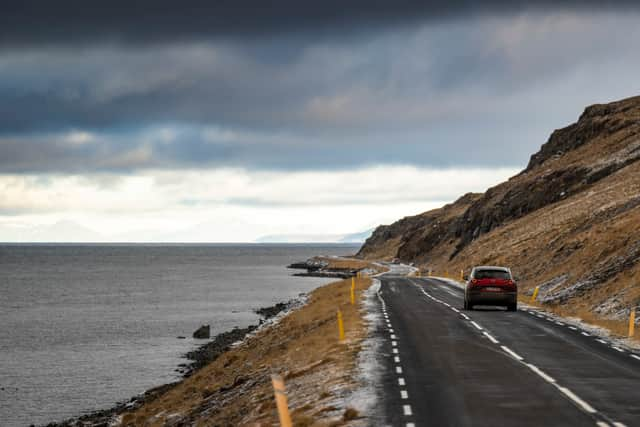
Despite Iceland’s advanced electric vehicle provisions, this is a route where you really (and we mean really) don’t want to run out of juice, and is one of those journeys that a plug-in hybrid comes into its own. It’s an ideal showcase for the MX-30 R-EV – you can still potter around the city as an EV, but with the backup of the extended petrol range when you’re miles away from civilisation, as is so often the case in Iceland.