
The evolution of the bikini


Created almost 80 years ago, the bikini has been making waves as a summer essential since the 1940s.
The late fashion editor Diana Vreeland called the bikini “the most important thing since the discovery of the atomic bomb.” Vreeland isn’t wrong, the two-piece swimsuit has lost none of its charm or scandalous appeal over the years.

The origin of the bikini
Ever since the mid-19th century, swimsuits have been gracing the waters of Normandy and Biarritz by the sea-bathing elite. But in the summer of 1946, a seismic shift in swimwear took place.

While visiting the beaches of Saint-Tropez, Réard observed women folding down their swimsuits to get a better tan – this sparked his idea to create a swimsuit that left the midriff completely bare.
The daringly minimalist design made its debut at Paris’s Molitor pool, modelled by Micheline Bernardini, a nude dancer from the Casino de Paris and the only woman willing to wear such a revealing piece.

Packaged in a tiny metal cube, just 6cm wide, and marketed as “the first anatomical bomb,” the bikini was set to challenge post-war modesty.
Among its early champions was Brigitte Bardot, who made headlines in 1953 when she wore a a simple floral bikini on the beaches of Cannes.
The 18-year-old actor’s youthful defiance helped turn the bikini into a symbol of a generation embracing freedom, pleasure and a rapidly changing consumer culture.
1960s
Come the 1960s, bikinis were still enjoying a surge in popularity, despite still being forbidden on some European beaches.
This was largely down to Hollywood. In the James Bond film Dr. No (1962), Ursula Andress stepped out of the sea wearing an iconic white belted bikini, and the moment certainly made waves.

That same year, actor Sue Lyon lounged on the grass in a floral two-piece in Lolita, while Raquel Welch went primal in a fur bikini in One Million Years B.C. (1966). These unforgettable cinematic moments played a major role in popularising the bikini across the globe.
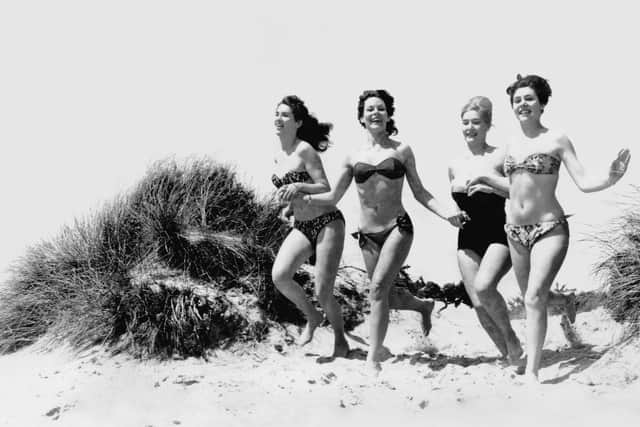
No longer just a skimpy beach outfit, the bikini became a subtle act of defiance: a way for women to reclaim ownership of their bodies, ditch the outdated constraints of modesty, and move freely – whether swimming, sunbathing, or simply being.
What was once scandalous had evolved into a symbol of liberation.
1980s
By the 1980s, the bikini made up 20% of swimsuit sales, more than any other swimwear model in the US.
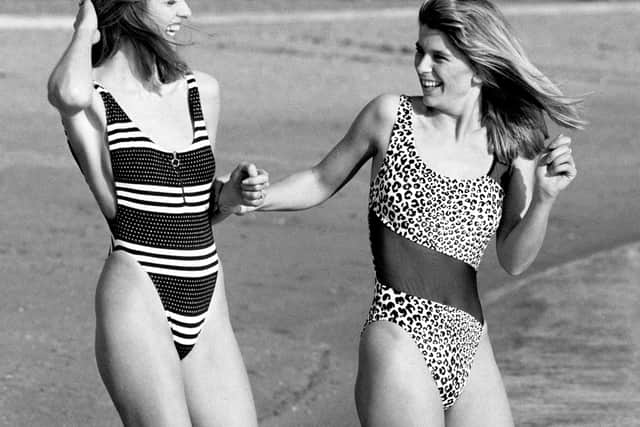

The likes of Baywatch’s Pamela Anderson and Sports Illustrated model Cindy Crawford became swimwear icons, wearing plunging one-pieces and high-rise bottoms.
1990s

This time, luxury labels began transforming the two-piece swimsuit into high-glamour statements.
In 1996, Chanel shrank it down and stamped it with its signature logo, and paraded it down the runway on supermodel Stella Tennant.
The following year, Tom Ford at Gucci took things even further with a barely-there ombré thong bikini adorned with a bold metal G – designed for all genders, and made to be seen.
2000s – present day
Today, the bikini remains a controversial piece of clothing, still finding itself under censorship.
In 2013, an advert featuring Pamela Anderson dancing in a bikini was banned by the British Advertising Standards Authority for degrading women.

But as designers become more inclusive and experimental with their designs – it seems the bikini has stepped into its golden age.
A symbol of liberation and freedom – the bikini remains one of the most popular sectors of the fashion industry, being valued at around $811 million.
Whatever its next form, one thing is certain: the bikini is here to stay.