
Two-million-miles-per-hour galaxy collision seen in detail
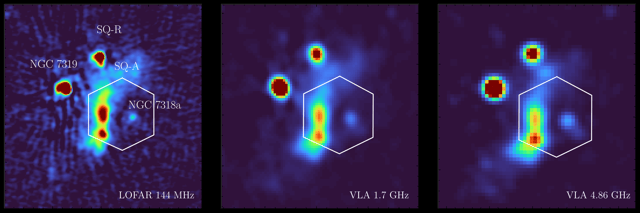

A massive collision of galaxies sparked by one travelling at two million miles per hour (mph) has been seen in unprecedented detail by one of Earth’s most powerful telescopes.
The impact sparked an immensely powerful shock similar to a sonic boom from a jet fighter – the likes of which are among the most striking phenomena in the Universe, experts suggest.
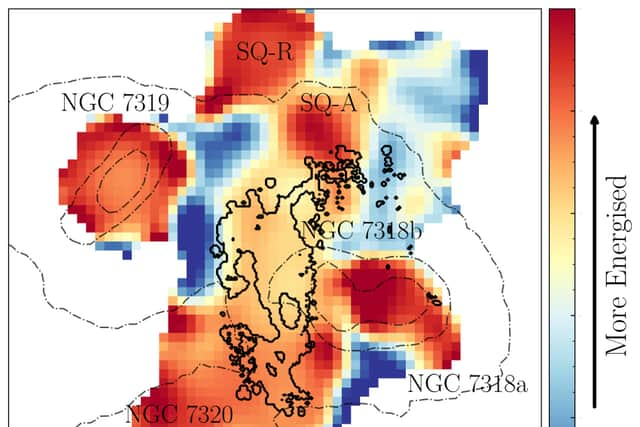
A team of scientists led by the University of Hertfordshire captured the event using the new 20 million euro William Herschel Telescope Enhanced Area Velocity Explorer (Weave) wide-field spectrograph in La Palma, Spain.
Dr Marina Arnaudova said: “Since its discovery in 1877, Stephan’s Quintet has captivated astronomers, because it represents a galactic crossroad where past collisions between galaxies have left behind a complex field of debris.
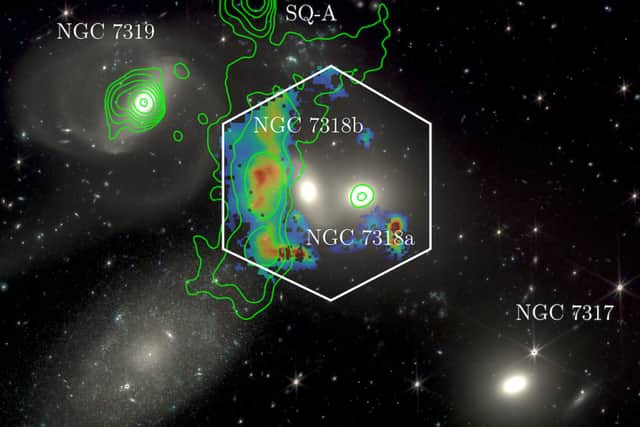
The researchers uncovered a dual nature behind the shock front, previously unknown to astronomers.
They found that as the shock moves through pockets of cold gas, it travels at hypersonic speeds, powerful enough to rip apart electrons from atoms, leaving behind a glowing trail of charged gas.
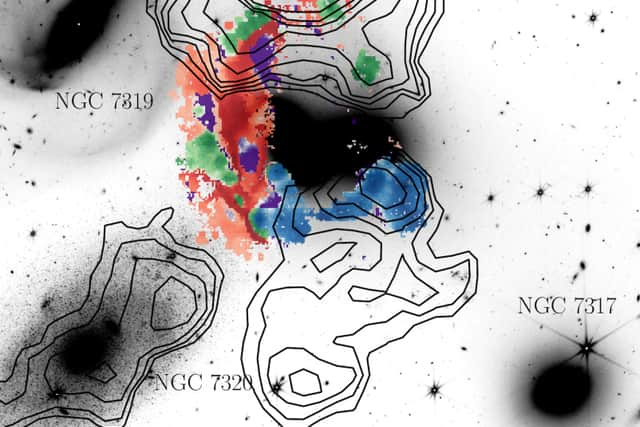
He added: “Instead of causing significant disruption, the weak shock compresses the hot gas, resulting in radio waves that are picked up by radio telescopes like the Low Frequency Array (LOFAR).”
The new insight and unprecedented detail came from Weave, combining data with other cutting-edge instruments, and the James Webb Space Telescope (JWST).
The findings are published in the Monthly Notices of the Royal Astronomical Society journal, and researchers believe that Weave is set to revolutionise our understanding of the Universe.