
Ukraine president orders full military mobilisation

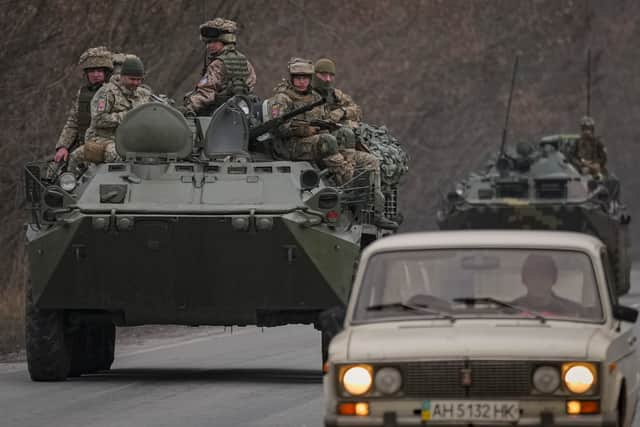
Ukrainian President Volodymyr Zelensky has ordered a full military mobilisation to counter the Russian invasion.
In a decree issued late on Thursday, he said the the mobilisation would last 90 days.
He tasked the military’s general staff with determining the number of people eligible for service and the number of reservists as well as the order of the call-up.

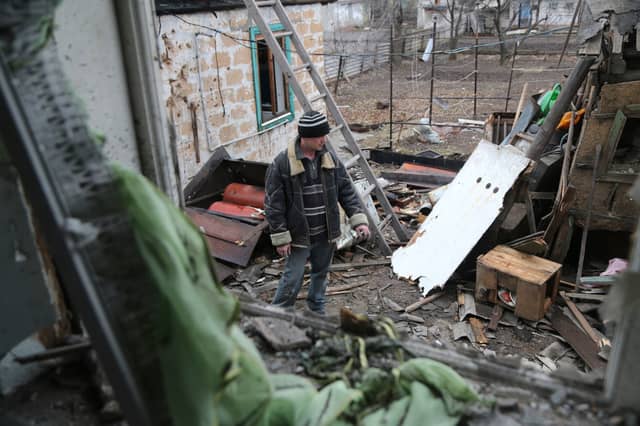
President Zelensky said 137 civilians and military personnel have been killed so far in the invasion of his country.
He called them “heroes” in a video address released early Friday in which he also said hundreds more have been wounded.
Mr Zelensky said that despite Russia’s claim it is attacking only military targets, civilian sites also have been struck.
In his words: “They’re killing people and turning peaceful cities into military targets. It’s foul and will never be forgiven.”
The president says all border guards on Zmiinyi island in the Odesa region were killed on Thursday. Ukraine’s border guard service earlier in the day reported that the island was taken by the Russians.
Russia earlier launched a wide-ranging attack on the eastern European country, hitting cities and bases with air strikes or shelling, as civilians piled into trains and cars to flee.
Ukraine has also lost control of the Chernobyl nuclear site, where forces had waged a fierce battle with Russian troops.
Adviser Myhailo Podolyak told The Associated Press that Ukrainian authorities did not know the current condition of the facilities at Chernobyl, the site of the world’s worst nuclear disaster.
“After the absolutely senseless attack of the Russians in this direction, it is impossible to say that the Chernobyl nuclear power plant is safe,” he said.
The Russian Defence Ministry said its ground forces have moved into Ukraine from Crimea, the first confirmation from Moscow that its ground forces have moved in, advancing towards the city of Kherson, north west of Crimea.
Kherson sits on a reservoir providing the bulk of fresh water for Crimea until Ukraine cut it off with a dam in 2017 in response to Moscow’s 2014 annexation of Ukraine’s Crimean Peninsula.
Defence Ministry spokesman Igor Konashenkov said the Russian troops’ move allowed the water supply to Crimea to resume.
In unleashing Moscow’s most aggressive action since the Soviet invasion of Afghanistan in 1979, President Vladimir Putin deflected global condemnation and cascading new sanctions – and chillingly referred to his country’s nuclear arsenal.
He threatened any foreign country attempting to interfere with “consequences you have never seen”.
Ukraine’s president said Russian forces were trying to seize the Chernobyl nuclear plant, site of the world’s worst nuclear disaster, and Ukrainian forces were battling other troops just miles from Kyiv for control of a strategic airport.
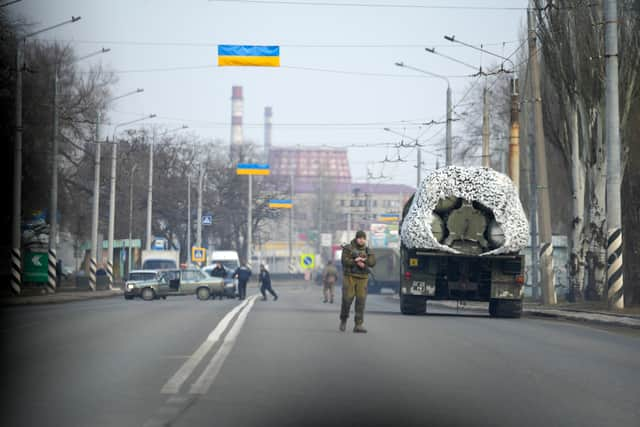
Large explosions were heard in the capital and in other cities, and people massed in train stations and took to roads, as the government said the former Soviet republic was seeing a long-anticipated invasion from the east, north and south.

The conflict was already shaking global financial markets – stocks plunged and oil prices soared amid concerns that heating bills and food prices would skyrocket.
Condemnation rained down not only from the US and Europe, but from South Korea, Australia and beyond – and many governments readied new sanctions.
Even friendly leaders such as Hungary’s Viktor Orban sought to distance themselves from Mr Putin.
Mr Zelensky cut diplomatic ties with Moscow and declared martial law.
“Russia has embarked on a path of evil, but Ukraine is defending itself and won’t give up its freedom.”
His adviser Mykhailo Podolyak said: “A full-scale war in Europe has begun. … Russia is not only attacking Ukraine, but the rules of normal life in the modern world.”
While some nervous Europeans speculated about a possible new world war, the US and its Nato partners have so far shown no indication they would join in a war against Russia.
They instead mobilised troops and equipment around Ukraine’s western flank – as Ukraine pleaded for defence assistance and help protecting its airspace.
In Washington, President Joe Biden convened a meeting of the National Security Council on Thursday to discuss Ukraine as the US prepares new sanctions.
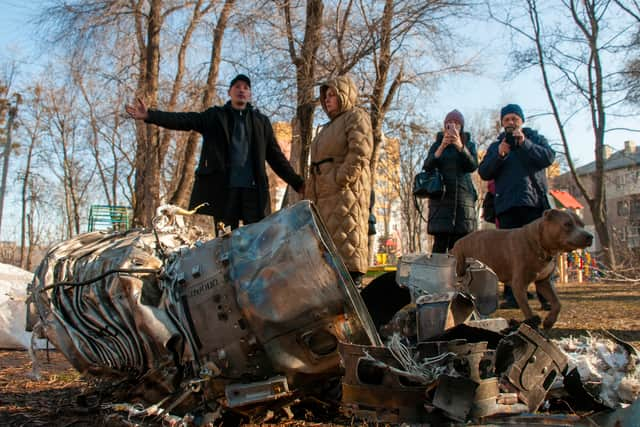
The attacks came first from the air.
Later Ukrainian authorities described ground invasions in multiple regions, and border guards released footage showing a line of Russian military vehicles crossing into Ukraine’s government-held territory.
After weeks of denying plans to invade, Mr Putin launched the operation on a country that has increasingly tilted towards the democratic West and away from Moscow’s sway.
The autocratic leader made clear earlier this week that he sees no reason for Ukraine to exist, raising fears of possible broader conflict in the vast space that the Soviet Union once ruled.
Mr Putin denied plans to occupy Ukraine, but his ultimate goals remain hazy.
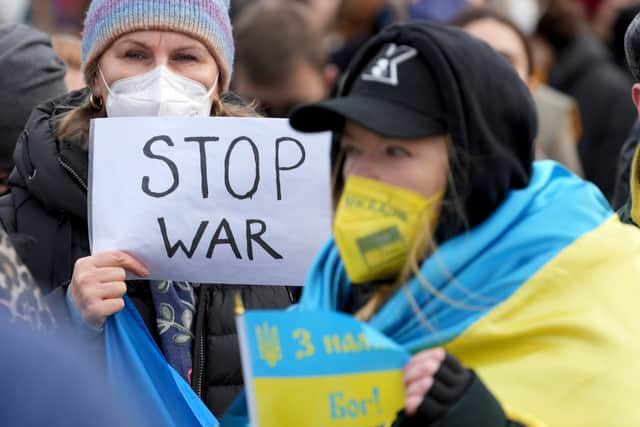
Ukrainians who had long braced for the prospect of an assault were urged to shelter in place and not to panic despite the dire warnings.
“We are facing a war and horror. What could be worse?” 64-year-old Liudmila Gireyeva said in Kyiv.
She planned to flee the city and try to eventually get to Poland to join her daughter.
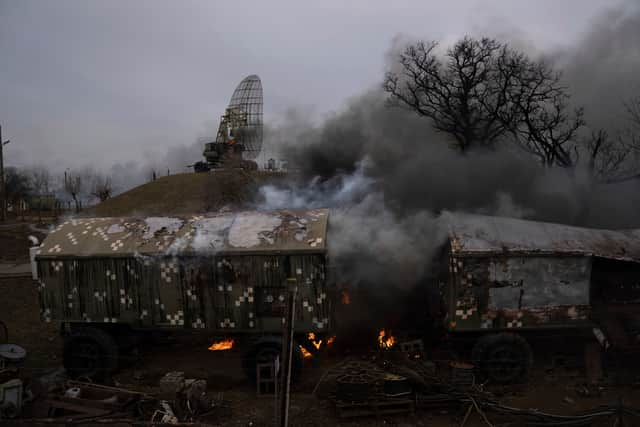
With social media amplifying a torrent of military claims and counter-claims, it was difficult to determine exactly what was happening on the ground.
Ukraine’s military chief Valerii Zaluzhnyi said his troops were fighting Russian forces just seven kilometres (four miles) from the capital – in Hostomel, which is home to the Antonov aircraft maker and has a runway that is long enough to handle even the biggest cargo planes.
Russian officials said separatist forces backed by Russia in the east have taken a new strip of territory from Ukrainian forces, but have not acknowledged ground troops elsewhere in the country.
Associated Press (AP) reporters saw or confirmed explosions in the capital, in Mariupol on the Azov Sea, Kharkiv in the east and beyond.
AP confirmed video showing Russian military vehicles crossing into Ukrainian-held territory in the north from Belarus and from Russian-annexed Crimea in the south.
Russian and Ukrainian authorities made competing claims about damage they had inflicted.
Russia’s Defence Ministry said it had destroyed scores of Ukrainian air bases, military facilities and drones, and confirmed the loss of a Su-25 attack jet, blaming it on “pilot error”.

Ukraine’s armed forces said they shot down multiple Russian aircraft.
They reported at least 40 soldiers dead, and said a military plane carrying 14 people crashed south of Kyiv.
Poland’s military increased its readiness level, and Lithuania and Moldova moved towards doing the same.
Border crossings increased from Ukraine to Poland, which has prepared centres for refugees.
Mr Putin justified his actions in an overnight televised address, asserting that the attack was needed to protect civilians in eastern Ukraine – a false claim the US had predicted he would make as a pretext for an invasion.
He accused the US and its allies of ignoring Russia’s demands to prevent Ukraine from joining Nato and for security guarantees.
The consequences of the conflict and resulting sanctions on Russia reverberated throughout the world.
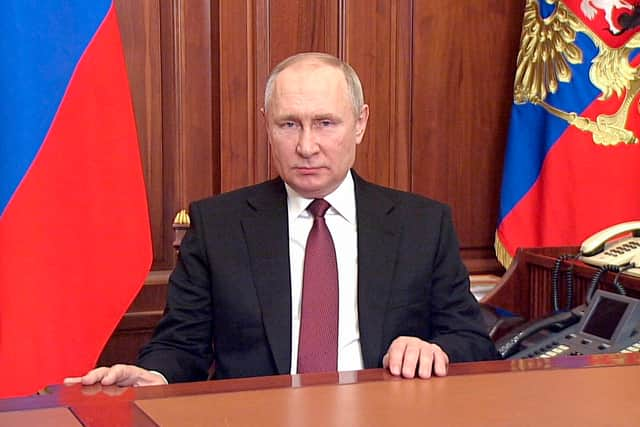
Anticipating international condemnation and countermeasures, Mr Putin issued a stark warning to other countries not to meddle.
In a reminder of Russia’s nuclear power, he warned that “no-one should have any doubts that a direct attack on our country will lead to the destruction and horrible consequences for any potential aggressor”.
Among Mr Putin’s pledges was to “denazify” Ukraine.
The Second World War looms large in Russia, after the Soviet Union suffered more deaths than any country while fighting Adolf Hitler’s forces.
Kremlin propaganda paints members of Ukrainian right-wing groups as neo-Nazis, exploiting their admiration for Second World War-era Ukrainian nationalist leaders who sided with the Nazis.
Ukraine is now led by a Jewish president who lost relatives in the Holocaust and angrily dismissed the Russian claims.

“The people of Ukraine and the government of Ukraine want peace,” Mr Zelensky said in an emotional overnight address, speaking in Russian in a direct appeal to Russian citizens.
Mr Zelensky said he asked to arrange a call with Mr Putin late on Wednesday, but the Kremlin did not respond.
The attack began even as the UN Security Council was meeting to hold off an invasion.
Members still unaware of Mr Putin’s announcement of the operation appealed to him to stand down.
UN secretary-general Antonio Guterres opened the emergency meeting, telling Mr Putin: “Give peace a chance.”
But hours later, Nato’s Jens Stoltenberg indicated it was too late: “Peace on our continent has been shattered.”