
VIDEO: A 24-year-old teams summer festival furry coat and bikini with walking stick and two stoma bags to celebrate surviving bowel cancer
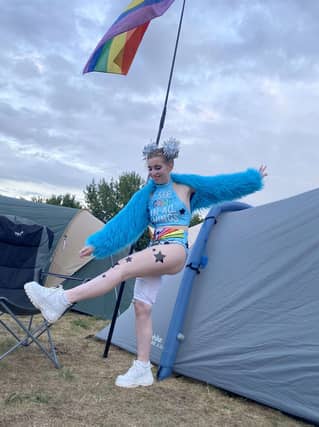

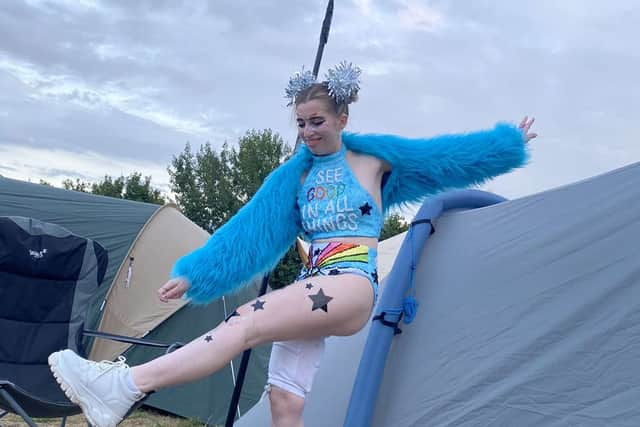
A 24-year-old teaching assistant proudly teamed her summer festival outfit of a blue bikini and furry coat with a walking stick twinkling with fairy lights and two stoma bags as she celebrated surviving stage three bowel cancer.
Diagnosed aged just 22, Sophie Anderson is now in remission and, inspired by bowel cancer campaigner Dame Deborah James, is determined to raise awareness of the disease – particularly in young people.
Sudden weight loss, passing blood and incontinence led to her initial diagnosis and treatment just after her 22nd birthday, only for the disease to return with a vengeance in October 2020 when a “football-sized” tumour was found on her bowel and harrowing life-saving surgery followed.
Refusing to be beaten, Sophie, of Huntingdon, Cambridgeshire, who has enjoyed fantastic support from her police officer boyfriend Alex, 24, is now making the most of life, saying: “So much happened to me, I shouldn’t even be here, but I am.”
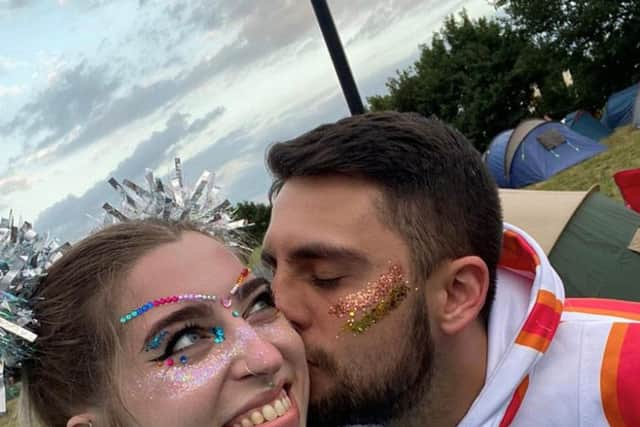
She said: “I went to the Secret Garden Party festival in Huntingdon in July with my friends and we all got dressed up.
“I had put on more weight and felt more confident and wore a blue bikini and a fur coat and wrapped my walking stick in fairy lights.
“I felt really good. I had such a good time and laughed more than I had in years.”
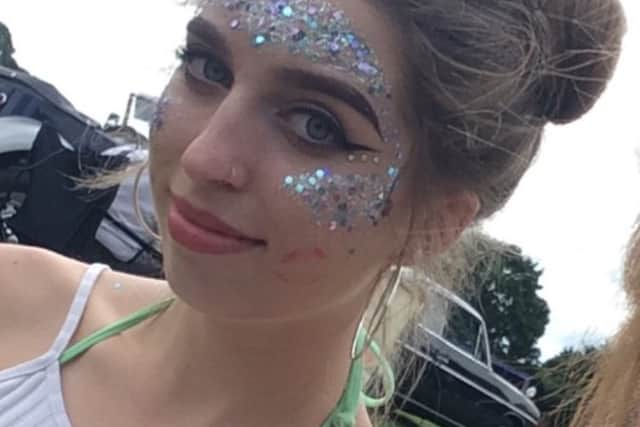
She said: “One day I needed to go to the toilet and passed a lot of blood.”
“It was weird, but it didn’t happen again for a while, so I thought maybe it was just a one off.
“Then I started to feel really weighed down, constantly bloated and fatigued.”
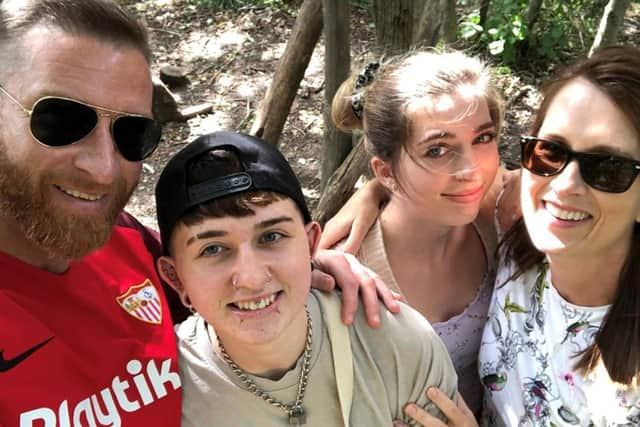
She said: “I was quite depressed because my body felt so weak and I couldn’t pinpoint why.”
Signed off from university at Easter 2017, as her mental health became increasingly fragile she moved back home, where she now lives with her mum, Elizabeth Anderson, 53, and sibling, Ash Anderson, 22, both teaching assistants, and saw her GP, who diagnosed depression and anxiety.
In July 2017, by then working as a carer, she began passing blood more often, saying: “Sometimes I would go for a week without anything,. Then there’d be lots and I was getting more constipated.”
Seeing different doctors over the coming months, she was diagnosed with digestive disorders including IBS, Crohn’s, ulcerative colitis, colon spasms and constipation – but no one suspected she had cancer.
She said: “I remember saying to my GP that I have a history of bowel cancer on my mum’s side of the family.
“I think, because of my age, it was just assumed that it could never be cancer, though.”
Concerned in case her carer role was making her stressed and impacting on her health, Sophie switched to become a teaching assistant at her local special needs school in December 2018.

When, by September, she had lost two stone, she was booked in for a colonoscopy, to check inside her bowels, while a biopsy revealed a month later that she had bowel cancer.
She said: “I remember being relieved at first, because it meant there was actually something wrong with me, but I think I just felt numb.
“I don’t think I heard anything else after they said those words.”
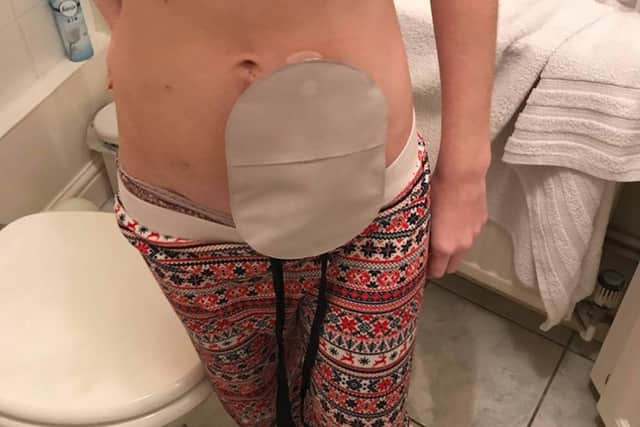
After that, she had surgery at Addenbrookes Hospital in Cambridge in March 2020 to remove a grapefruit-sized tumour on her bowel, as well as a full hysterectomy.
She had part of her colon and her left ovary removed, where the tumour had grown so much and her temporary stoma to collect waste was also successfully reversed.
Luckily, further chemotherapy was cancelled, as she was confirmed to be in remission by July.
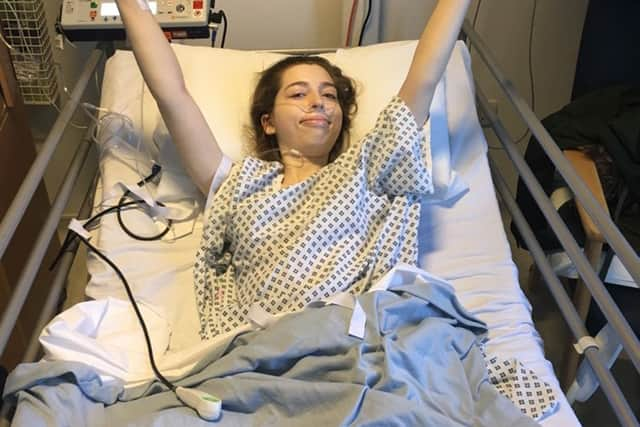
In the meantime, while Sophie knew that her grandmother, Hazel Cockrill, had died from bowel cancer in 1998, she did not know that her grandfather, John Cockrill, had from the same disease at the same age in 2011.
And investigations revealed that she had Lynch syndrome – a hereditary gene which shows a strong history of colon cancer – also detected posthumously in her grandfather’s DNA, as well as in her mum.
Sophie said: “It never occurred to me that I could have the same.”
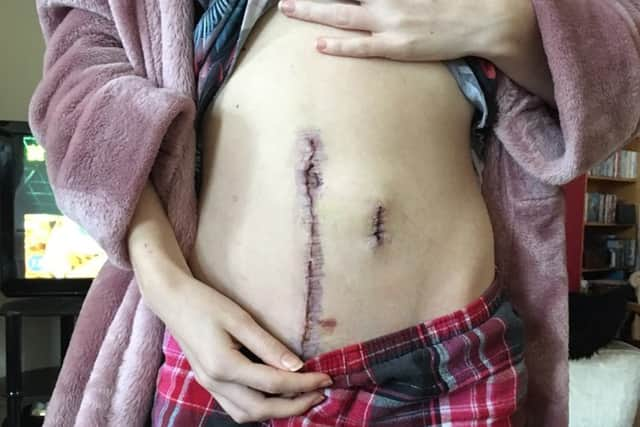
This time, she was told the tumour on her bowel was very large.
She said: “I started to think it was actually something that could kill me.
“It started to feel really real and to mess with my head.
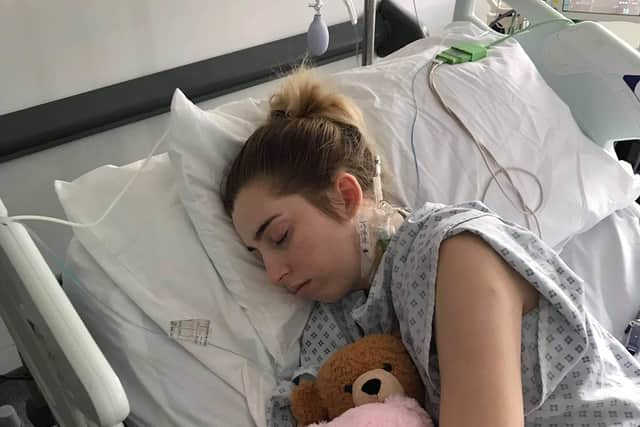
To try and shrink the tumour before surgery, she was admitted to hospital for three months of immunotherapy – a specialised cancer treatment.
She pulled through despite suffering significant liver damage and suspected sepsis – a life threatening reaction to an infection.
By June 2021, Sophie was ready for a 14-hour operation to remove the tumour as well as part of her vagina, rectum, bowel, bladder, and tailbone, where the tumour had spread.
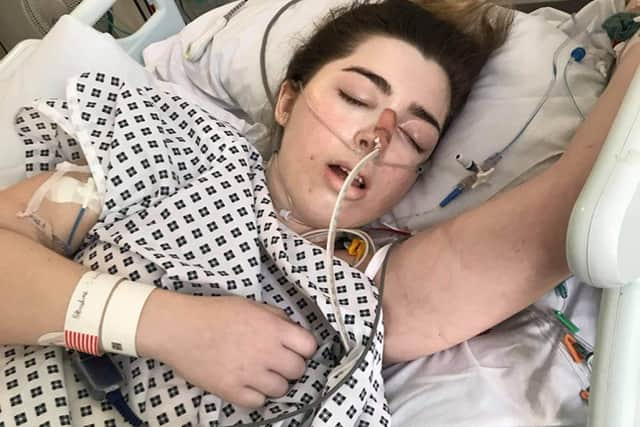
She said: “I felt numb.
“The doctors just listed everything I needed to lose and I started to think about how it would affect me day-to-day and had no idea what I would still be able to do.
“I was scared my life could be over and the surgery might not even work.”
With no guarantees of a cure, Sophie feared the treatment might be too much to bear.
She said: “I was scared that I could be making myself disabled because they feared that I may get foot drop – which I thankfully didn’t – and I didn’t like thinking about life with two stomas.
“I was scared that I would lose so much of myself and it might not even be worth it. ”
In June 2021 when she arrived at St Mark’s Hospital, a specialist bowel unit in London, the last thing Sophie remembers is being given anaesthetic.
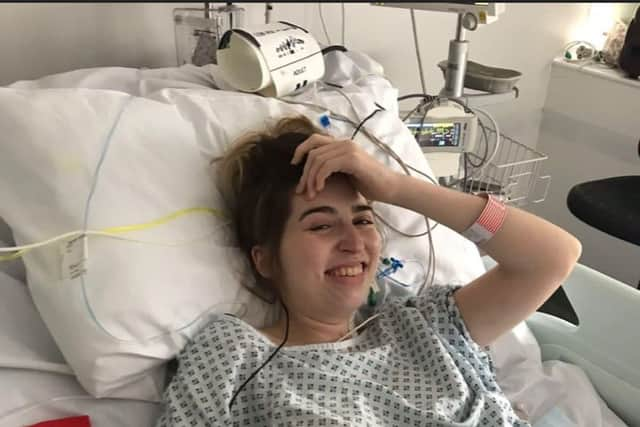
She added: “I was told that I woke up after surgery and wouldn’t stop screaming.
“They found out I had internal bleeding, so I was taken back into the operating theatre for four hours and didn’t come to for another five days.”
In the meantime, she suffered a stroke, which means she now sometimes becomes confused or muddled.
Despite her positivity, coming to terms with her extensive surgery has been incredibly difficult for Sophie.
She said: “Losing part of my vagina made me feel like I wasn’t as much of a woman anymore.
“I was already completely infertile, with no possibility of having any biological children because of surgery. Then to have part of my vagina removed too was devastating.”
She said: “I do feel like I have lost a lot of my womanhood, especially as the hysterectomy means I am going through the menopause. It has had a huge impact on me.
“Alex and I have been together for six years and he’s been so supportive throughout. We have spoken about adoption in the future, or surrogacy. But we will just have to see what happens.”
For two months after her operations, Sophie was kept in intensive care, as she recovered from surgery and was slowly taught to manage with every day life.

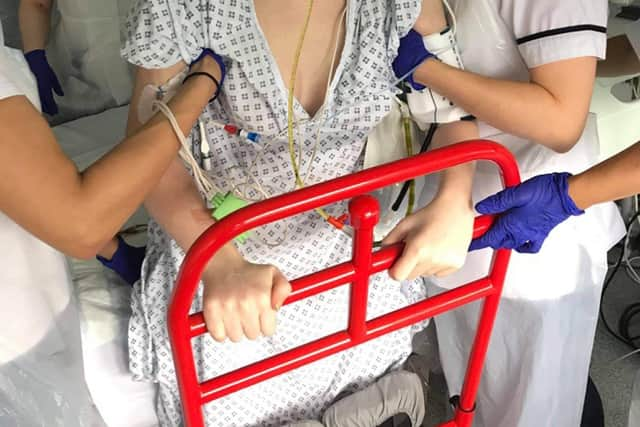
She added: “Waking up with two bags on my stomach and not feeling my left leg was really scary. I felt broken.
“I needed four people to help me stand up on the first day. Then I just started learning to walk with very, very small steps.”
By August 2021, Sophie was home, starting a year of recovery – relying on her parents and boyfriend to help her rebuild her health.
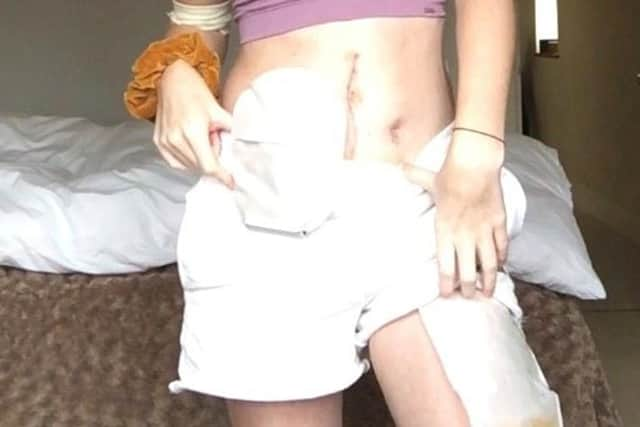
She added: “I started to be able to do my stomas myself and my own dressings and pain medication and to feel more independent.”
Gradually, Sophie has regained most of her strength and, by early summer this year, she began making plans with friends and is even hoping to return to work next month.
She said: “I hadn’t driven my car for two years as I wasn’t well enough.
Sophie added: “Alex and I went on a date to a steak house 10 minutes away from where I live, too, in October. I put on a dress and some make up and had my hair done. I felt more human.
“Alex has been brilliant. He came to appointments with me and visited me in hospital whenever he could.
“For so long, we were almost in this carer-partner relationship and now we are getting back into being a proper couple again.
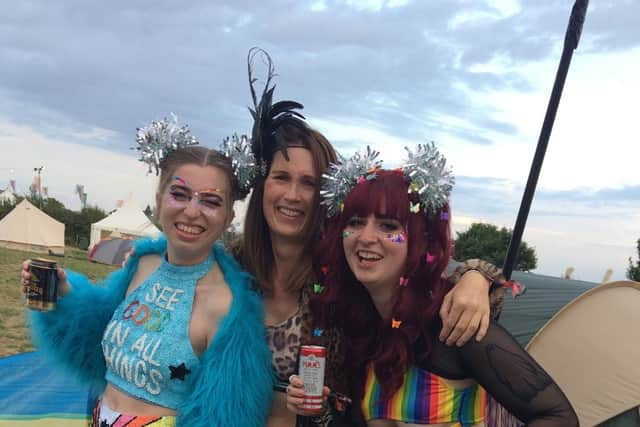
And Sophie was overjoyed to join her pals at some of this year’s summer music festivals.
After the Secret Garden Festival she went to the Wilderness Festival in Oxfordshire earlier this month.
She also went on a charity-organised trip to Bournemouth, Dorset, in July, with other young cancer-survivors, to enjoy kayaking, pottery and fun by the seaside.
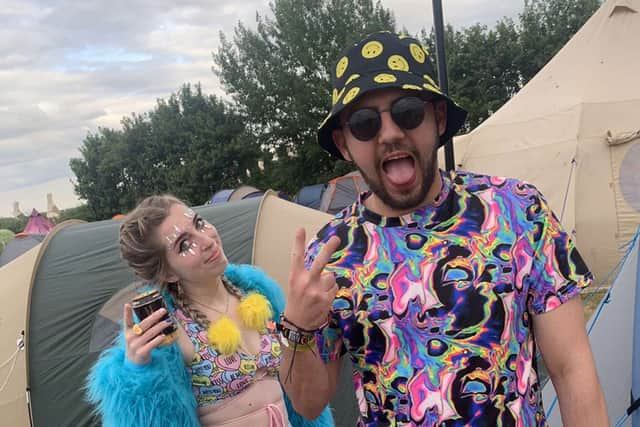
As well as preparing to return to her school job in September, Sophie is keen to spread awareness of bowel cancer and to highlight how it can affect young people.
Bravely documenting her own progress in videos on her phone she said: “No one seems to look for bowel cancer in people under a certain age.
“If someone had suspected I had bowel cancer earlier, I would probably be in a better position now.
“It is so important to recognise the symptoms, such as passing blood, bloating or fatigue – even if you are young, when it’s easy to brush off certain things and think they will go away.”
Sophie added: “You have to listen to your body and push to get the right tests done, because this could save your life.
“If, by raising awareness, I can get just one person to push to have a colonoscopy and get an early diagnosis, it will be worth it.
“I don’t want anyone else to go through what I have been through.”
She said: “I am so happy I am here.
“This summer I have done things that I never thought I would do again.
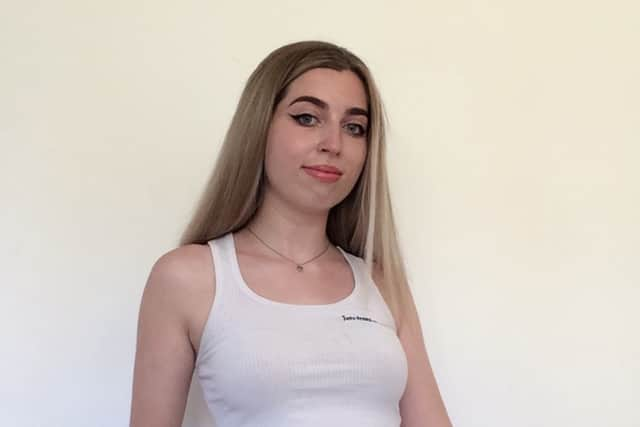
Meanwhile, Alex could not be prouder of his girlfriend.
He said: “I can’t say anything else other than how proud I am of Sophie.
“Seeing everything she has been through has been the hardest thing I will ever face.
“After having the surgery last year and everything that happened, when I saw her walk for the first time without support or a crutch, I have never felt more proud.
“To go through all that and then be willing to talk about it and try and help others, just makes me love her even more.“It all made me realise that the thing I loved most about her was how determined she was. I didn’t know it when I met her, but it was her determination that made me fall in love with her.”
For more information about bowel cancer go to: https://www.bowelcanceruk.org.uk/