
What are the next steps for Finland and Sweden on Nato membership?

Finland and Sweden have signalled their intention to join Nato over Russia’s war in Ukraine and things will move fast once they formally apply for membership in the world’s biggest security alliance.
Russian President Vladimir Putin has already made clear that there would be consequences if the two Nordic countries join. So it is important for Nato to bring them swiftly into the fold where they can benefit from the security guarantees that membership provides.
– How long will it take for Finland and Sweden to join Nato?
Nato officials say the membership procedure could be completed “in a couple of weeks”.
But the most time-consuming part – ratification of their accession protocols by the alliance’s 30 member countries, sometimes involving parliaments – could take months. How many is anyone’s guess, although that step has taken eight to 12 months with recent candidates.
Canadian foreign minister Melanie Joly said on Monday that “we think that it could take days for Canada”. The fastest were West Germany, Turkey and Greece, whose endorsement took around four months in the 1950s, when Nato was less than half its current size. Still, war on Nato’s doorstep is sure to focus minds.
The US and Britain, among others, stand ready to provide security support if needed until the process is complete.
– How does a country go about joining?
First though, a request to join must be submitted. It usually comes in the form of a letter from a government minister or leader.
Nato then assesses that request. That is done in a sitting of the North Atlantic Council (NAC) of the 30 member countries, probably at ambassadorial level.
The NAC decides whether to move towards membership and what steps must be taken to achieve it. This depends on how well aligned the candidate countries are with Nato’s political, military and legal standards, and whether they contribute to security in the North Atlantic area. It should pose no problem for Finland and Sweden.
– How do membership talks work?
The candidate is asked to commit to uphold Article 5 – Nato’s collective defence clause guaranteeing that an attack on any one ally would be met with a response from them all. It would have to commit to spending obligations concerning the Nato in-house budget, which runs to around 2.5 billion dollars (£2 billion).
The candidate is made aware of their role in Nato defence planning, and of any other legal or security obligations they might have, such as the vetting of personnel and handling of classified information.
Nato staff then write a report informing allies about the outcome of the talks. The report states what issues were raised with the partner and what commitments that country made. At the same time, the candidate sends a letter, usually from a foreign minister, confirming that their country accepts all these obligations.
– How do they know whether they’re accepted?
The accession report and candidate’s letter are submitted once more to the NAC for a final decision.

If yes, a small ceremony is held giving a symbolic and legal form to this part of the membership process. The protocol is then sent to capitals for ratification according to the 30 national procedures, some of which require parliamentary approval.
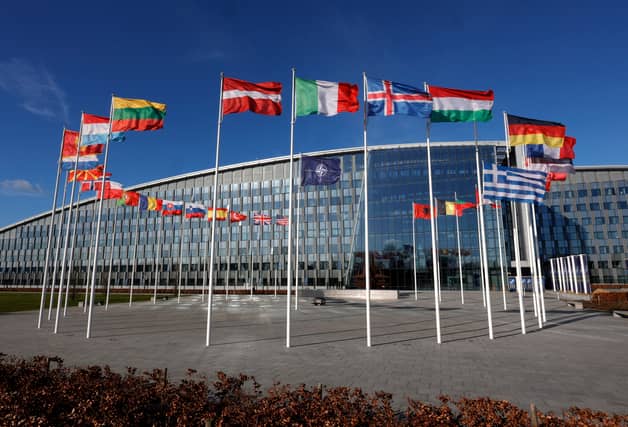
Once completed, the invitee then ratifies the protocol and deposits it in Washington. They are then officially a member and their national flag is hoisted outside Nato headquarters in Brussels.
– Are there any objections to them joining?
Nato takes all its decisions by consensus, so each country has a de facto veto.
Last week, Turkish President Recep Tayyip Erdogan raised concerns about Finland’s and Sweden’s stance on Kurdish militants, whom Turkey classifies as terrorists.
Mr Erdogan did not threaten outright to veto membership, and officials and analysts believe he will not stand in their way. No other country has raised serious objections to them joining, either in public at home or at Nato headquarters in Brussels, officials say.