
Gardaí and emergency services responded to this single vehicle collision on the N65 at Moyleen
Search


18 Jan 2026

Please allow ads as they help fund our trusted local news content.
Kindly add us to your ad blocker whitelist.
If you want further access to Ireland's best local journalism, consider contributing and/or subscribing to our free daily Newsletter .
Support our mission and join our community now.
To continue reading this article, you can subscribe for as little as €0.50 per week which will also give you access to all of our premium content and archived articles!
Alternatively, you can pay €0.50 per article, capped at €1 per day.
Thank you for supporting Ireland's best local journalism!

Jimmy Kelly, JJ Jurley, Michael Ramsbottom, Paul Byrne, and Joe Brennan (Treasurer)

For more than a century, homing pigeons have been more than just birds in back gardens, they've been athletes, companions and symbols of patience and precision.
In Carlow, these feathered competitors still command devotion, drawing lifelong keepers in a sport that marries tradition with community, memory and a timeless bond.
READ NEXT: 'So proud' - Young Carlow woman lands prestigious SETU President's volunteering award
Every Sunday in Graiguecullen, the men of the pigeon club meet to discuss races, training, and money, amongst other things.
Originating all the way back to 1965, the club started with just six or seven members in the back of one of the men's shed's on the Staplestown Rd, a place where they could meet and discuss "the goings on" before applying for accreditation with the Irish Homing Union (IHU).
The IHU, founded in 1895, is the sports longest governing body in Ireland. Today it oversees hundreds of clubs across the country, supporting members through registration, rules, and the issuing of unique IHU bands that identify each bird to it's owners.
"Back in the day they were racing pigeons with and without rings," says Frank Archbold, one of the clubs founding members.
Officially, birds have to be registered to their owners. A ring is put on the birds leg after they're born (6 or 7 days old) and the ring can't be take off again.
"Nowadays it's an ETS ring...back in the day it was a rubber ring which had to be put on by a machine and everything was registered to the owner, one ring for each bird," said Frank.
Depending on the situation, keepers or pigeon fanciers as they are widely known, could have up to 150 birds, who they train and race. Others would have less, preferring to keep their flock to just quality birds they want to race.
"It's not just a thing where you'd put a hen and cock together and you get two pigeons, you can do that, but they wouldn't fly from here to the car," said Joe Brennan, treasurer of the club, "You have to breed them and you'd get pedigrees. There's people paying thousands and thousands for a bird and you'd go down the line with pedigrees."
Astonishingly, the record price for a racing pigeon is €1.6 million, a seemingly inconceivable price for one bird, but buyers take this very seriously.
"Most of these buyers would have stud farms and would artificially inseminate the hens and they'd get 100 pigeons out of them in a few days and then they'd sell them," said Joe, "The Chinese are the big crowd at the moment buying them. There's some money in it.
"It's a business with a lot of people - here in Ireland too. People go out and pay a few thousand for pigeons, and put them into their lofts...there could be 30 cocks and 30 hens, but you can't guarantee the pedigree of them. But on the stud farms, they'd all be housed individually in breeding pens."
"One of the big problems with pigeon racing is," Frank explained, "People look at it...around the town here, there are thousands of pigeons, destroying everywhere, and that's what gives it a bad name.
"In certain areas, there's lads keeping pigeons who are not looking after them properly, and the next door neighbour can't hang their washing up. But people don't see the other side of it...the enjoyment of it.
"99.9% of the lads in the pigeon club would have top class lofts, they keep it clean and they look after their birds. It's these other people that just have them hanging around the roof all day."
"The majority of them people wouldn't even be in a club," added Joe, "They just had an open loft and let them in and out and throw them a bit of food now and again, but the pigeons that we have are better looked after than ourselves, they're vaccinated and wormed. They're fed wheat, barley, maize, oats - the best of food."
Over the years, pigeon racing in Ireland has evolved from more than just a hobby to a regulated sport with sophisticated lofts and a broader competitive nature, while still retaining it's community spirit.
"I'm retired now and I find it great," said Joe, "You'd go out and look at them, clean them out, and you're going for a toss with them. And this time of year, you're trying to work out on paper what you have. Say you have 40 young birds left over after racing last year, and you're trying to figure out what hen to put with what cock. You're going back to see what races they had.
"99 times out of 100, you're going to bed thinking about them. You'd get up in the morning and the first thing you'd do is look out the window and see are they alright, And if you lose a good one you're looking out all day and sometimes they wouldn't come back at all."
READ NEXT: Carlow dad launches new World Cup anthem to raise funds for hospital that helped his baby
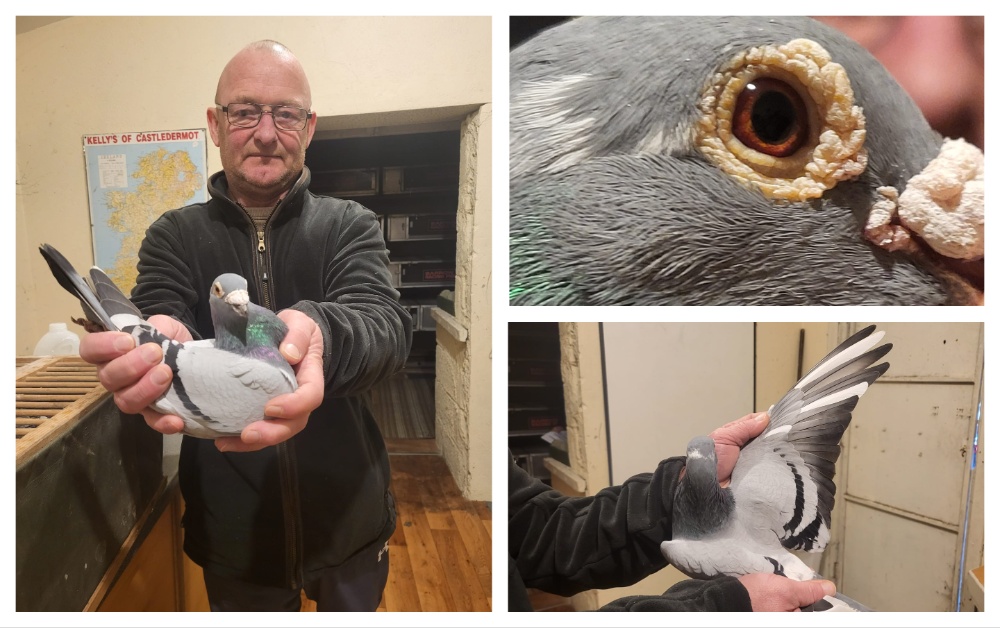
Most of the men in the club have kept pigeons since they were kids, including Jimmy Kelly from Palatine, who has had birds since he was five. Passed down to him from his father, Jimmy said he loves nothing more than sitting out with the pigeons every morning having his coffee.
While the pigeons can bring in money from time to time, bonds are made between owner and bird, "you'd have a few favourites, and they have their own personalities, their own way of doing things" they say, "but you definitely know the bad ones".
Of the ones that won't make racers, Joe said he would usually give them to some young lad who keeps birds, "we wouldn't be going around killing pigeons".
Losing birds for long periods of time is commonplace, one member recalls losing his bird for 8 months and another for 12 months, "I was delighted when he came back, I couldn't believe it, I was full sure he was dead."
"You could lose a bird for a month," said Joe, "And then all of a sudden he'd arrive back, even still he'd go back into his own box as they're very territorial. Another bird may have taken it over, and that's when the problems start.
"See what would happen there is, someone was after catching him in, and he'd have him for the 8 months thinking they might stay with them, but as soon as he gets out he's gone.
"They might have got a belt from a wire or something and they find a loft to go into. A lot of birds, if they get hurt, they'll go into someone else's loft...that's where the ring numbers come in.
"The after a week or two, their wing gets a bit better and they'd start flying around the other loft. They might fly off for 10 minutes and come back, because they know they're not strong enough to go. But once they get strong enough, they're gone.
"Next thing you'd get a phone call and someone down in cork would be after reporting my bird and I'd have to go down and get him
"Some of them you couldn't get rid of," they all laugh, "You know the bad ones. If you were training 20 pigeons every day, and there's 19 of them coming and landing on the loft together, and the other one would come 2 hours after. We give them every chance but sometimes they just don't take to it.
"But some of them would be very smart, certain ones would come out of the basket and they're gone."
READ NEXT: Carlow people could be losing hundreds on insurance premiums amid new advice
While it would predominantly be a male dominated club, there are some woman who keep and race pigeons, along with most of the men's wives who would help out a lot with the birds.
Also keen to pass the hobby on to their kids, one member, Paul Byrne, enlists the help of his two sons, Lennon (13) and Parker (10) in the hopes of passing the torch and keeping the wonderful tradition alive.
Starting out back in the early 60s, there was only one club in Carlow, but rivalry throughout the years caused the club to split.
"How it happened years ago when the club started up, there was south road racing and north road racing - half the club wanted to go south, the other half wanted to go north - we came down here because we were racing north and the top of the town were racing south. But then north road racing died a death so we're all on the south road now, that's where we fly," explained Joe.
Asked if there is still rivalry between the clubs today, Joe said "oh Jaysus there is. There's rivalry between us in this club," he laughed.
"We'd all joke and have the craic but when it comes to Friday night and Saturday morning, it's a different story."
"When the race is over and we were all to meet," said Frank, " Everybody can go down there and get a pint and have a great chat, it would never be anything too serious."
"Even if we were having our presentation the boys from the other club would come down," said JJ Hurley. "It's the same as going into the pub after a football match, you'd kill one another on the pitch and then we'd all be grand with each other after."
Racing season starts in April and training starts about 2 weeks before the 1st race.
"It's no different to horse racing...there's thousands of foals born every year and not all of them are champions. It just doesn't work like that. But it's a great aul sport and it's not the hardest thing in the world to keep them but you can make it very expensive for yourself, if you want to," said Joe.
The sport of pigeon racing began in the 19th century, originating in Belgium, who are credited as the first country to organise competitive races, however, Ireland quickly embraced the pastime and made it its own.
Long before modern races, pigeons were valued for their remarkable homing instincts - their ability to return home over long distances - a trait that once made them invaluable messengers across battlefields and borders.
The club in Carlow, along with others across the country, race pigeons in Ireland, over to England and even all the way to France with pigeons flying up to 15 hours a day.
Sprint pigeons can fly from 0 to 100 miles, middle distance pigeons can fly from 0 to 250 miles, while long distance pigeons would fly from 0 up to 700 miles.
The training process can take time, with the pigeons being put on a landing board when they're babies. Their incredible homing ability brings them back home.
"Like I could give you one in the morning and you could let it out and he'd fly back to me," said Frank.
"But if you wanted, you'd have to take the bird when he's very young, only just weaned from his parents, and bring him home with you and put him in the pen, let him see out for a couple of days, gradually nurse him to come out on the landing board, and he'd have a look around and go back in, and that'll be home to him, there's no where else."
READ NEXT: Carlow bucks Ireland's slowdown as vacancies in local jobs market almost doubles
Different techniques are also used to train the birds for racing, including the widowhood system - a popular motivation based method used to encourage strong homing instinct and speed. It is one of the most widely used systems in pigeon racing.
Male pigeons are paired with females before the racing season so a strong bond forms. Once bonded, the birds are then separated and kept alone in their pens.
The males are then trained and raced and then allowed to return to their hen briefly. The desire to return to their mate acts as the main motivation.
Males and females are both raced, while some favour the cocks over the hens, "one is as good as the other".
"Some lads get it into their heads that the cocks are better," said Joe. They might only want to race a few at a time. With the widowhood system you would get 12 weeks good racing with the cocks, you'd barely get 6 with the hens...the hens go off form quicker, but it's all down to timing."
"When they're finished racing, you break them down onto lighter food like barley, just for the winter and then when they're coming to mate up, you give them more protein, then when they're rearing their youngsters, you give them a heavier diet, and then when all that's done, you cut them back down for racing to get them fit.
Regarding wins, some men in the club said they have definitely won a few races in their time.
"A lot of us won nationals, nationals is the top spot," said Joe. "You'd have club, regionals and nationals. One of us won a €1000, another won €1400, so there'd be a bit in it. But it all goes back into the birds...you'd buy houses with the money spent on them."
Pigeon keeping in Ireland may no longer command the numbers it once did, but in places like Carlow, it endures through quiet dedication. The sport remains a living tradition, one that always finds its way home.

Subscribe or register today to discover more from DonegalLive.ie
Buy the e-paper of the Donegal Democrat, Donegal People's Press, Donegal Post and Inish Times here for instant access to Donegal's premier news titles.
Keep up with the latest news from Donegal with our daily newsletter featuring the most important stories of the day delivered to your inbox every evening at 5pm.

This publication supports the work of the Press Council of Ireland and Office of the Press Ombudsman, and our staff operate within the Code of Practice of the Press Council. You can obtain a copy of the Code, or contact the Council, at www.presscouncil.ie, Lo-call 1800 208 080 or email: info@presscouncil.ie.