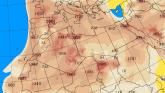
Pictured is a still of a University of Athens map shared by Carlow Weather on social media
Search


02 Mar 2026

Please allow ads as they help fund our trusted local news content.
Kindly add us to your ad blocker whitelist.
If you want further access to Ireland's best local journalism, consider contributing and/or subscribing to our free daily Newsletter .
Support our mission and join our community now.
To continue reading this article, you can subscribe for as little as €0.50 per week which will also give you access to all of our premium content and archived articles!
Alternatively, you can pay €0.50 per article, capped at €1 per day.
Thank you for supporting Ireland's best local journalism!


Shares in London nursed heavy losses on Monday, alongside peers in Europe, as US and Israeli strikes on Iran sparked fears of a drawn-out conflict in the Middle East.
The FTSE 100 Index ended down 130.44 points, 1.2%, at 10,780.11.
The FTSE 250 ended down 333.51 points, 1.4%, at 23,423.64 and the AIM All-Share closed 3.64 points lower, 0.4%, at 815.89.
On Monday, the Israeli military said it began new strikes on Tehran, on the third day of the US-Israeli joint assault, while blasts rocked Lebanon’s capital Beirut.
US President Donald Trump’s administration vowed to stay the course.
Defence secretary Pete Hegseth told reporters that no US troops were yet on the ground in Iran, but added: “We’ll go as far as we need to go.”
Israel and the US have been striking targets across Iran since Saturday.
The war that began with the killing of Iran’s Supreme Leader Ayatollah Ali Khamenei has engulfed the region, with explosions ringing out in Dubai, Bahrain, Iraq and elsewhere.
Barclays analyst Emmanuel Cau at Barclays said: “Given the scale of Iran’s retaliation, an unclear endgame to the conflict and uncertainty around succession plans following Khamenei’s death, we think markets may continue to trade defensively in the near term.
“The situation remains highly fluid, and it is uncertain how long this conflict will last, with potential risks to energy supplies, sea freight in the Strait of Hormuz, air travel and tourism.”
In European equities on Monday, the CAC 40 in Paris closed down 2.2%, while the DAX 40 in Frankfurt ended 2.6% lower.
The reaction in New York was more muted following heavy falls on Friday.
The Dow Jones Industrial Average was down 0.4%, the S&P 500 index was 0.2% lower, while the Nasdaq Composite was slightly higher.
The crisis saw oil prices soar, boosting BP, up 2.5%, and Shell, up 2.1%, in London.
Brent oil traded higher at 77.92 dollars a barrel on Monday afternoon, up from 72.71 dollars at the same time on Friday.
“Investors scrambled to cover shorts and get long after the joint US-Israeli attacks,” noted David Morrison at Trade Nation.
He added: “As far as traders are concerned, the Strait of Hormuz is key as this is a potential chokehold for the delivery of around 20% of the world’s crude oil and natural gas from producers to consumers.
“If Iran manages to blockade the Strait or disrupt traffic through it for any length of time, then oil prices may rally further.
“But should any disruption prove short-lived, then prices could easily reverse.”
Safe haven gold firmed to 5,288.00 dollars an ounce on Monday from 5,235.52 dollars on Friday.
The dollar also gained traction.
The pound was lower at 1.3360 dollars on Monday afternoon, from 1.3458 dollars at the equities close on Friday.
The euro stood lower at 1.1672 dollars, from 1.1818 dollars.
Against the yen, the dollar was trading higher at 157.73 yen, compared with 156.05 yen.
The yield on the US 10-year Treasury widened to 4.05% on Monday from 3.98% on Friday.
The yield on the US 30-year Treasury stretched to 4.70% from 4.64%.
Back on the FTSE 100, and events in the Middle East dominated the risers and fallers list.
Aside from oil majors, defence contractors BAE Systems and Babcock International rose 6.1% and 1.7% respectively.
Citi analyst Charles Armitage explained BAE Systems is most exposed to any upward moves in US defence spending, with 50% of sales stateside.
But travel and hotel stocks suffered.
Airlines faced the double whammy of higher fuel costs and travel disruption.
British Airways owner International Consolidated Airlines fell 5.5% while budget airline easyJet eased 3.0%.
Holiday Inn owner Intercontinental Hotels Group dropped 4.2%, cruise operator Carnival slumped 8.0% while travel retailer WH Smith shed 7.9%.
Also in the red was Informa, down 4.4%.
Panmure Liberum explained about a third of the Informa live events business is exposed to the Middle East region, about a quarter of the group.
But the broker pointed out while the shares are likely to see a “sentiment mark down” the group has already traded its major first-half events and the major second-half events are late in the year.
“Therefore immediate impact is likely to be limited and we will need to see how long the conflict continues to see if there is going to be a material impact,” Panmure Liberum added.
Burberry fell 4.7% on fears of lower spending on luxury items amid travel disruption and a possible economic hit.
Analysts at RBC Capital Markets said they expect “luxury stocks to be under pressure given luxury demand typically requires ‘feel good’ backdrop, supportive consumer confidence, positive wealth creation and unabated traveller flows all of which will be negatively impacted at least in the short term”.
Beazley gained 1.9% as it announced agreed terms for an £8.2 billion takeover from Zurich Financial Group.
The two firms had previously disclosed bid talks were ongoing.
London-based Beazley finally accepted a 1,335 pence per share offer, which includes a 25p per share dividend.
Economic data on Monday showed UK mortgage approvals unexpectedly declined in January.
According to the Bank of England, mortgage approvals fell to 59,999 in January, from 61,007 in December.
The latest reading was the lowest since 55,946 in January 2024 and was below the FXStreet cited consensus of 62,000.
The downbeat figures come ahead of Tuesday’s spring statement.
Ahead of the statement, Chancellor Rachel Reeves reiterated a commitment to move to one fiscal event per year.
This means the Treasury will only respond to the Office for Budget Responsibility’s forecasts if they show a significant or material change to the economic outlook.
Panmure Liberum chief economist Simon French thinks Ms Reeves “deserves credit for following through with her promise to de-emphasise this year’s spring forecast”.
He added: “There will be no new policy measures for UK businesses to absorb.
“It reveals that Reeves is learning valuable lessons on the job.
“The last thing the UK economy needs right now is more tinkering, more uncertainty, more distractions.”
Press leaks and market speculation characterised the spring and autumn statements in 2025, culminating in the accidental early release of November’s budget.
This resulted in the departure of the head of the Office for Budget Responsibility, Richard Hughes.
The biggest risers on the FTSE 100 were BAE Systems, up 129p at 2,241p, Airtel Africa, up 11.2p at 360.2p, Bunzl, up 52p at 2,246p, Sage Group, up 18.2p at 840p and BP, up 10.2p at 487.85p.
The biggest fallers on the FTSE 100 were International Consolidated Airlines, down 23.2p at 400.5p, Standard Chartered, down 97p at 1,735p, JD Sports, down 4.1p at 77.88p, Hikma Pharmaceuticals, down 65p at 1,249p and Burberry, down 54.5p at 1,108.5p.
Tuesday’s global economic calendar has the UK spring statement and eurozone CPI figures.
Tuesday’s UK corporate calendar has full-year results from gold miner Fresnillo and bakery chain Greggs.
Contributed by Alliance News

Subscribe or register today to discover more from DonegalLive.ie
Buy the e-paper of the Donegal Democrat, Donegal People's Press, Donegal Post and Inish Times here for instant access to Donegal's premier news titles.
Keep up with the latest news from Donegal with our daily newsletter featuring the most important stories of the day delivered to your inbox every evening at 5pm.

This publication supports the work of the Press Council of Ireland and Office of the Press Ombudsman, and our staff operate within the Code of Practice of the Press Council. You can obtain a copy of the Code, or contact the Council, at www.presscouncil.ie, Lo-call 1800 208 080 or email: info@presscouncil.ie.