
RIP: Body found in search for missing man (63) as heartbreaking statement is issued
Search


09 Mar 2026

Please allow ads as they help fund our trusted local news content.
Kindly add us to your ad blocker whitelist.
If you want further access to Ireland's best local journalism, consider contributing and/or subscribing to our free daily Newsletter .
Support our mission and join our community now.
To continue reading this article, you can subscribe for as little as €0.50 per week which will also give you access to all of our premium content and archived articles!
Alternatively, you can pay €0.50 per article, capped at €1 per day.
Thank you for supporting Ireland's best local journalism!

he Magherafelt Workhouse Information Board & Memorial Stone. Photography by John O’Neill

A County Derry historical society has unveiled a new memorial stone to commemorate Magherafelt workhouse.
The new memorial stone has been formally unveiled at the site of the old workhouse at Mid Ulster Hospital.
A large crowd of people turned up for the unveiling, to remember the 5,000 plus people who passed through the Workhouse and over a thousand buried here in unmarked graves. These memorials and the website will tell their story for years to come.
The evening also saw the launch of a brand new website and information board packed with information on the local workhouse that provided refuge to many people throughout the Famine.
A website details the history of the workhouse and the two burial grounds nearby, where many inmates were buried without any marker, especially during the years of An Gorta Mor (Famine) 1845 -1852.
The Society has been working on the project over the past two years to document and highlight the history of Magherafelt Workhouse (opened 1842, closed 1945).
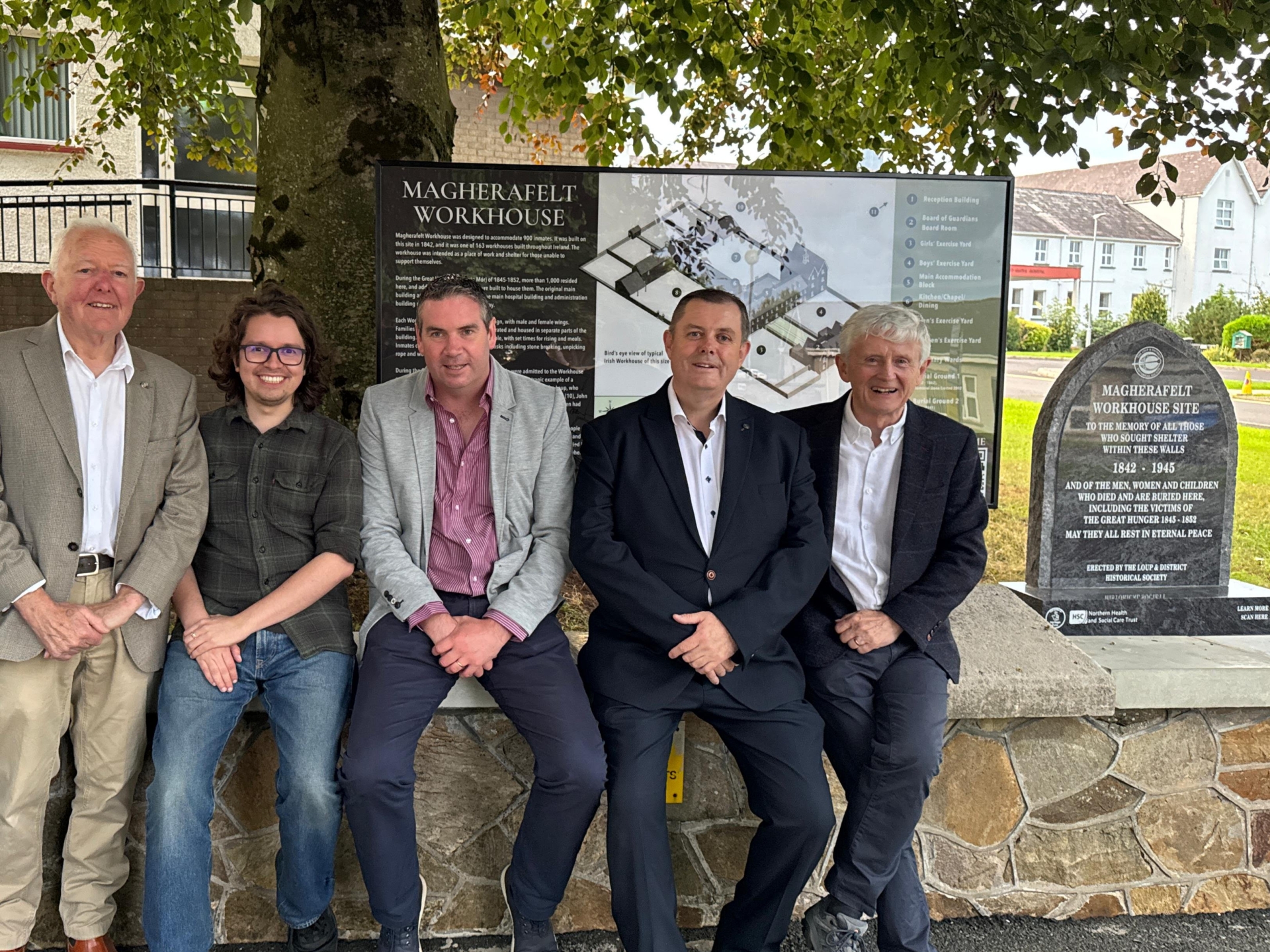
ABOVE: (Left to right) John Conway (Researcher), Patrick McNicholl (Designer), Dr Ciaran Reilly (Historian Maynooth University), Jody Wilson (Researcher), Seamus O'Brien (Researcher). Photography: John O’Neill
Speaking at the memorial event, Chairman of the The Loup The Loup & District Historical Society, Jody Wilson spoke about the project.
“This is a very important night for local history,” Jody said. “We are experiencing a very dark period in the area where people who were desperate, hungry, homeless and with no means of income, long before there was a social benefits system, decided they had no option but to come to the workhouse. It was a place for them to seek shelter, nourishment, and help.
“When you entered the workhouse your family was separated. There was a very strict regimen and miserable diet. It really was desperation.
“This project all began two years ago when we did a history walk around Magherafelt.
“We ended up here at the hospital beside the workhouse. We felt it was worth making what happened here.
“There has been a huge amount of work put in to make this happen. We now have a memorial stone, new signage and a fantastic website.
“I would like to thank the public for attending the event tonight. The site is owned by the Northern Health and Social Care trust and they have been fantastic.
“Paddy Graffin the Director of Infrastructure, ·The Northern Trust has been fantastic from the moment we met him. Everything we asked for was provided without hesitation.
“The society can’t thank them enough, they knew how important it was to mark the site. Also to Dr Jim McGreevey from The National Lottery and Heritage Fund. As you know funding is tight, it is difficult to get.
“The National Lottery and Heritage Fund gave us the funds to complete the project and gave us a bit of time to research. We are forever grateful to them for that.
"A lot of the work was done by the local history society but we didn’t have the expertise to complete it.
“We decided we needed some professional support so we chose to work with Historian Dr Ciarán Reilly from Maynooth University. He has been fantastic at providing research, coming to Belfast to research with us, a real guiding light. He has a great deal of knowledge on the social history of Ireland.
“We are a cross community historical society and we invited everyone along to the event. It is great to see a turnout from all sections of the community. I want to thank the Chairperson of Mid Ulster District Council Frances Burton and Vice Chairperson Denise Johnston for attending. Thank you also to our local councillors and MLAs.”
Offering thanks to The Loup & District Historical Society Dr Jim McGreevey from The National Lottery and Heritage Fund said:
“I am grateful to the society but it is us that need to thank you.
“Essentially what The National Lottery and Heritage Fund does is recycle money that comes from lottery players. It can only respond to great ideas, this is what I call a great idea. There are a number of things that The National Lottery and Heritage Fund seeks to support.
“Top of the list is heritage and participation in communities, sustainability and leaving a legacy. What a legacy this project is actually leaving for many years to come. This stone is a great legacy of the project but also the history the project seeks to tell.
“I’m not a historian but I think of history in a simplistic way. I think of it as a net, usually a net with a wide mesh. That means that most people fall through that mesh and their history and stories aren’t told.
“We are used to hearing about the big stories, events and people but the little people don't often feature.
“This is very much about people who have been forgotten. Who stories haven’t been told.
“As we all know poverty and plight don’t discriminate. I think that is what this project reminds us of.
“It is telling a story that has not been told before. In my opinion and the opinion of the fund that is an extremely honorable thing to do.
“Many congratulations to society and everyone that has been involved in bringing this project to fruition.”
Paddy Graffin from The Director of Infrastructure, ·The Northern Trust who also worked with the society on the project said: “Over the past two years the society has worked tirelessly on this project of the Magherafelt workhouse. A place that served as a last resort for the most vulnerable.
“Today’s unveiling of this memorial stone and information board marks more than just historical recognition. It is an act of remembrance for those who were forgotten.
“I commend the society for their precision and their commitment to bringing this project to life. This not only honours those who have suffered but reminds us of the collective value of care for the most vulnerable in our society.
“I would like to pay thanks to our past and current estates services department including Mark Marrow who was instrumental in this project.
“The department has always maintained the workhouse building to a high standard sometimes in very challenging financial times.”
Patrick McNicholl, a young member of the society, was ‘instrumental’ in the development of the new workhouse website.
Secretary of the society Seamus O’Brien praised Patrick saying “This young man is a computer specialist, graphic designer who was a key member of the team. We are honoured and delighted to have him as part of the society. He is so valuable and has so many talents.”
Speaking at the event about the website and the workhouse Patrick said: “This project when it was started two years ago a good friend of mine and former chairman of the society Sean Corey was a driving force and it’s sad that he isn’t here to see the culmination of this project. I think he would be very proud.
“The Famine and workhouses are a horrible part of our history but it is important to document. It is the reality that this is happening currently in the world, such as the scenes in Gaza. There is starvation happening at this moment. So it’s important that we keep in mind and remember what happened here on our doorstep.
“There is a QR code on the information board and the memorial stone. That will bring people directly to the website where they can delve deep into the details of those who passed the doors here. I encourage everyone when they can to get a look at the research there when you can.”
Dr Ciarán Reilly from Maynooth University reflected on the project, the impact of the Famine in the local area: “It is wonderful to be here and see such a crowd. It is a testament to the work the society has done but also the community and how you respect the past and honour buildings like this.
“Two years ago I gave a talk here on Magherafelt workhouse and what it meant for the people of the locality. I left with enthusiasm for what they were doing. Great credit is to be given to the team here.
“It started with the idea of marking the spot with some information, it led on to the memorial stone and now the website which is packed with information. I want to pay tribute to those who have worked on aspects of the past and the history of Magherafelt workhouse.
“There is a great interest in the workhouse within the past couple of years in the North of Ireland, that is to be commended. It is important to see as this is a shared history.
“As we delved into records in Belfast a few weeks ago we could see that to be true. Today marks the 187th anniversary of the passing of the Irish Poor Law Act. On 31 July 1838 the British Government passed the act which gave way for the creation of the workhouse system.
“That came on the foot of a poor law inquiry which was conducted between 1834-1846 in Ireland to try and ascertain what was the problem with poverty in Ireland. Not just in Magherafelt or South Derry but right across the country.
“There was 3,000 pages worth of information gathered. One of the things they suggested to remedy the problem of poverty was the creation of workhouses.
“Between 1838-1945, 130 workhouses were built in Ireland; further 33 were added during and after the Great Famine.
“The buildings were grey with very little comfort inside in order to deter people from actually seeking refuge. People came here as a last resort.
“The workhouse was opened here in March 1842. There was a great need for a workhouse in Magherafelt. It covers around 25 townlands. Records show that people from all over came here. They are described as being ‘dirty, famished and naked’.
“From 1843 those people sought sanctuary here before the Famine even commenced. In a few years the building was overrun and rampant with disease. 500 people here in 1847.
“Without the workhouse the mortality rates during the famine would’ve been a lot higher. It is significant that we are here on a day when that legislation went through to pave the way for the workhouse.”
Before visiting the Famine graveyard for prayer and reflection a lament was played on violin by Aileen McCourt.
At the graveside of those who perished during the Famine, Parish Priest for Magherafelt Father Gates led final prayers.
Speaking to the County Derry Post. Vice Chairperson of Mid Ulster District Council Denise Johnston shared her thoughts on the event saying: “I was delighted to be able to attend this event. As a history teacher this is something very important to me. I think this will be a great education for the pupils in the Magherafelt area.
“They will have the memorial stone, the information board, the actual site and most importantly the accessible qr code to the new website. That will be very useful to them as young people learning about the Famine.
“It is really important that they do learn it and understand it. It is very relative today when you think about what is going on in Gaza and Sudan.
“It is very important that we mark this site with the memorial stone. This is part of our shared history. Catholic, Protestant, Dissenter were all affected.
“You can’t help but think about the anguish they must have felt when they found themselves at the door to the workhouse, because they knew if they went in there was a chance they may not come out.
“They had to leave their lives behind them. So it’s important to remember.”
To find out more about the project you can visit magherafeltworkhouse.com

Subscribe or register today to discover more from DonegalLive.ie
Buy the e-paper of the Donegal Democrat, Donegal People's Press, Donegal Post and Inish Times here for instant access to Donegal's premier news titles.
Keep up with the latest news from Donegal with our daily newsletter featuring the most important stories of the day delivered to your inbox every evening at 5pm.

This publication supports the work of the Press Council of Ireland and Office of the Press Ombudsman, and our staff operate within the Code of Practice of the Press Council. You can obtain a copy of the Code, or contact the Council, at www.presscouncil.ie, Lo-call 1800 208 080 or email: info@presscouncil.ie.