Search


29 Dec 2025
Search
29 Dec 2025

Please allow ads as they help fund our trusted local news content.
Kindly add us to your ad blocker whitelist.
If you want further access to Ireland's best local journalism, consider contributing and/or subscribing to our free daily Newsletter .
Support our mission and join our community now.
To continue reading this article, you can subscribe for as little as €0.50 per week which will also give you access to all of our premium content and archived articles!
Alternatively, you can pay €0.50 per article, capped at €1 per day.
Thank you for supporting Ireland's best local journalism!

Laurence Lenty Gallagher. Laurence was born on Arranmore Island in 1945 and is a fluent Irish speaker

Donegal has a long history of emigration dating back to the Great Famine. While the famine devastated the entire island, Donegal was among the worst-affected areas.
Poverty, limited agricultural prospects, and geographic isolation pushed thousands of young men to seek work overseas. Many entered heavy construction and mining trades. Among them were the men later known as the Donegal Tunnel Tigers, a group of highly skilled underground workers whose reputation spread across Britain, mainland Europe, Asia, Africa, and North America.
READ NEXT: Six years in the Shetlands: A Donegal man's North Sea Oil story
From the mid-nineteenth century to the present day, Donegal tunnellers contributed to major underground works, including railway tunnels, hydroelectric schemes in Scotland, early London Underground extensions, and later civil engineering projects such as the Channel Tunnel and HS2. Their skill and endurance became well known among contractors. Tunnel work paid far more than general construction but exposed workers to extreme danger and high mortality rates.
Meeting Laurence Lenty Gallagher
This account focuses on one of the most experienced and respected Donegal Tunnel Tigers, Laurence Lenty Gallagher. Laurence was born on Arranmore Island in 1945 and is a fluent Irish speaker.
At 16, he emigrated to Scotland to join the Scottish Hydro Electric tunnelling workforce. These schemes brought power to remote Highland regions and relied heavily on Donegal's skilled labour.
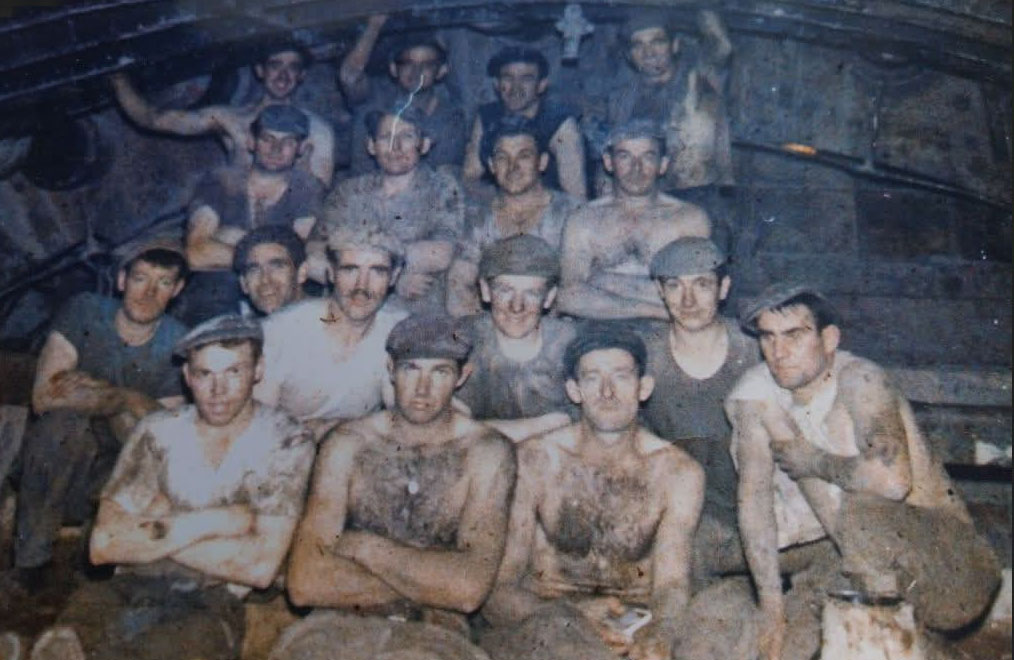
Donegal Tunnel Tigers during excavation works on the Clyde Tunnel, 1960. The image captures a full crew immediately after a shift, covered in clay, rock dust, and gelignite residue, reflecting the physical intensity and hazardous conditions of mid twentieth century tunnelling
When Laurence entered the industry in the early 1960s, tunnelling was still dominated by difficult and dangerous manual drill and blast. Donegal crews advanced headings with pneumatic drills, drill steels, and gelignite explosives. Laurence recalls long hours drilling shot holes, placing charges, and excavating clay and rock. On one job, a blast designed to open a ventilation connection detonated without warning on the receiving side. Most men had gone for a tea break. One man who remained was buried by debris but survived.
The Early Tunnelling Era
Although Laurence did not work in the nineteenth century, he appreciates the history of his trade. Earlier generations laboured under conditions that would now be deemed inhumane.
From around 1840 until well into the twentieth century tunnelling relied on hand drilling, black powder explosives, and almost no regard for health and safety. There was little ventilation, no dust suppression, and no Personal Protective Equipment. Workers were exposed to extreme dust, vibration, fumes, moisture, shrapnel, and asbestos. Many were killed instantly by tunnel collapses or premature explosions while others suffered long-term lung disease and other disabling injuries. Laurence explained that sadly, during his lifetime, he lost around sixty work colleagues, most of whom were close friends.
Legislative protection for workers was extremely limited until the mid-twentieth century. The Health and Safety at Work Act, introduced in Britain in 1974, marked the first comprehensive regulation of workplace safety. Laurence entered the industry shortly before these changes and witnessed the transition from minimal protection to structured risk management and best practices.
Compressed Air Tunnelling
Some early tunnels used compressed air to stabilise soft ground or prevent water ingress. Workers entered pressurised chambers where internal air pressure resisted groundwater forces. Pressures of two to four atmospheres were common. Although compressed air provided temporary stability, it exposed workers to serious medical risks. At the end of a shift, workers were required to pass through decompression chambers to return safely to normal pressure. This was frequently ignored. Sudden decompression caused nitrogen bubbles to form in the bloodstream, producing decompression sickness. Many workers suffered severe joint pain, paralysis, or permanent neurological damage. Some died immediately and others suffered delayed complications.
By the time Laurence entered the trade, compressed air was declining due to advances in drilling, ground stabilisation, and boring equipment. However, he was familiar with the dangers and the accounts of men permanently injured in earlier compressed air tunnelling works.
Ground Investigation and Geological Knowledge
Modern tunnelling projects rely on extensive ground investigation before boring begins. Boreholes, laboratory testing, geophysical surveys, groundwater modelling, and geological analysis are now standard. The Channel Tunnel project, for example, carried out around two hundred boreholes between England and France to understand the chalk marl formation and groundwater behaviour.
This level of investigation did not exist on most early twentieth century tunnels. When Laurence entered the industry in the early 1960s investigation practices were improving but still limited. Many tunnels relied on few boreholes and on the judgement of the tunnellers who encountered the ground directly. The Donegal Tigers developed an instinctive understanding of ground behaviour. By observing drilling speed, hardness, and fracture patterns they estimated the correct quantity of explosives. Misjudgement sometimes caused overbreak, collapses, or incomplete blasts. Flying shrapnel and misfires caused many serious injuries. The work demanded constant awareness and rapid decision making.
London Victoria Line, 1966 to 1972
After gaining experience in Scotland, Laurence moved to London to work on the Victoria Line extension. The method used was shield driven tunnelling. Workers excavated London clay from within a circular steel shield. Excavation was carried out using F22 air spades with interchangeable tips for clay and harder material. As the shield advanced, crews assembled cast iron lining rings. These rings remain visible from train windows today. The work was physically demanding and carried out in confined spaces. Laurence recalls the discipline and coordination required to maintain production and safety.
The Channel Tunnel: 1987-1994, Donegal Grit and Thatcher’s Salute
Laurence later worked on the Channel Tunnel, widely regarded by engineering institutions as one of the most significant civil engineering achievements of the twentieth century. For Laurence, it was the first project where he encountered a fully structured safety culture. Procedures were enforced, equipment was modern, and supervision was professional. Despite these advancements, twelve workers lost their lives during construction.
Excavation was carried out using large tunnel boring machines, each approximately eight metres in diameter and sixty metres in length. Built in Seattle and transported to Dover, each machine cost around £100 million. The works were preceded by extensive ground investigation. Although the route followed stable chalk marl, ground behaviour can never be predicted with complete certainty. At one stage, unexpected groundwater ingress caused concern among geologists, engineers, and workers. Initial fears that seawater was entering the tunnel led some men to stay away from the next shift for fear of encountering the uncontrollable flow of the English Channel. Subsequent testing confirmed the water was natural groundwater, and the area was stabilised using pressure grouting.
One year into production, in 1988, Prime Minister Margaret Thatcher visited the Channel Tunnel construction site, where she met members of the Donegal Tunnel Tigers. 'She asked one of them, "How far are you going boys?"' he remembered. 'He told her, "All the way," and she smiled and said, "That’s what I like to hear."' This anecdote endures among the men who built the tunnel as a moment of pride and recognition. The project was successfully completed in 1994.
The Price and Pride of a Tunnelling Tradition
Laurence Gallagher’s career reflects both the achievement and the cost of a century of Donegal tunnelling. Over his working life, he lost sixty colleagues, 12 of whom were neighbours from Arranmore Island. One of the most devastating incidents occurred in January 1986 when three close friends were killed after entering a Scottish shaft where undetected gas ignited on the first day back after the Christmas break.
The tunnelling tradition continued into the next generation. His son, Laurence Junior, joined the industry and works today on the HS2 project in London. Their shared experience represents the continuity of a Donegal skill set that has spanned more than 150 years.
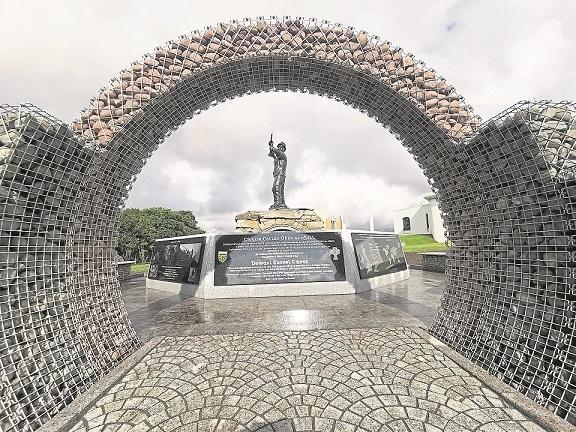
A permanent memorial now stands in Dungloe, County Donegal, honouring the men who died instantly underground and those who later died from long term occupational illness and injury.
Between 1840 and 1980 tunnelling relied largely on manual drill and blast. Modern tunnelling is dominated by computer-controlled mechanical systems and rigorous health and safety standards, marking a transformation built on the sacrifices of earlier Donegal Tunnel Tigers.
Eamonn Coyle is a Chartered Engineer and Chartered Environmentalist

Subscribe or register today to discover more from DonegalLive.ie
Buy the e-paper of the Donegal Democrat, Donegal People's Press, Donegal Post and Inish Times here for instant access to Donegal's premier news titles.
Keep up with the latest news from Donegal with our daily newsletter featuring the most important stories of the day delivered to your inbox every evening at 5pm.

This publication supports the work of the Press Council of Ireland and Office of the Press Ombudsman, and our staff operate within the Code of Practice of the Press Council. You can obtain a copy of the Code, or contact the Council, at www.presscouncil.ie, Lo-call 1800 208 080 or email: info@presscouncil.ie.