
The man was sentenced at the Central Criminal Court in Dublin
Search


21 Apr 2026

Please allow ads as they help fund our trusted local news content.
Kindly add us to your ad blocker whitelist.
If you want further access to Ireland's best local journalism, consider contributing and/or subscribing to our free daily Newsletter .
Support our mission and join our community now.
To continue reading this article, you can subscribe for as little as €0.50 per week which will also give you access to all of our premium content and archived articles!
Alternatively, you can pay €0.50 per article, capped at €1 per day.
Thank you for supporting Ireland's best local journalism!


Large areas of the UK look set to be hit by cold weather over the next few days as Arctic air blasts parts of the country.
The Met Office has already issued a yellow warning for snow and rain in parts of England and Wales, running through Wednesday and into Thursday. But how can you stay safe when driving in snow and cold conditions, and how can you prepare? Let’s take a look.
If the conditions look bad outside, then the safest thing you can do is stay at home. One of the easiest ways to avoid a potential accident is to postpone your trip if it isn’t a necessity.
⚠️ Yellow weather warning issued ⚠️
Snow across parts of Wales and central England
Wednesday 1600 – Thursday 0600
Latest info 👉 https://t.co/QwDLMfRBfs
Stay #WeatherAware⚠️ pic.twitter.com/LHNfg2iPdj
— Met Office (@metoffice) February 17, 2026
It’s not worth pushing beyond your own comfort levels when driving in poor conditions. In doing so, you may be increasing the chance of an incident. So if you’re not happy, then stay put.

However, if you do need to drive when it’s bad outside, you should slow things down. Reduce your speed and give yourself more time to react to road conditions, while increasing the distance between yourself and the car in front.
In doing so, you’ll give yourself a lot more time to respond if something should happen ahead. Ice patches aren’t always visible, too, so while the road ahead might look clear, there could be slippery conditions underneath. Lower your speed to give yourself a better chance of dealing with a slide or skid.
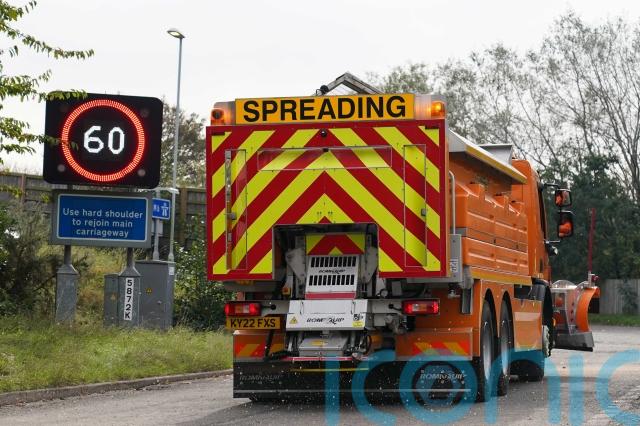
Planning ahead can make a big difference when the weather is bad outside. For instance, stick to major roads or motorways – these are the most likely to be fully gritted when the temperatures dip – as minor roads are harder for gritter services to access. Small lanes and routes are also more prone to flooding.
It could be worth checking for traffic or slowdowns on your route before you set off. If there has been a crash ahead, then it could quickly add a lot of time to your journey, so check a mapping service like Google Maps or Waze before you start to help avoid this.
You can’t tell the future when it comes to driving, so packing for an unplanned breakdown can pay dividends later on. While there’s no need to go mad and pack everything, we’d recommend bringing some extra clothing, a blanket and perhaps some snacks to keep you going should you need to stop for a long period.
A fully charged power bank would also be a great addition to this pack, as it’ll ensure that you’re always able to keep your mobile topped up. Don’t rely on your car’s battery to keep your phone charged – if you’re stopped and the engine isn’t running, then doing this could quickly leave your car flat.
Driving in poor conditions takes extra concentration and this can be quite wearing, particularly if you’re travelling over a long distance. It’s for this reason that we’d recommend factoring in a stop to have a break, have a snack and a drink before commencing the rest of your journey.
Driving when tired is dangerous – even during good conditions – and being fatigued when you’re behind the wheel in cold weather could increase the chance of a collision or other incident.

Subscribe or register today to discover more from DonegalLive.ie
Buy the e-paper of the Donegal Democrat, Donegal People's Press, Donegal Post and Inish Times here for instant access to Donegal's premier news titles.
Keep up with the latest news from Donegal with our daily newsletter featuring the most important stories of the day delivered to your inbox every evening at 5pm.

This publication supports the work of the Press Council of Ireland and Office of the Press Ombudsman, and our staff operate within the Code of Practice of the Press Council. You can obtain a copy of the Code, or contact the Council, at www.presscouncil.ie, Lo-call 1800 208 080 or email: info@presscouncil.ie.