A photo of Scarlett Faulkner surrounded by candles in a church I PICTURE: Facebook
Search


02 Apr 2026

Please allow ads as they help fund our trusted local news content.
Kindly add us to your ad blocker whitelist.
If you want further access to Ireland's best local journalism, consider contributing and/or subscribing to our free daily Newsletter .
Support our mission and join our community now.
To continue reading this article, you can subscribe for as little as €0.50 per week which will also give you access to all of our premium content and archived articles!
Alternatively, you can pay €0.50 per article, capped at €1 per day.
Thank you for supporting Ireland's best local journalism!


The longer, brighter days may have encouraged you out of winter hibernation, and provided the much-need push to head back onto the trails and pavements for some refreshing springtime runs.
As well as the welcomed blue skies and mild weather, the upcoming London Marathon (April 26) will also undoubtedly inspire many of us to lace up our running shoes and get moving.
While the thought of posing with a shiny finisher’s medal might be enough to tempt you to enter next year’s ballot, have you ever thought about what actually happens to the body during a marathon?
We spoke to Francesca Bagshaw, a performance physiologist at Nuffield Health MIHP, to find out…
Increase in breathing rate and heart rate

Both our breathing and heart rate pick up in pace significantly during a run, and Bagshaw explains that this is because the muscles demand greater oxygen delivery and nutrients when we exercise, especially during a marathon.
“For us to make and produce enough energy to run and exercise, our muscles require more oxygen,” she explains. “Therefore, during a marathon we tend to naturally breathe more to get more air into the lungs, and then the heart will beat more to transport that oxygen from the lungs into the muscles, so it can be used to make energy for us to keep running.”
Alongside this, runners will also experience a significant increase in stroke volume.
“The volume of blood that leaves the heart per beat will also increase to help us meet the demands of running,” says Bagshaw.
Some marathon runners will also experience a ‘cardiac drift’.
“A cardiac drift is when your heart rate increases disproportionately, usually by five to 20 beats per minute, during exercise,” says Bagshaw. “This is usually a sign that you are dehydrated and are getting too hot, which puts your cardiovascular system under greater strain. You might feel like your heart rate in your chest is running faster compared to the effort that you’re putting out.”
Micro-tears in the muscles

Training and running a marathon engages a lot of muscles in the body.
“Running heavily engages your lower muscles – especially your hamstrings, calves and quadriceps – but then also engages your abdominal muscles to help keep you running in a straight line and your arms to help drive you forward,” says the performance physiologist.
She explains how these repetitive movements and demand on the body will often lead to micro-tears in the muscle.
“These little micro-tears that we get during training will stimulate inflammation and various other responses around the muscle that adapt so the next time you go out and run, the muscle will be stronger and will be able to cope with the load and the intensity that you put on those muscles,” says Bagshaw.
“What can happen during a marathon is that you can sustain micro-tears and then get something called ‘delayed onset muscle soreness’ in the 24-72 hours after a marathon, where the muscles become really sore. To overcome that, do some light walking to keep the blood flowing to the muscles.”
Increase in sweat due to thermal regulation

“As you start to exercise, a massive majority of the energy you’re producing is not actually going into the energy to run – it’s being produced as heat, and that heat from the muscles drives up your core body temperature, which is usually around 36 to 37 degrees,” explains Bagshaw.
“As you get warmer, that triggers your body to want to cool itself down and get back down to its normal temperature by redirecting your blood flow to the skin.
“When you’ve got more blood going to the skin, it heats up the temperature of your skin and the sweat glands will release sweat as you get warmer that will come down the skin, and will evaporate away to try and cool your core body temperature.”
She notes that as a result, there is an increased fluid and electrolyte loss which can lead to dehydration if not properly managed.
Increase in metabolism
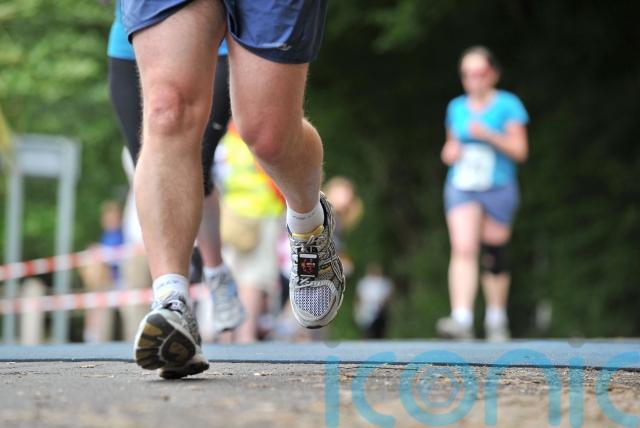
“During a marathon, your metabolism – which means how we burn either glycogen or fats as a fuel – increases,” says the performance physiologist. “In the early miles, glycogen is the dominant fuel source for most runners due to its rapid ATP (energy) turnover and efficient oxidation (burn) rate. This enables a runner to sustain pace with little metabolic delay.”
However, she highlights how the glycogen stores will start to decline mid-race and if not sufficiently replaced with fuelling, the body will switch towards fat oxidation and using fats as a fuel.
“Although energy rich, it produces energy and ATP slowly, increasing perceived effort (i.e. heavy legs) at the same pace, or may even result in slowing down pace,” says Bagshaw.
Towards the back end of the race, runners can run out of energy.
“For most recreational marathon runners, their primary fuel source during the marathon is glycogen stored in the muscles and liver. However, these stores are finite,” notes Bagshaw. “As the race duration increases, these stores are depleted and if not sufficiently replaced, a phenomenon known as ‘hitting the wall’ is experienced around mile 18-20 or 28-35km. ‘Hitting the wall’ will often result in the earlier onset of fatigue and ultimately a drop in pacing and performance.”

Subscribe or register today to discover more from DonegalLive.ie
Buy the e-paper of the Donegal Democrat, Donegal People's Press, Donegal Post and Inish Times here for instant access to Donegal's premier news titles.
Keep up with the latest news from Donegal with our daily newsletter featuring the most important stories of the day delivered to your inbox every evening at 5pm.

This publication supports the work of the Press Council of Ireland and Office of the Press Ombudsman, and our staff operate within the Code of Practice of the Press Council. You can obtain a copy of the Code, or contact the Council, at www.presscouncil.ie, Lo-call 1800 208 080 or email: info@presscouncil.ie.