Search


21 Apr 2026
Search
21 Apr 2026

Please allow ads as they help fund our trusted local news content.
Kindly add us to your ad blocker whitelist.
If you want further access to Ireland's best local journalism, consider contributing and/or subscribing to our free daily Newsletter .
Support our mission and join our community now.
To continue reading this article, you can subscribe for as little as €0.50 per week which will also give you access to all of our premium content and archived articles!
Alternatively, you can pay €0.50 per article, capped at €1 per day.
Thank you for supporting Ireland's best local journalism!


A London-based eye surgeon who has performed thousands of eye surgeries found himself on the operating table after noticing a blind spot in his right eye that could have left him with permanent vision loss.
Amir Hamid, 51, has performed more than 10,000 cataract and laser refractive surgeries in his career, but unexpectedly found himself in the patient chair last year.
“At the end of July, I noticed that there was a blank patch in the field of vision in my right eye and immediately realised that it could be the start of a detached retina,” Amir told PA Real Life.
A detached retina is when the thin layer at the back of your eye (retina) becomes loose, and it needs to be treated quickly to stop it permanently affecting your sight, according to the NHS website.
“I very quickly went down to the hospital to get my eyes tested and scanned and also spoke to one of the retinal surgeons that I know very well,” recollected Amir, who is chief medical officer for eye hospital group Optegra.
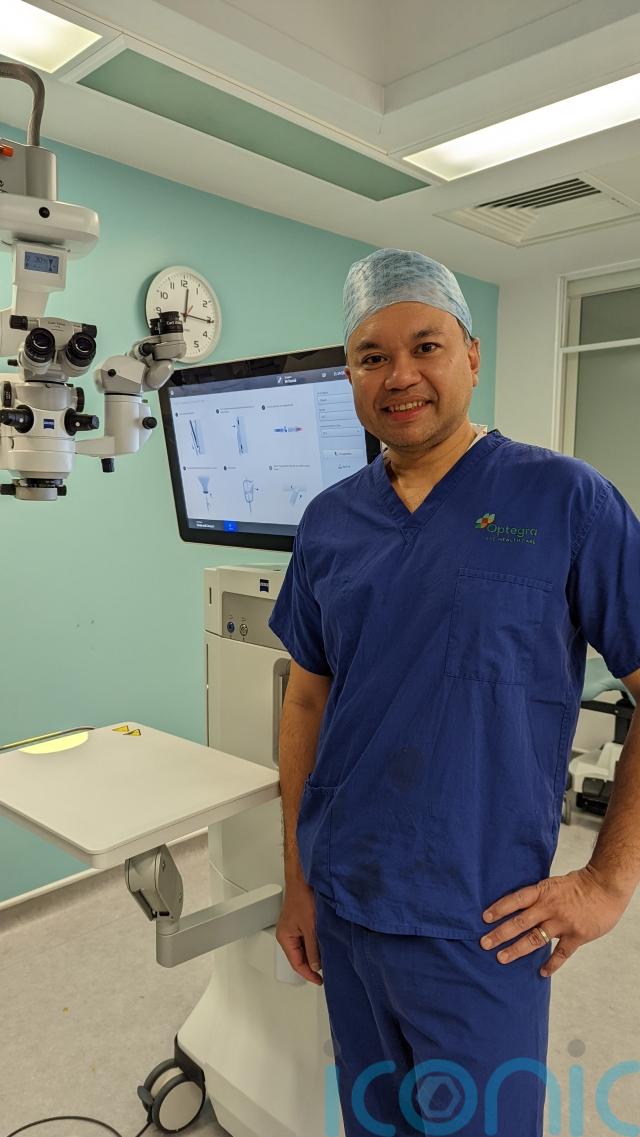
“I am very short-sighted, and a detached retina can be common in myopic eyes. We tend to have very big eyes, and the retina at the back of the eye is thinner at certain points. This means the vitreous solution – the fluid inside the eye – can detach more easily and pull on the retina. It can pull on the weak part of retina which may then tear and detach.”
Luckily, the ophthalmic surgeon’s quick instincts meant he was able to get vitreo-retinal treatment that very day.
“Within three hours I was scheduled for surgery on my right eye, and only then did I tell my wife I’m going to have an operation in a few hours,” said Amir.
“As an eye surgeon, it could have been a very stressful and frightening time, but I know some very good surgeons and I trusted the process.
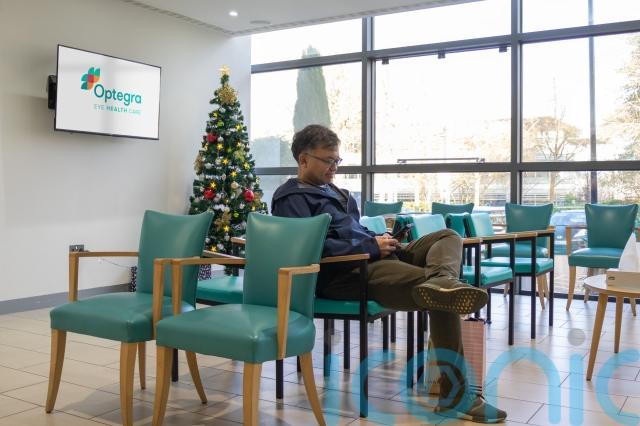
“I was very lucky as it was an inferior tear, which means it was very slow moving and did not affect my central vision. I had the treatment done in time to preserve all my sight and after a couple of weeks’ recovery I could go back to work with no issues at all.”
Amir said that one potential side effect of this treatment is the onset of a cataract, which typically occurs after several years. In his case, however, this happened within a few months.
“In November, I started noticing my right eye distance vision was changing and was not as good as it was before, but my near vision was getting much, much better, which is something we call a myopic shift,” said Amir. “That is when I realised it must be a cataract.
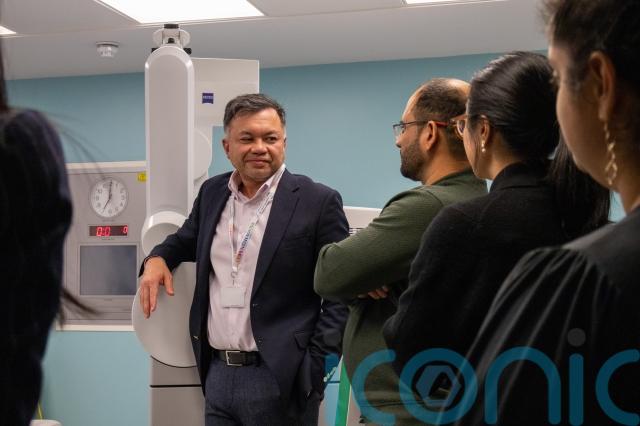
As an eye surgeon, Amir’s surgeries demand precision and excellent vision, so he was keen not to waste any time and to get it sorted.
“I only work in a two millimetres by 10 millimetres space when I do my surgeries, so I need to be able to see well and react well in that small space,” said Amir. “So I couldn’t wait for my vision to be impaired before I did something about it.”
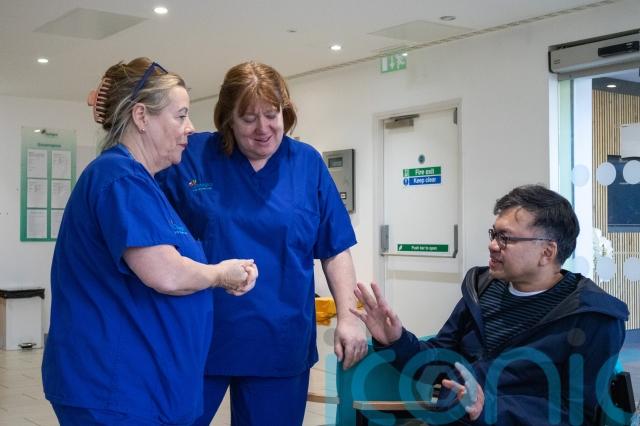
Amir quickly booked in to have cataract surgery on his affected right eye, which was carried out on December 19, just before Christmas, at the Optegra Hospital in Hampshire. The procedure was performed by his trusted colleague Alastair Stuart, a medical director at Optegra.
Together they decided not only to operate on the problematic right eye but to also take the opportunity to eliminate Amir’s need for glasses by performing lens replacement surgery on his left eye at the same time.
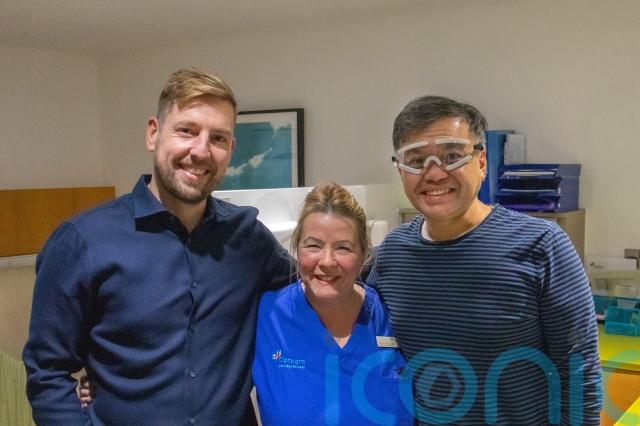
“Within 20 minutes, I was out of the theatre having had both eyes done,” said Amir.
“It was interesting being on the other side. I was not nervous going into it, but the heart rate monitor which was attached to my fingers was going off very quickly during the procedure! But I was told that I was a good patient, and it went very smoothly and it was completely pain free.”
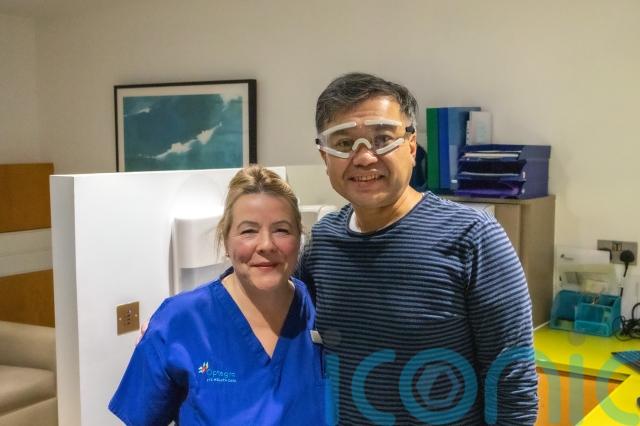
After spending more than four decades wearing glasses, Amir was amazed by the results.
“I was immediately like: Wow, this is crazy,” said Amir. “The next day my eyesight got even better in terms of my distance vision. I couldn’t believe how crisp, how sharp and how colourful things were.
“I tell my patients all the time that they will have great results, but when it happens to you it really validates the things that you’ve been saying. Seeing is believing.
“I couldn’t really describe the joy that I felt. It was great to be able to have an experience that I’m able to impart to my patients. It was a real full-circle moment.”
After his own positive experience, Amir is urging anyone with a cataract to just book the surgery and emphasised how life-changing it can be.
“With a cataract, you’ll start to notice your vision getting blurred for different distances and it’s important to get a diagnosis, because cataracts are completely reversible,” said Amir.
“Cataract surgery is one of the best procedures that has ever been created because it can actually make your vision better than it was before.”
In addition to the clear professional advantages of his post-surgery improved vision, the father-of-two added that his newly sharpened eyesight has also had benefits at home.
“It has been great to be able to just play around with my daughter, who likes to jump on me, without having to worry about my glasses breaking,” said Amir, who has a 16-year-old son and a seven-year-old daughter.
Furthermore, clearer sight has helped sharpen up his skills in the kitchen.

“I cook most of the time for the family and I am also part of this Facebook group where we cook and present our dishes to each other,” shared Amir.
“I really enjoy plating my food so that it looks its absolute best and the standard on the online group is pretty high, in fact two guys in the group have gone on MasterChef. It’s so much fun, and so precise, and having brilliant vision is vital.”

The eye surgeon wanted to share his story to highlight the importance of flagging up any unusual symptoms with an eye care professional.
“You certainly shouldn’t ignore the symptoms of retinal detachment, because it can lead to loss of vision, and if it’s left too late, it may be difficult to recover that vision,” said Amir.
“Key symptoms to look out for are flashing lights and floaters in your field of vision. You may also get a black curtain coming into your field vision which can come from the bottom, top or from the side.”
Amir has also noticed an increase in patients with advanced cataracts since the pandemic, so has urged everyone to get their eyes tested regularly.
“Sometimes people are scared and try and deny that they have a problem and then wait until it’s too late,” said Amir.
“Remember that it’s always better to have a diagnosis, because then we know what it is and how we can fix it.
“The older population in particular are often more accepting of certain changes or compromises in their lifestyle and health, but that shouldn’t be the case because things can be done.”

Subscribe or register today to discover more from DonegalLive.ie
Buy the e-paper of the Donegal Democrat, Donegal People's Press, Donegal Post and Inish Times here for instant access to Donegal's premier news titles.
Keep up with the latest news from Donegal with our daily newsletter featuring the most important stories of the day delivered to your inbox every evening at 5pm.

This publication supports the work of the Press Council of Ireland and Office of the Press Ombudsman, and our staff operate within the Code of Practice of the Press Council. You can obtain a copy of the Code, or contact the Council, at www.presscouncil.ie, Lo-call 1800 208 080 or email: info@presscouncil.ie.