Search


08 Mar 2026
Search
08 Mar 2026

Please allow ads as they help fund our trusted local news content.
Kindly add us to your ad blocker whitelist.
If you want further access to Ireland's best local journalism, consider contributing and/or subscribing to our free daily Newsletter .
Support our mission and join our community now.
To continue reading this article, you can subscribe for as little as €0.50 per week which will also give you access to all of our premium content and archived articles!
Alternatively, you can pay €0.50 per article, capped at €1 per day.
Thank you for supporting Ireland's best local journalism!


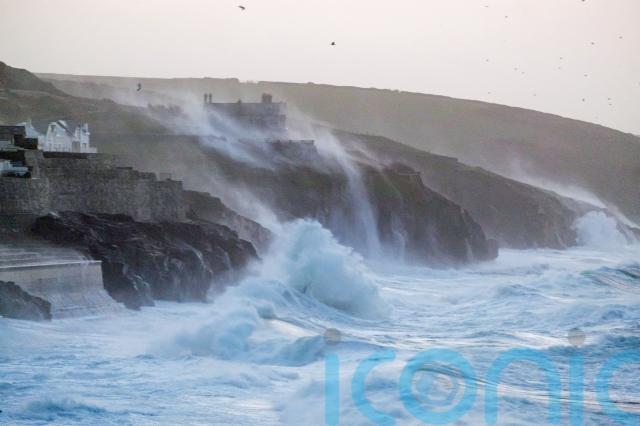
It might seem like we’ve only just had Storm Dudley – but now the next, and potentially more damaging, storm is here.
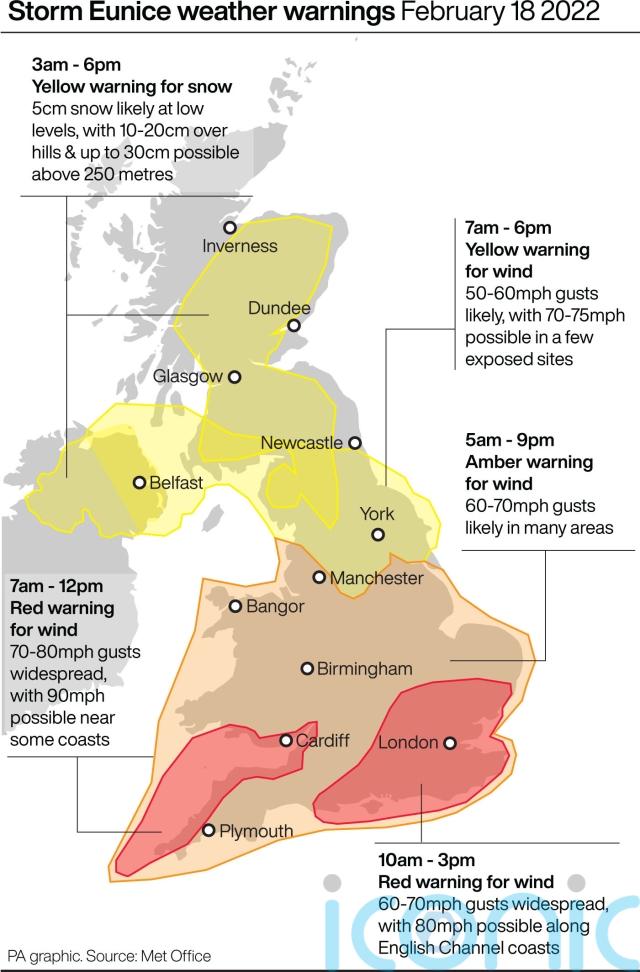
Storm Eunice is set to deliver “dangerous conditions”, with two rare red weather warnings in place for much of the south of England and part of Wales.
⚠️⚠️🔴 Another Red Weather Warning Issued 🔴⚠️⚠️
Another Red Weather Warning has been issued for much of the south and southeast for #StormEunice.
Latest info 👉 https://t.co/QwDLMfRBfs
Advice 👉 https://t.co/JFRa8CtfWY
Stay #WeatherAware⚠️ pic.twitter.com/yXcegW7Mh5
— Met Office (@metoffice) February 18, 2022
The Met Office said the storm could cause “significant disruption and dangerous conditions due to extremely strong winds” up to 90mph.
If you live in a high-risk area, you might be thinking about how you can protect your property – and yourself. Winds and flooding can both potentially cause damage, along with the risk of flying debris.
Remember, it’s always a case of safety first – so certainly don’t venture outdoors to do anything that’s best left until the winds have calmed down.
With high winds predicted, it’s important to look around your property and secure anything that might get lifted and blown away. Items caught in high winds can pose the risk of striking people or cars, causing serious danger.
The Met Office says: “When high winds are forecast, remember that some everyday items in the garden can become ‘missiles’. Most winters we see pictures of airborne trampolines and garden furniture.”
Remove the netting from trampolines and try to secure or safely weight items down – this could be by putting sandbags over the legs of trampolines or furniture, or securing them with rope to solid trees. Watch out for anything else that’s loose – such as gardening tools or light ornaments – and make sure they’re placed safely inside.
Before the storm hits, the Met Office also recommends you: “Close and securely fasten doors and windows, particularly those on the windward side of the house, and especially large doors such as those on garages.”

Flooding might follow heavy rain, and water can cause irreparable damage to your home and valuables. If this is a key concern in the area you live, there might be a few things to think about.
“You can move items that cannot be replaced – such as photograph albums – to safe places on upper floors,” says Ian Paton, partner in building consultancy at Cluttons (cluttons.com). Other items to consider relocating include “cars, pets, furniture, electrical equipment and treasured possessions”.
If you don’t have an upper floor, consider moving things like important documents to higher storage spaces, rather than keeping them in drawers close to ground level.
Suzy Tiffany, home claims director at More Than (morethan.com), says: “If you spot any problems immediately before a storm, try and find an expert to get them fixed as soon as possible. But if no experts are available at short notice, try and move any treasured items away from that area of the house, just in case.”
If there’s a chance you may need to evacuate your home in a storm, it’s important to be prepared.
“Make sure you are registered with the Environment Agency Flood Warnings Direct scheme and check with your local council to find out where your nearest evacuation centre might be if required,” Paton says. “You should also check if pets are allowed – if not, consider moving your pet elsewhere.”
In the event of floodwater entering your property, make sure you know how to turn off gas, electricity and water mains. Paton adds: “Check insurance is up to date and covers storms and flooding, and that the value of your contents is up to date.”
Check your flood risk at: gov.uk/check-flood-risk.
There are currently 18 #flood alerts across the #NorthWest & 4 #flood warnings, 3 are in #Cumbria & there's 1 for the Irish Sea at New Brighton⚠️💧.
Across #England there are 97 flood alerts 28 flood warnings & 10 severe flood warnings!
Stay safe and prepare for #flooding.(1/2) pic.twitter.com/59fddrj0kX
— The Flood Hub (@TheFloodHub) February 18, 2022
A flood kit contains copies of important documents and practical items such as “torches, spare batteries, a windup radio, bottled water (fill all spare vessels with clean drinking water), medicines, spare clothing and blankets”, Paton says.
He also advises keeping a paper copy of “emergency phone numbers in your flood kit, including doctors, energy suppliers, local police, local builders, family and neighbours”.

With the winds as they are right now, you don’t really want to be braving the outdoors unless it is absolutely essential. Anyone in high risk areas is advised to stay safely indoors. So things like checking your roofing and gutters are not jobs to attempt when there are dangerous winds – but when things calm down, it could be wise to prepare yourself for the next potential storm.
“Check roof tiles are in good order and gutters are free-flowing, and cleared of all leaves and debris,” says Michael Jones, national waterproofing manager at Rentokil Property Care (rentokil.co.uk) and Peter Cox (petercox.com).
“It’s important to check your roof is of sturdy build, with no structural damage, such as rot or woodworm, that may cause a collapse due to the weight of snow on the roof.”

Subscribe or register today to discover more from DonegalLive.ie
Buy the e-paper of the Donegal Democrat, Donegal People's Press, Donegal Post and Inish Times here for instant access to Donegal's premier news titles.
Keep up with the latest news from Donegal with our daily newsletter featuring the most important stories of the day delivered to your inbox every evening at 5pm.

This publication supports the work of the Press Council of Ireland and Office of the Press Ombudsman, and our staff operate within the Code of Practice of the Press Council. You can obtain a copy of the Code, or contact the Council, at www.presscouncil.ie, Lo-call 1800 208 080 or email: info@presscouncil.ie.