Search


16 Apr 2026
Search
16 Apr 2026

Please allow ads as they help fund our trusted local news content.
Kindly add us to your ad blocker whitelist.
If you want further access to Ireland's best local journalism, consider contributing and/or subscribing to our free daily Newsletter .
Support our mission and join our community now.
To continue reading this article, you can subscribe for as little as €0.50 per week which will also give you access to all of our premium content and archived articles!
Alternatively, you can pay €0.50 per article, capped at €1 per day.
Thank you for supporting Ireland's best local journalism!


Cornadrung Cottage once stood in the parish of Colmcille, north Longford, on the a picturesque shore of the largest lake in the area, Lough Gowna. Its history dates back to 1686, when the lakeside lands were granted to the Baron of Delvin by James the Second of England.
Originally a modest hunting lodge, it was transformed into a decorative villa in 1860. Its attractive features included a belt of mature trees, terraced lawns leading down to the shoreline, as well as large enclosed stables and a coach house to the rear. Among its many owners was Baron Hughes, who, in 1850, was Solicitor-General for Ireland.
On May 6, 1920, Captain Robert Steel bought the property for £1,500. However, the War of Independence made living in the residence very uncomfortable for him and he sold the property to Frank Cole, a successful publican from 33 Bride Street, Dublin, and my maternal grandfather.
Frank had a large family comprising three boys and six girls – one of whom was my mother, Josephine Cole. Tragically, his first wife, Margaret Mary Verschoyle, died at a young age, and so Frank, originally from the nearby parish of Dromard, decided the cottage would become a summer residence for the family. The Coles were highly musical, and loved nothing better than to organise ‘concerts’ for the neighbours when they visited.
By all accounts, the local families reciprocated with many fine shows of their own, featuring instrumental music, song, dance and sketch comedy. As a result, the Cottage became a great place to meet people, have the craic, and enjoy the odd dance in the Coach House.
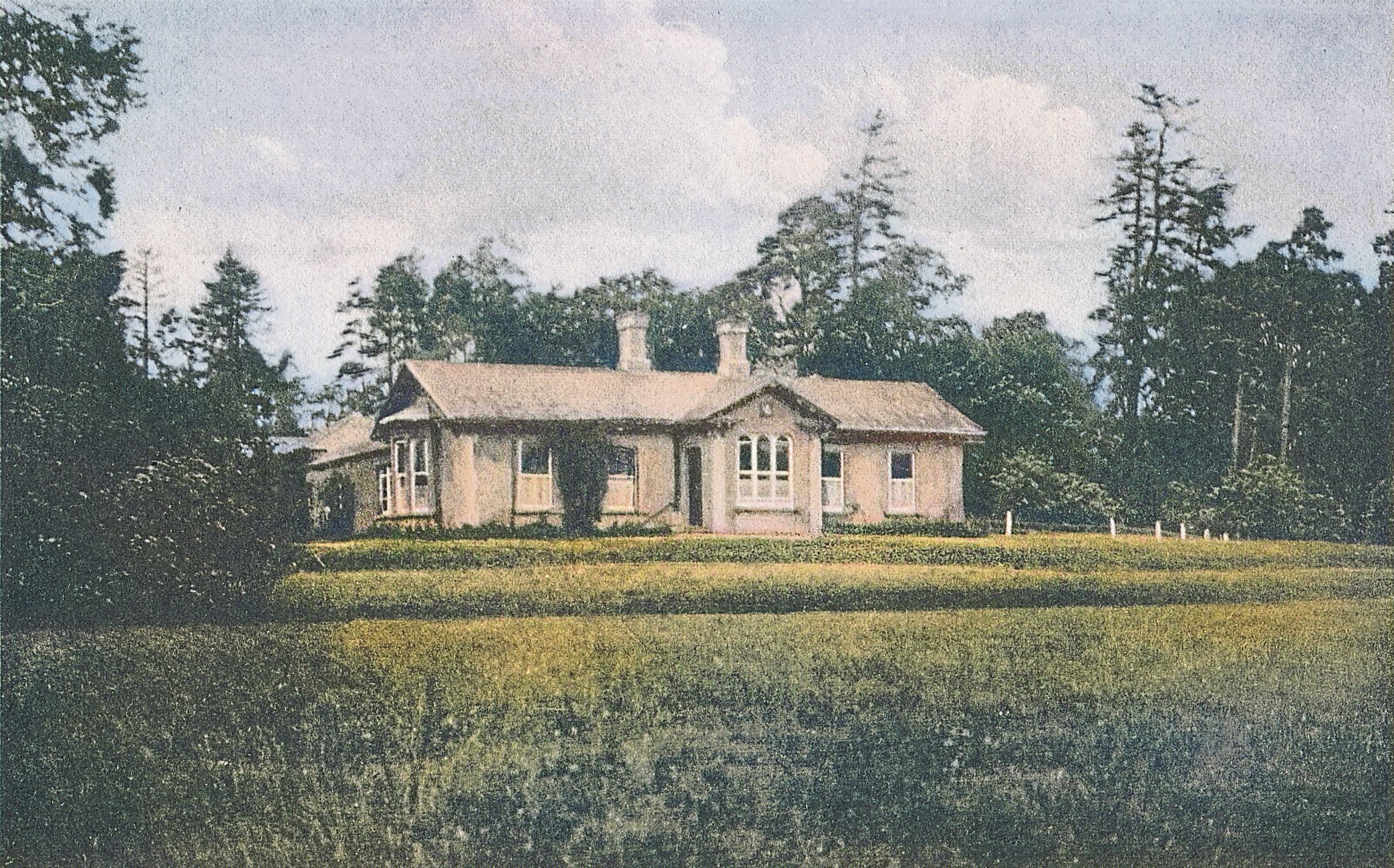
Cornadrung Cottage in the parish of Colmcille, north Longford - a modest hunting lodge, it was transformed into a decorative villa in 1860
The 1917 by-election brought Michael Collins, Harry Boland, Tom Ashe and Collins’ cousin, Gearoid O’Sullivan, to Longford town to canvas.
As fate would have it, there was no suitable accommodation available in Longford town, so the men decided to stay in the Greville Arms Hotel in Granard, owned by the Kiernan family. There they were introduced to the four Kiernan girls: Chris, Kitty, Maud and Helen. Michael immediately fell for Helen; however, she was courting Paul McGovern, a solicitor from Co Fermanagh. (By all accounts, Collins did not want her to marry McGovern, although she eventually went ahead with the nuptials). Collins’ cousin Gearoid began to date Maud, while Kitty and Harry Boland also started courting.
In December 1918, a general election was called and Michael and his friend Harry Boland came to Longford and once again stayed in the Greville Arms. Harry was, by then, in a steady relationship with Kitty.
In June 1919, De Valera escaped from Lincoln Jail, England, and asked Harry to accompany him in a financial support mission to America. They were away for twelve months, which left the way open for Collins to win Kitty’s heart. (In romance as in war, it would appear he was a shrewd operator.)
Michael was to write many letters to Kitty from Dublin and London during their courtship, and eventually a rendezvous was arranged in the midst of Ireland’s great struggle for independence. The location for this meeting would be Cornadrung Cottage.
According to family lore, Frank Cole had personally invited Michael to visit the Cottage some time previous to this. (It is pure speculation, but perhaps the two men crossed paths over a pint in the Greville Arms; Frank may have told Michael about the attractive new summer home he had recently acquired, and suggested a visit.)
Whatever the truth, it is believed that both Michael and Kitty arrived at the Cottage grounds by car. Joe Reilly, Michael’s trusted friend, bodyguard and aide-de-camp does not appear to have accompanied Michael on this occasion – perhaps three was a crowd – but it’s hard to believe he was far away. Everything went according to plan, except for the Irish weather: the pair got completely soaked.
Michael and Kitty proceeded to knock at the front door of Cornadrung Cottage, where they were greeted by a young Benjamin Cole, son of Frank, who was about seventeen at the time. He was convalescing in the Cottage, having sustained a nasty injury in Dublin when a heavy gate fell on his leg. The young Cole brought the drenched couple up to the big range in the kitchen, where they attempted to dry off.
According to Ben’s niece Paula O’Donoghue, who lived with him in her early years, each Christmas Ben would recount the same story of serving afternoon tea to the distinguished visitors. And while we can only speculate about the food he offered them (ham sandwiches? apple tart and cream?), or the topic and length of their conversation, nobody can deny how interesting it must have been to be a fly on the wall!
Did they talk about the house in Greystones that Kitty and Michael planned to move into after their wedding? The couple were due to marry on June 24, 1921, a date then deferred to August 22. Of course, all plans were ultimately upended by the outbreak of the Civil War. On the day he was due to be married - in a double wedding with his cousin Gearoid O’Sullivan and Kitty’s sister Maud - Collins was tragically shot dead near Beal na Blath, Co Cork, by anti-treaty forces.
No doubt Kitty Kiernan was devastated by the loss of her fiancé, and her imagined future. However, four years later on June 10, 1925, she went on to marry Felix Cronin, who was Quartermaster General in the Irish Army. They had two children, Felix junior and Michael Collins Cronin. Kitty died, aged 52, of a cerebral haemorrhage on July 24, 1945, and her grave is close to that of Collins in Glasnevin Cemetery. Her husband Felix died in 1961 and is also buried in Glasnevin.
What of the aforementioned members of the Cole family? My mother, Josephine Cole, married PJ Mulligan, a shop owner, auctioneer and Cunard Line agent from Aughnacliffe, in the parish of Colmcille, and they had seven children together.
Ben Cole, the young man who served afternoon to Michael Collins and Kitty Kiernan, went on to become a sales agent for Thompsons Ltd importers of wines and spirits. He had a good tenor voice and sang with The Bohemians in Jury’s Hotel. He also took part in shows from RTE sound studios in the GPO. (On a tangential note, his younger brother, Tony, was employed by the same company, servicing the country outside of Dublin. As children, we looked forward to seeing Tony arrive in Aughnacliffe in his big American car. He was a wonderful uncle, entertainer and pianist, whose special party piece was “There is Nothing Whatever the Matter with Me”. Ben and Tony’s brother, Frank Cole, had a prominent pub in Fairview and was also dearly beloved by his Aughnacliffe relatives.)
Of course, on that fateful day at Cornadrung Cottage, the young Ben Cole may not have fully comprehended the magnitude of the couple who stood before him, nor the part Michael Collins would play in the formation of the modern Irish State we have today.
Ben always regretted not having some little memento from that unique meeting with the ‘The Big Fellow’ – Michael’s signature in his address book would have gone some way in making his story more believable to his friends and others.
Michael Collins, did, however, put his signature to something much more important – the signing of the Peace Treaty together with British prime minister Lloyd George on July 11, 1921, an act that he knew would put him in grave danger, and so it proved.
May we never forget the weight of responsibility he bore, and the leadership role he exercised against such a powerful foe. May we be forever grateful to the gallant young men and women who fought and died for the cause of freedom, including those who fought on both sides in the terrible Civil War that was to follow.
‘Ar dheis De go raibh a n-anamacha dilse’
Researched and compiled by Brian Mulligan (September 2023)
Edited by Bernice Barrington

Subscribe or register today to discover more from DonegalLive.ie
Buy the e-paper of the Donegal Democrat, Donegal People's Press, Donegal Post and Inish Times here for instant access to Donegal's premier news titles.
Keep up with the latest news from Donegal with our daily newsletter featuring the most important stories of the day delivered to your inbox every evening at 5pm.

This publication supports the work of the Press Council of Ireland and Office of the Press Ombudsman, and our staff operate within the Code of Practice of the Press Council. You can obtain a copy of the Code, or contact the Council, at www.presscouncil.ie, Lo-call 1800 208 080 or email: info@presscouncil.ie.