RIP: Body found in search for missing man (63) as heartbreaking statement is issued
Search


09 Mar 2026

Please allow ads as they help fund our trusted local news content.
Kindly add us to your ad blocker whitelist.
If you want further access to Ireland's best local journalism, consider contributing and/or subscribing to our free daily Newsletter .
Support our mission and join our community now.
To continue reading this article, you can subscribe for as little as €0.50 per week which will also give you access to all of our premium content and archived articles!
Alternatively, you can pay €0.50 per article, capped at €1 per day.
Thank you for supporting Ireland's best local journalism!


Troubles’ deaths leave a wound that does “not simply heal with time”, a gathering of bereaved families has heard.
An event to mark European Day for Victims of Terrorism was hosted by TUV MLA Timothy Gaston at Stormont, and heard from family members of those killed by groups including the IRA and UVF, and a survivor of the 2017 Westminster Bridge Islamist-related terrorist attack.
Pastor Stephen Thompson lost his aunt, Yvonne Dunlop, who was killed by an IRA firebomb in Ballymena in 1976.
Mr Thompson’s grandparents stepped in to raise her children, and he said the “weight of losing a daughter in such a brutal way was something no parent should ever have to endure”.
“My granddad was never the same after Yvonne’s death, many of us believe he died of a broken heart,” he said.
“My daughter is exactly the same age Yvonne was back then. I can’t even begin to imagine the hurting that he suffered.
“The grief never truly left him. The pain of burying his own child marked him deeply and permanently.”
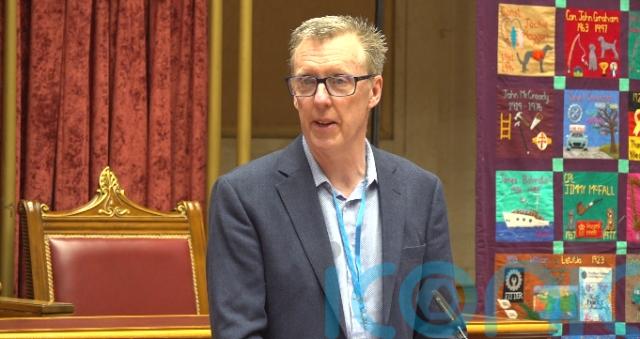
He spoke of the extended impact on his family, including them moving to Nottingham and his sister becoming addicted to drugs, and said violence “does not stop at one act”.
“When people speak about the Troubles, the phrase can sound distant and almost clinical, but for families like mine and many others, there was nothing abstract about it,” he said.
“Violence was not something you watched on the news. It came into your home, your conversations, your sense of safety and your future.
“Yvonne’s death devastated. It created a wound that did not simply heal with time. It changed the course of our lives in ways we could never have imagined.”
He added: “Violence does not end when the act itself is over. It simply doesn’t.
“It travels through generations. It shapes relationships. It influences how people see the world, how they trust and how actually they cope.
“It creates anger, rage, bitterness and a deep sense of injustice that can last for decades. I know this because I felt a lot of these emotions myself.”
He said he found his faith in his 30s, not coming from an overly religious family, but it became “central” to his processing of grief.
“I did forgive,” he said.
“Forgiveness for me was not about excusing what happened, what happened was wrong and will forever be wrong.
“It was not about saying the act was acceptable because it wasn’t. It was not about forgiving, nor was it about removing responsibility from those who carried it out.
“Forgiveness was something I did for my own heart and my own peace.”
Travis Dylan Frain, who survived the 2017 Westminster Bridge terrorist attack, also spoke at Stormont.
He has since became an advocate for victims of terrorism and fighting against violent extremism.
While at university Mr Frain travelled to London on a study trip. He and his friends were hit by a vehicle driven by an Islamist terrorist, Khalid Masood. The attacker killed five people and injured more than fifty.
Mr Frain was one of six British survivors of terrorism who co-founded the charity Survivors Against Terror, to campaign for improvements in state support provided to victims of terrorism.
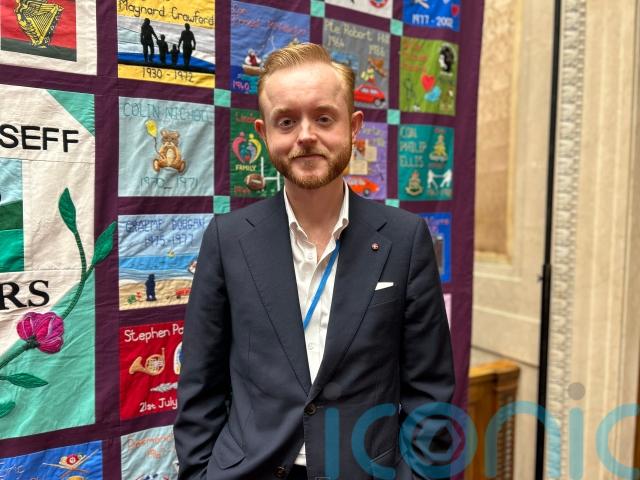
Describing the attack, he said: “We didn’t have time to react.
“I remember I went atop the bonnet, I hit the windshield, and I remember being thrown into the earth for what felt like forever, and of course it could have only been a split second in reality, if that.
“But it felt like forever that I was in the air. I had time to process what had happened. I had time to realise that I’ve been sort of flipped over in the air.”
He added: “The doctors were pretty clear afterwards that the only reason that I survived was because when I landed, that down on the ground I landed on the left side of my body, and took a range of injuries, my head actually landed on the stomach of one of the other lads in my group, who’d been knocked to the ground already.”
He said that like many others in the UK, before the incident he was “completely ignorant to these issues to terrorism and indeed to the Troubles as well”.
“I had to learn the hard way that there was simply not enough support for victims,” he said
“And the way in which we support victims of terrorism or not, is far more indicative on us and our society than it is on terrorists themselves.
“And I think it’s incredibly important to remember that the whole point of terrorism is to reduce people’s faith in the system and the systems that govern us, and when we then fail to support those victims, we are doing the terrorists’ job for them.”
He added: “I know I’m a bit of an outsider as someone not affected by the Troubles, but it means a lot to have that connectedness and that peer-to-peer nature and to be here with you all, and I wish you all the best in your efforts and accountability and justice.”
John Sproule’s brother, Ian Sproule, was killed by the provisional IRA at 24 years old, and the family believe there was Garda collusion.
He said his mother never recovered from the loss of one of her sons and died at 67 from a “broken heart”.
Mr Sproule said the Irish state “needs to step up and own its contribution to what happened”.
“I will never stop seeking truth and justice for Ian. There needs to be an independent public inquiry by the Irish state. Ian was just not my brother. He was also my best friend,” he said.
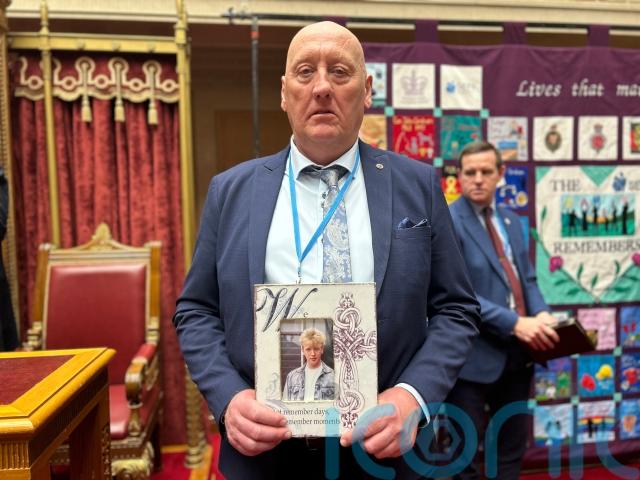
The event also heard from Denise Mullen, who was just four when her father, Denis Mullen, was murdered by the UVF in Moy, Co Tyrone, as part of the Glenanne gang series of killings.
Mr Gaston said the event was about “about drawing a line of distinction between a victim-maker and a victim”.
“When Europe pauses to reflect, there is a clear definition of what a victim is,” he said.
“Directive 2017/541, on combat and terrorism, tells us that a victim is a natural person who has suffered harm as a direct result of a terrorist offence.
“Sadly that is not the definition we have here in Northern Ireland.
“In Northern Ireland, the definition reads someone who is or has been physically or psychologically injured as a result or a consequence of a conflict related incident.
“That is obnoxious, that is wrong, and we must do all we can to ensure history isn’t rewritten and that the terrorist injured by his own bomb by his own hand, is not classed as a victim.”
UUP leader Jon Burrows said: “The pain and grief and trauma and loss of the Troubles was permanent and profound and we’ve heard today how it ripples on through things like addictions, mental health and all kinds of other impacts.”

Subscribe or register today to discover more from DonegalLive.ie
Buy the e-paper of the Donegal Democrat, Donegal People's Press, Donegal Post and Inish Times here for instant access to Donegal's premier news titles.
Keep up with the latest news from Donegal with our daily newsletter featuring the most important stories of the day delivered to your inbox every evening at 5pm.

This publication supports the work of the Press Council of Ireland and Office of the Press Ombudsman, and our staff operate within the Code of Practice of the Press Council. You can obtain a copy of the Code, or contact the Council, at www.presscouncil.ie, Lo-call 1800 208 080 or email: info@presscouncil.ie.