Search


18 Mar 2026
Search
18 Mar 2026

Please allow ads as they help fund our trusted local news content.
Kindly add us to your ad blocker whitelist.
If you want further access to Ireland's best local journalism, consider contributing and/or subscribing to our free daily Newsletter .
Support our mission and join our community now.
To continue reading this article, you can subscribe for as little as €0.50 per week which will also give you access to all of our premium content and archived articles!
Alternatively, you can pay €0.50 per article, capped at €1 per day.
Thank you for supporting Ireland's best local journalism!


The Irish language commissioner has insisted he was “trying to distance” himself from a group’s decision to work towards a united Ireland.
In February, Conradh na Gaeilge voted to amend its constitution to “work towards a united Ireland for the benefit of the Irish language and the Gaeltacht”.
Shortly afterwards, Northern Ireland’s Irish language commissioner, Pol Deeds, criticised hostility towards Irish and was quoted as inviting people to reflect “that every word spoken against the Irish language could be seen in one sense as another blow struck in the cause of Irish unification”.
The remarks were criticised by some unionists as straying into constitutional issues and evoking a Troubles-era phrase attributed to a Sinn Fein official that “every word of Irish spoken is a bullet fired for Irish freedom”.
On Wednesday, Mr Deeds said he was “parodying” the original phrase and “turning it on its head”.
He told Stormont’s Executive Office Committee that he had been inviting people to “reflect on that possibility” as a response to Conradh na Gaeilge’s decision, which he said was made by young activists who were “radicalised by ongoing hostility to the Irish language”.
Mr Deeds previously canvassed on behalf of Sinn Fein but said he had left the party about five years ago.
Asked by DUP MLA Philip Brett if he believed it was his role to give out constitutional advice, the commissioner said it was “absolutely not constitutional advice”.
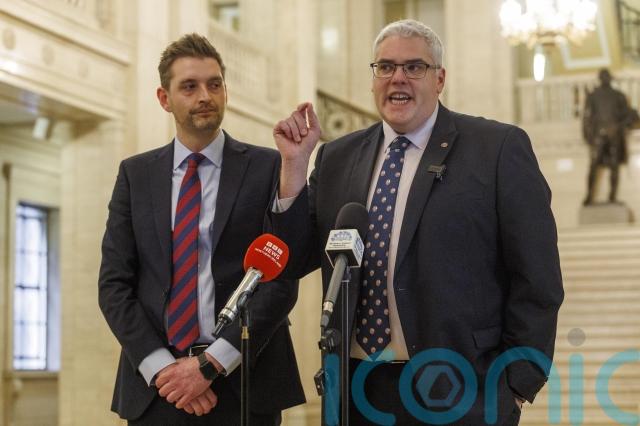
“The advice was for people to reflect upon the consequences of their actions, in terms of the ongoing hostility towards the Irish language and towards my office.”
Mr Deeds told the committee his response was “appropriate” but it had “snowballed” when “people were encouraged to react to reaction”.
He said that several unionists had told him what he said was right and questioned whether some of the offence expressed was legitimate.
Asked by Mr Brett why some in the Protestant, Unionist, and Loyalist community were suspicious of Irish, the commissioner said issues around identity and language had previously not been dealt with well and that past conflict had been “partly related” to identity and language.
Asked how the Conradh na Gaeilge decision would help unionist understanding of the Irish language, Mr Deeds said: “When I gave my comments, I was actually trying to distance myself from their decision.”
Pressed on whether it was wrong, he replied: “I don’t want to say too much because they’re a democratic organisation.”
However, he said he had challenged everyone at the Conradh na Gaeilge to think about including other cultures and identities.
He said he asked Lee Reynolds, commissioner for the Ulster Scots and the Ulster British tradition, to disregard an exclusion for his own office from facilitation guidance.
TUV MLA Timothy Gaston also dedicated his committee time to challenging the commissioner’s past comments.
Mr Gaston accused Mr Deeds of “continuing in the vein” of his former party, Sinn Fein, and “politicising” the Irish language.
He said the commissioner showed “no self awareness” and a lack of understanding of unionist concerns.
Mr Deeds said: “I would love to ask you, do you honestly not get the point I was making?”
The commissioner accused Mr Gaston of “attacking” him and “politicising” his office.
The TUV MLA said: “You’ve confirmed my suspicion that you have no self awareness of how this is seen within unionism, of how the Irish language being inflicted on unionist communities in Belfast, how that parody of that 1982 slogan has been received within unionism.”
Mr Deeds said he did not understand Mr Gaston’s interpretation of his wording.
“There’s a clear link between this ongoing hostility shown towards the Irish language and to my office, and people becoming radicalised and pro-United Ireland. It was a very obvious point.”
The commissioner added that every time he speaks he promotes respect for the Ulster Scots and Ulster British traditions.
He told Mr Gaston: “Your party leader called me a bigot a couple of weeks ago, like it’s not in the real world.”
Mr Gaston also questioned Mr Deeds on his opinion of loyalist activist Jamie Bryson.
The commissioner said he did not want to apologise for any previous comments about Mr Bryson and expressed a desire not to comment on him.
Asked if he held a personal hostility to Mr Bryson, he said: “There’s clearly a personal hostility coming from the other direction.
“I don’t know the individual, but I can’t go too far into those issues.”
Mr Deeds told the committee he was “asked the question” about whether Mr Bryson’s challenges to Irish language signage were lawful.
Following the session with Mr Deeds, the committee agreed with suggestions by Mr Gaston and Mr Brett to seek an answer on whether that question was legal advice coming from his own budget or the Executive Office – and on what grounds that query was made.
The committee also heard from Mr Reynolds and the director of the Office of Identity and Cultural Expression, Dr Katy Radford.
They, along with Mr Deeds, expressed concern about budgetary constraints impacting their ability to hold events, do research, and recruit the necessary amount of staff.
Mr Reynolds said, under the existing budgetary parameters, one-off set-up costs combined with inflation and public sector pay rises had placed a “ball of chain around our ankles” rather than allowing a “full running start”.
On the work of his office, he said he was examining whether Ulster Scots fell under existing equality law protections and whether a legal challenge would be necessary – adding that he would hope to have an answer before summer.
He later suggested that the World Pipe Band Championships, normally held in Glasgow, “might be looking for somewhere to go”.
Dr Radford told the committee that her office’s grant-making function had yet to be determined and that Castlereagh Foundation research body had yet to be given powers.

Subscribe or register today to discover more from DonegalLive.ie
Buy the e-paper of the Donegal Democrat, Donegal People's Press, Donegal Post and Inish Times here for instant access to Donegal's premier news titles.
Keep up with the latest news from Donegal with our daily newsletter featuring the most important stories of the day delivered to your inbox every evening at 5pm.

This publication supports the work of the Press Council of Ireland and Office of the Press Ombudsman, and our staff operate within the Code of Practice of the Press Council. You can obtain a copy of the Code, or contact the Council, at www.presscouncil.ie, Lo-call 1800 208 080 or email: info@presscouncil.ie.