The late Paul Kavanagh beaming after riding a winner in JP McManus' famous silks
Search


29 Dec 2025

Please allow ads as they help fund our trusted local news content.
Kindly add us to your ad blocker whitelist.
If you want further access to Ireland's best local journalism, consider contributing and/or subscribing to our free daily Newsletter .
Support our mission and join our community now.
To continue reading this article, you can subscribe for as little as €0.50 per week which will also give you access to all of our premium content and archived articles!
Alternatively, you can pay €0.50 per article, capped at €1 per day.
Thank you for supporting Ireland's best local journalism!


The MSP spearheading a Bill that would legalise assisted dying in Scotland has said he is “confident” of getting it passed by Holyrood.
Liberal Democrat MSP Liam McArthur secured a landmark victory in May 2025 when the Scottish Parliament voted in favour of the general principles of his Bill – which would give terminally ill adults the option of seeking help to die.
That was the third time the Scottish Parliament had voted on the issue, with previous attempts at legislation falling at this hurdle.
With Holyrood’s Health Committee now having considered almost 300 amendments to the Assisted Dying for Terminally Ill Adults (Scotland) Bill, the legislation is expected to come back before Holyrood early in 2026.
Further amendments could be made to the proposals at this stage, before the crucial final vote – which is expected in March.
With the Bill having passed its initial vote by 70 to 56, opponents of assisted dying believe they can stop the change becoming law.
But speaking to the Press Association, Mr McArthur said: “I am confident that still a majority of my MSP colleagues support a change in the law.”
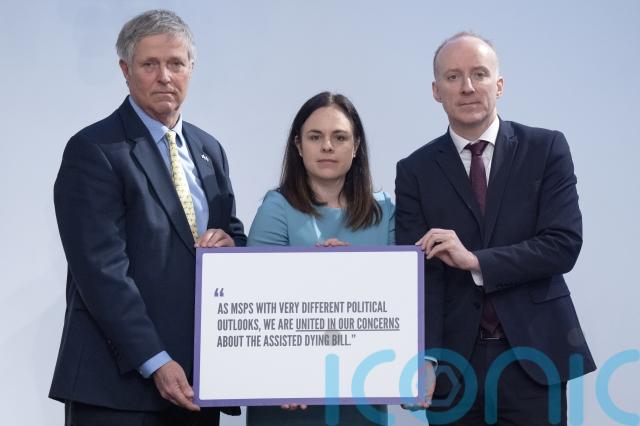
His comments came after three MSPs – Deputy First Minister Kate Forbes, Labour’s Michael Marra and Scottish Conservative Edward Mountain – came together to publicly speak out against his Bill.
Mr McArthur said the final amending stage could give MSPs the chance to make changes to the Bill “they feel are appropriate”.
This final amendment stage could be a “lengthy process”, he added, with Mr McArthur saying there could “perhaps” be more than 300 possible amendments put forward.
He added: “I hope on the back of that they will pass this legislation, allow more choice at the end of life for the small but not insignificant number of Scots desperately, desperately in need of that.”
Under his proposals a person would have to be suffering from an “advanced and progressive disease, illness or condition from which they are unable to recover and that can reasonably be expected to cause their premature death”.
They would also have to have the mental capacity to request an assisted death, and would have to have lived in Scotland for at least a year before doing so.
The Bill has been going through the Scottish Parliament at the same time as Westminster considers similar proposals from MP Kim Leadbeater – with extra time having to be allowed there for further scrutiny of her Bill in the House of Lords.
This has led opponents of assisted dying to claim that consideration of Mr McArthur’s Bill has been more rushed in comparison.
But he insists “that’s a hard argument to stack up”, with the MSP saying: “I announced my intention to introduce the Bill back in June 2021.
“The proposals have been subject to lengthy consultation, the drafting of the Bill took the best part of 18 months, the scrutiny process through the Health and Social Care Committee was painstaking, a detailed report prepared on that, a lengthy process of stage two amendments considered and further stage three amendments to come in the new year.
“That’s the best part of five years. I can’t think of a Bill that has been subject to quite as much scrutiny as this Bill.”
This level of scrutiny is “right and proper” for an “issue of this sensitivity”, he added.
But he stressed: “I think the public has long been in support of a change in the law. I think what they want to see is MSPs across the parties engaging with the process, treating it seriously and making sure that whatever legislation we ultimately pass is fit for the circumstances here in Scotland.”
And while he “very much” hopes that Parliament will pass the Bill and “introduce a law that is long overdue and much needed” he said politicians must also be aware that “not passing the law has significant consequences as well”.
He added: “The current ban on assisted dying is leading to too many Scots having a series of pretty unpalatable choices at the end of life.”
Dr Miro Griffiths, of the Better Way campaign against assisted dying, said even a “cursory” look at the Bill shows claims that scrutiny has improved the legislation “to be untrue”.
Speaking about the prospect of hundreds more amendments being considered, he insisted: “This is a negative, not a positive.
“It shows that parliamentarians still lack confidence in the Bill. Many serious issues were identified at stage two and not addressed.
“This compounds the challenge MSPs will face at the next stage – they will have to grapple with dozens if not hundreds more potential changes to a Bill that has life or death consequences for Scots.”
He also argued there are still “unsolvable problems in the assisted suicide Bill”, adding: “There is nothing that could rule out people being coerced into ending their lives, either behind closed doors in an abusive situation or through societal pressure that arises from a lack of support.
“There is nothing to prevent mission creep in legislation in years to come that makes Scotland’s law even more permissive.”

Subscribe or register today to discover more from DonegalLive.ie
Buy the e-paper of the Donegal Democrat, Donegal People's Press, Donegal Post and Inish Times here for instant access to Donegal's premier news titles.
Keep up with the latest news from Donegal with our daily newsletter featuring the most important stories of the day delivered to your inbox every evening at 5pm.

This publication supports the work of the Press Council of Ireland and Office of the Press Ombudsman, and our staff operate within the Code of Practice of the Press Council. You can obtain a copy of the Code, or contact the Council, at www.presscouncil.ie, Lo-call 1800 208 080 or email: info@presscouncil.ie.