Search


21 Apr 2026
Search
21 Apr 2026

Please allow ads as they help fund our trusted local news content.
Kindly add us to your ad blocker whitelist.
If you want further access to Ireland's best local journalism, consider contributing and/or subscribing to our free daily Newsletter .
Support our mission and join our community now.
To continue reading this article, you can subscribe for as little as €0.50 per week which will also give you access to all of our premium content and archived articles!
Alternatively, you can pay €0.50 per article, capped at €1 per day.
Thank you for supporting Ireland's best local journalism!


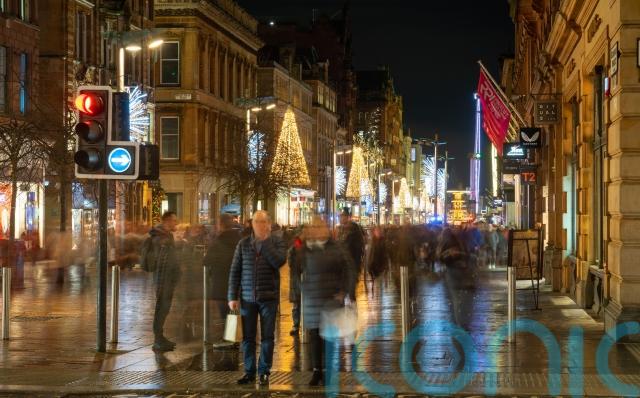
There was “little Christmas cheer” for Scotland’s retailers with just a small increase in sales over the festive period, an industry body has said.
The Scottish Retail Consortium-KPMG Scottish retail sales monitor shows that between November 30 and January 3, total sales in Scotland increased 0.4% compared with December 2024, when they had risen 0.8%.
The rise was below the three-month average increase of 0.8%, and below the 12-month average of 0.8%.
Adjusted for inflation, there was a year-on-year decrease of 0.2%.
Total food sales increased 1.1% compared with December 2024, when sales were 0.0% – below the three-month average increase of 1.4% and above the 12-month average increase of 0.4%, according to the data.
Total non-food sales decreased 0.1% compared with December 2024, when they had increased by 1.5%. This was below the three-month average increase of 0.2% and below the 12-month average rise of 1.2%.
Adjusted for the effect of online sales, non-food sales in Scotland decreased 0.2% compared with December 2024, when they had increased by 6.1%. This was below the three-month average increase of 0.2% and below the 12-month average increase of 1.7%.
Scottish Retail Consortium director David Lonsdale said: “There was little Christmas cheer for Scotland’s shopkeepers as the total value of retail sales inched up by a meagre 0.4% during December.
“Trading over the so-called ‘golden quarter’ fared a touch better but failed to sparkle and 2025 as a whole was frankly unspectacular.
“Lingering concerns over the cost of living and economy meant consumers were fewer in number and those who did shop continued to take a parsimonious approach towards spending.
“Click and collect purchases proved popular, particularly in the days immediately prior to Christmas.
“Other bright spots were sales of toys, cosmetics and perfumes, and festive fare.
“Non-food was more mixed. Computing, gaming and fashion did ok but sales of electrical products, such as TVs, and home textiles dwindled, as did Christmas decorations as shoppers opted to reuse older baubles rather than splash out on new items.
“Overall, customers tended to shop early by capitalising on Black Friday promotions with the only noticeable uplift in purchasing during December occurring in the post-Christmas sales as shoppers took advantage of discounting and used vouchers they had received as gifts.”
He also said the Budget outlined by the Scottish Government this week failed to provide a boost for retailers.
“After a Scottish Budget which fell well short of offering stores a business rate discount comparable to that on offer to counterparts in England, all eyes now turn towards May’s election,” Mr Lonsdale said.
“It reinforces the need for policymakers to bear down on the cost of living for households but also the cost of doing business for firms.”
Linda Ellett, UK head of consumer, retail and leisure at KPMG, said: “While there are individual festive success stories among retailers, retail sales largely froze in December.
“Total retail sales in Scotland only increased marginally, with higher inflation also a factor in the sales growth.
“It remains a challenging time for retailers, with consumer cutting back on spending due to higher household bills and any discretionary spend is being prioritised, particularly toward holidays and home improvements.
“Retailers are also facing increasing costs while needing to invest in innovation. There will be an ever-sharpening focus on business models, efficiencies and profit margin in the months ahead.”
Deputy First Minister Kate Forbes said: “Our draft Budget for 2026-27 sets out the most generous small business rates relief anywhere in the UK. As a result of our £864 million non-domestic rates relief package, we estimate that 96% of retail, hospitality and leisure businesses could benefit from some form of relief in 2026-27.
“On average, households in the lower half of the income distribution in Scotland are around £480 better off a year than they would be under UK tax and social security policies.
“We will continue to work with the retail sector as we seek to drive growth and prosperity in communities across Scotland.”

Subscribe or register today to discover more from DonegalLive.ie
Buy the e-paper of the Donegal Democrat, Donegal People's Press, Donegal Post and Inish Times here for instant access to Donegal's premier news titles.
Keep up with the latest news from Donegal with our daily newsletter featuring the most important stories of the day delivered to your inbox every evening at 5pm.

This publication supports the work of the Press Council of Ireland and Office of the Press Ombudsman, and our staff operate within the Code of Practice of the Press Council. You can obtain a copy of the Code, or contact the Council, at www.presscouncil.ie, Lo-call 1800 208 080 or email: info@presscouncil.ie.