Search


22 Apr 2026
Search
22 Apr 2026

Please allow ads as they help fund our trusted local news content.
Kindly add us to your ad blocker whitelist.
If you want further access to Ireland's best local journalism, consider contributing and/or subscribing to our free daily Newsletter .
Support our mission and join our community now.
To continue reading this article, you can subscribe for as little as €0.50 per week which will also give you access to all of our premium content and archived articles!
Alternatively, you can pay €0.50 per article, capped at €1 per day.
Thank you for supporting Ireland's best local journalism!


The Scottish Government has announced millions of pounds of investment to improve community capacity to respond to cardiac arrests.
First Minister John Swinney set out the £2.5 million investment which will see the purchase of 1,000-1,250 additional defibrillators over three years.
It came as he met with Scottish Ambulance Service staff and cardiac arrest survivor John Sinclair, who received CPR from a responder using the GoodSAM app.
The funding will also support the promotion and increased uptake of the app, supported by the Scottish Ambulance Service, which alerts registered users to nearby cardiac arrests so they can provide first response.
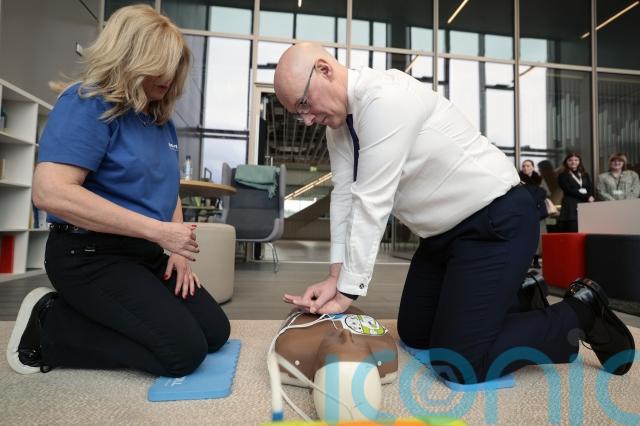
Mr Swinney said: “The Government wants to make sure that we have a very large range of services available to support individuals who face health difficulties, particularly in emergency situations with a cardiac arrest.
“We are investing £2.5 million of new money in the expansion of the defibrillator network around Scotland. This will deliver at least 1,000 extra defibrillators around the country, and also support organisations that do vital work in assisting in the delivery of CPR training around the country, so that more and more people are able to help people who face cardiac arrest.
“By making sure we’ve got these resources spread across the country, by making sure we’ve got people who are able to make that early intervention in all of this support, we can improve health outcomes for individuals and save lives, and that’s at the heart of the Government’s approach.”
The funding will also support new Cardiac Arrest Rescue (CARe) Zones to strengthen the community response to cardiac arrests, such as increased CPR training in schools.
Areas facing the greatest inequalities will be prioritised for the CARe Zones, as Mr Swinney said there are some parts of the country where “health outcomes are poorer than others”.
He said: “We’ve got to make sure that we improve health outcomes in all parts of the country, but there are some areas where those health outcomes are poorer than others, and it tends to be in areas of deprivation.
“The Government is wanting to make sure the resources that we put in place are supporting the improvement of those outcomes, so that the life chances of individuals living in areas of deprivation can be improved.
“Now, of course, there is a much wider range of work the Government is undertaking to improve outcomes for people in deprivation by changing lives. The Government’s child poverty strategy is all about doing that, about making sure we improve opportunities.
“The attainment challenge work is doing exactly the same, it’s focused on exactly the same work. So if we can work collaboratively with a range of organisations around the country focused on improving life chances in areas of deprivation, we will improve health outcomes, and that’s an advantage for the whole of Scotland.”
Save A Life For Scotland chairman Dr Gareth Clegg said: “This £2.5 million investment is a transformative step for communities across Scotland.
“By expanding access to defibrillators in the places they are most needed, we are giving many more people the chance to survive cardiac arrest and return home to their families.
“This funding will allow the University of Edinburgh to work in close partnership with the Scottish Ambulance Service, councils, emergency services, schools and third-sector organisations to ensure defibrillators are not only more numerous, but more equitably and strategically deployed in communities that are ready to use them.”

Subscribe or register today to discover more from DonegalLive.ie
Buy the e-paper of the Donegal Democrat, Donegal People's Press, Donegal Post and Inish Times here for instant access to Donegal's premier news titles.
Keep up with the latest news from Donegal with our daily newsletter featuring the most important stories of the day delivered to your inbox every evening at 5pm.

This publication supports the work of the Press Council of Ireland and Office of the Press Ombudsman, and our staff operate within the Code of Practice of the Press Council. You can obtain a copy of the Code, or contact the Council, at www.presscouncil.ie, Lo-call 1800 208 080 or email: info@presscouncil.ie.