The shocking act happened near the Shannon River on the Condell Road I PICTURE: Google Maps
Search


11 Mar 2026

Please allow ads as they help fund our trusted local news content.
Kindly add us to your ad blocker whitelist.
If you want further access to Ireland's best local journalism, consider contributing and/or subscribing to our free daily Newsletter .
Support our mission and join our community now.
To continue reading this article, you can subscribe for as little as €0.50 per week which will also give you access to all of our premium content and archived articles!
Alternatively, you can pay €0.50 per article, capped at €1 per day.
Thank you for supporting Ireland's best local journalism!


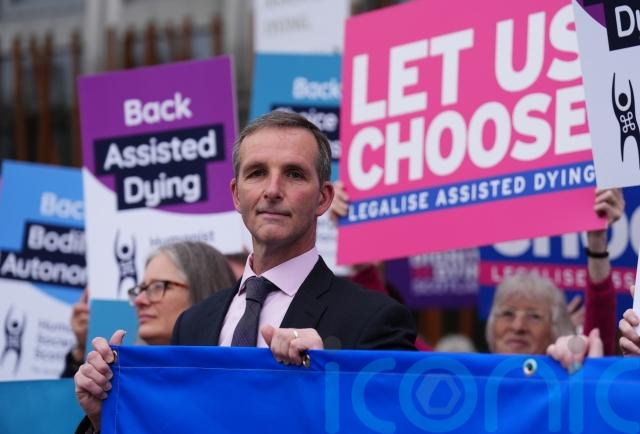
John Swinney has intervened in the debate over assisted dying, with the First Minister insisting a Bill that would allow terminally ill Scots to seek help to die “did not recognise” some provisions were outside of Holyrood’s powers.
The First Minister spoke out as MSPs debated hundreds of amendments to legislation brought forward by Liberal Democrat MSP Liam McArthur that, if passed, would allow those with a terminal illness to legally seek help to end their life.
But Mr Swinney insisted that Mr McArthur’s Bill “did not recognise” issues that the Scottish Government had “put on the record”, when it had “consistently” noted that measures around the medication that would be used to end someone’s life and about employment rights for medics are “outside legislative competence”.
Mr Swinney insisted “that is not a new surprise”, saying that the “government has put that on the table for a long time”.
The First Minister stated: “Mr McArthur introduced a Bill to Parliament that did not recognise those issues that the government had put on the record.”
He added: “The government is neutral on the Bill but it has pointed out for some considerable time the issues of legislative competence, and we have sought means of resolving them.”
If the legislation is passed by Holyrood he said a section 30 order – where Westminster permits Holyrood to legislate on areas which are usually outside its powers – would be agreed to resolve some of these issues.
But the First Minister added a separate section 104 order would also be needed or the Bill “will be legislatively incompetent”.
Mr McArthur insisted he had “always acknowledged” parts of the legislation were reserved to Westminster.
And he said the Scottish and UK governments had “worked at pace” to try to resolve these.
But Conservative MSP Brian Whittle said although MSPs had been “discussing this for years” they had only discovered “at the last minute” that the legislation might not be competent.
The Tory hit out and said: “The pushback and the lack of engagement from the Scottish Government I think is quite disgraceful.”
Mr Swinney however accused Mr Whittle of attacking the “reputation of my government”, with the First Minister insisting: “A section 30 order would not have had to be sought from the United Kingdom Parliament had provisions in this Bill not been outside of legislative competence, it just would not have been required.
“And my government in good faith sought that section 30 order to enable Parliament to properly pass legislatively competent legislation, by agreement with the United Kingdom government.”
His stance was backed by Deputy First Minister Kate Forbes, who said that when the Bill was first introduced it was “not made clear that the regulation of drugs and employment rights were reserved matters and therefore there would be elements of this Bill that would always be legally incompetent”.
She insisted: “It’s not the Scottish Government that has introduced this Bill, or has determined what is reserved under the Scotland Act.”
The debate over the competence of the legislation came as Holyrood prepared to take the highly unusual step of sitting on Friday to continue considering the 300-plus amendments that have been submitted.
These all have to be debated and voted upon before the final vote on the Bill, which is currently scheduled for Tuesday March 17.
Meanwhile, Mr McArthur said amendments passed by Holyrood on Wednesday would introduce further safeguards to the legislation.
Measures agreed by MSPs mean the Bill would permit someone to set out an advance care directive about their wishes for an assisted death in the event that they lose capacity.
Other amendments altered the definition of coercion in the legislation to make clear this can encompass a range of circumstances, and that the person seeking help to die would also have to be given information about palliative care.
Another change to the Bill would require assessments as part of the process to be carried out in person, with a doctor who approves someone for an assisted death required to have met the person more than once.
Mr McArthur said there had been “a large number of amendments passed that bring further clarity and assurance to dying people, the public and MSPs that the Bill will make assisted dying a safe and compassionate end of life choice for dying Scots who need it”.
He added: “With these measures in place, MSPs can vote with confidence knowing that this is a Bill which gives terminally ill Scots the compassionate choice of an assisted death should they want one, while significantly increasing protections for all.”

Subscribe or register today to discover more from DonegalLive.ie
Buy the e-paper of the Donegal Democrat, Donegal People's Press, Donegal Post and Inish Times here for instant access to Donegal's premier news titles.
Keep up with the latest news from Donegal with our daily newsletter featuring the most important stories of the day delivered to your inbox every evening at 5pm.

This publication supports the work of the Press Council of Ireland and Office of the Press Ombudsman, and our staff operate within the Code of Practice of the Press Council. You can obtain a copy of the Code, or contact the Council, at www.presscouncil.ie, Lo-call 1800 208 080 or email: info@presscouncil.ie.