Michelle Doherty and son Max (11) escaped the shooting on Bondi Beach by a matter of minutes.
Search


16 Dec 2025

Please allow ads as they help fund our trusted local news content.
Kindly add us to your ad blocker whitelist.
If you want further access to Ireland's best local journalism, consider contributing and/or subscribing to our free daily Newsletter .
Support our mission and join our community now.
To continue reading this article, you can subscribe for as little as €0.50 per week which will also give you access to all of our premium content and archived articles!
Alternatively, you can pay €0.50 per article, capped at €1 per day.
Thank you for supporting Ireland's best local journalism!


European leaders have set out conditions for peace in Ukraine following a meeting in Berlin.
Any deal with Russia will have to allow Kyiv to maintain its armed forces at 800,000 troops, involve a European-led multinational force operating inside Ukraine and support the country joining the EU.
Meanwhile, US officials have reportedly offered unspecified security guarantees to Ukraine.
Leaders from 10 countries and the EU attended the Berlin meeting with Ukrainian President Volodymyr Zelensky on Monday night, including Sir Keir Starmer, who earlier told MPs the UK “cannot let up” its efforts to bring about peace.
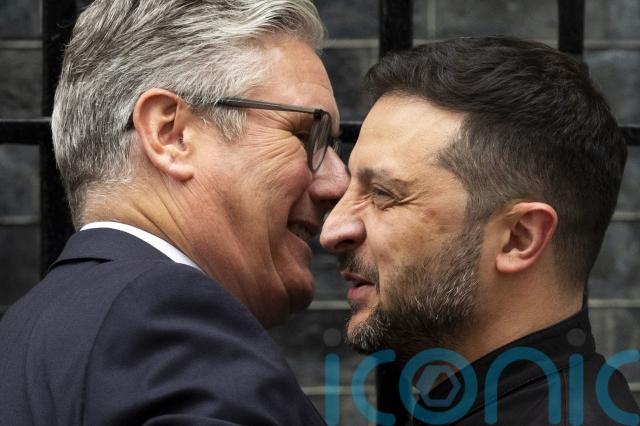
In a joint statement, Sir Keir and other leaders said they and the US had “committed to work together to provide robust security guarantees” and economic support “in the context” of a peace deal.
And they set out six commitments to be included in any deal, including on the size of Ukraine’s armed forces and the involvement of Europe and the US.
A limit of 800,000 personnel is a significant increase on an earlier draft of the US-backed plan, which had suggested 600,000, and according to Mr Zelensky, is only slightly below the current size of the Ukrainian military.
The conditions also included a role for the “multinational force Ukraine” currently being developed by the “coalition of the willing” led by Sir Keir and France’s Emmanuel Macron, along with a US-backed ceasefire monitoring mechanism and a binding commitment to come to Ukraine’s aid if Russia attacks again.
Other conditions included an agreement to invest in Ukraine’s economic future, “taking into account” the need for Russia to provide compensation, and strong support for Kyiv’s accession to the EU.
While the joint statement included a role for Nato in “providing robust deterrence”, the conditions did not include a reference to Ukraine joining the alliance, something that Moscow is strongly opposed to.
Joint statement from European leaders in Berlin this evening:—”The Leaders welcomed significant progress on President Trump’s efforts to secure a just and lasting peace in Ukraine. They also welcomed the close work between President Zelenskyy’s and President Trump’s teams as… pic.twitter.com/tfbG2uu3qb
— Ulf Kristersson (@SwedishPM) December 15, 2025
The leaders said it was “now incumbent upon Russia to show willingness to work towards a lasting peace” by signing up to the plan and agreeing a ceasefire.
Monday’s meeting in Berlin follows almost a year of discussions about a peace deal following US President Donald Trump’s promise to end the war on his first day in office in January.
Moscow has so far resisted calls for a ceasefire, and is strongly opposed to any deal that sees Nato troops deployed in Ukraine.
Russia has also repeatedly pushed for Ukraine to give up territory in exchange for peace.
On Monday, the European leaders said international borders “must not be changed by force”, but added decisions on territory were “for the people of Ukraine” to make once effective security guarantees were in place.
The meeting was hosted by German Chancellor Friedrich Merz and, along with Sir Keir and Mr Zelensky, was attended by the leaders of Denmark, Finland, France, Italy, the Netherlands, Norway, Poland and Sweden, as well as European Council President Antonio Costa and EU Commission president Ursula von der Leyen.
It is understood US negotiators also agreed to the joint statement.
Mr Zelensky said there had been “progress” on an agreement, with the military aspects looking “quite solid”, but added there were some “destructive” elements to the American proposal that should not appear in “new versions”.
He added: “We will do everything possible to find clear answers to questions about security guarantees, territories, and money as compensation for Ukraine to rebuild.”

Subscribe or register today to discover more from DonegalLive.ie
Buy the e-paper of the Donegal Democrat, Donegal People's Press, Donegal Post and Inish Times here for instant access to Donegal's premier news titles.
Keep up with the latest news from Donegal with our daily newsletter featuring the most important stories of the day delivered to your inbox every evening at 5pm.

This publication supports the work of the Press Council of Ireland and Office of the Press Ombudsman, and our staff operate within the Code of Practice of the Press Council. You can obtain a copy of the Code, or contact the Council, at www.presscouncil.ie, Lo-call 1800 208 080 or email: info@presscouncil.ie.