Towards the end of the evidence, the child expressed her desire to see her friend and her cat again
Search


14 Jan 2026

Please allow ads as they help fund our trusted local news content.
Kindly add us to your ad blocker whitelist.
If you want further access to Ireland's best local journalism, consider contributing and/or subscribing to our free daily Newsletter .
Support our mission and join our community now.
To continue reading this article, you can subscribe for as little as €0.50 per week which will also give you access to all of our premium content and archived articles!
Alternatively, you can pay €0.50 per article, capped at €1 per day.
Thank you for supporting Ireland's best local journalism!


John Swinney has insisted his Government’s Budget provides support for families “when they need that assistance most”, with the Scottish First Minister rejecting claims not enough is being done to meet child poverty targets.
He stressed his “determination to eradicate child poverty”, adding the 2026-27 Scottish Budget unveiled at Holyrood on Tuesday will “put in place the support that families need”.
The Scottish child payment, a weekly benefit that goes to help low-income families, will be increased to £40 a week for babies under the age of one under the Budget plans, with SNP ministers also promising more support through primary school breakfast clubs, wraparound childcare, and a “summer of sport” with free activities for youngsters.
However John Dickie of the Child Poverty Action Group noted the rise in the child payment for under-ones “won’t kick in for over a year”, as the change is not planned until April 2027.
Even then he said limiting the increase to babies “leaves the vast majority of children without any additional financial support”.
Chris Birt, associate director with the Joseph Rowntree Foundation in Scotland, said the rest of the poverty-related funding announced in the Budget “doesn’t meet the scale of action required”, claiming there is a “disappointing lack of detail” from the Scottish Government on how cash will be spent.
“There is still a lot of work to be done if we are to meet Scotland’s child poverty reduction targets,” he warned.
Mr Swinney however insisted the Budget will “put in place the support that families need, all families need, at a time when income is under such pressure due to the rising cost of living”.
Speaking to the Press Association, he said: “All of the measures in the Budget targeted on families are about supporting people at a time when they need that assistance most, whether that is about the expansion of free breakfast clubs around the country, or whether that’s about the expansion of the Scottish child payment, to increase it to £40 for babies under the age of one, or whether that’s the support that we’re putting in place for housing.”
He added that ministers are “creating a balance of measures” to try to tackle child poverty, saying these include direct cash support for some families, along with action to help more parents into employment – with this including the plans for all primary schools to have free breakfast clubs.
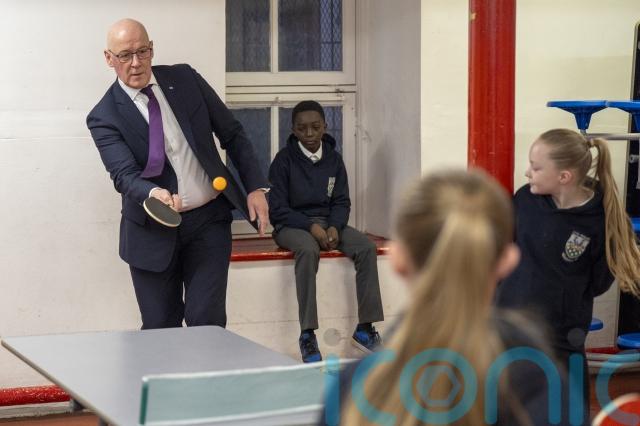
Mr Swinney was speaking as he visited a breakfast club at a primary school in Leith, Edinburgh, on Wednesday, where he played table tennis and the card game Uno with youngsters.
He said such facilities are “a very tangible and practical way of helping families to be able to access employment”.
He added: “This is all part of a long term child poverty agenda, which is all about making sure that we eradicate child poverty.
“Scotland is making significant progress in that respect, with falling levels of child poverty, which is projected to rise in other parts of the United Kingdom.”
Mr Swinney also defended the Budget from claims from the trade union Unison Scotland that it does “not go far enough to address the deepening crisis across public services”.
The SNP leader argued his Government had “invested very significantly in our public services”, pointing to real-terms increases in the Budget in funding for both the health service and local councils, along with “very strong settlements for police, fire and the justice system”.
While he accepted there are “enormous financial pressures in our public services”, he pointed to the impact of Government investment in areas such as the NHS.
Mr Swinney said: “In Scotland, in the health service, we are seeing monthly reductions in long waits, just as I promised people.
“I told people that I would reduce long waits in our hospitals, and we’ve had six consecutive months of falls as a consequence of the priority that we’ve attached to that particular issue.
“So there is strong investment in our public services, especially in our national health service, to help it recover from Covid and the disruption of Covid, and we are seeing better outcomes emerging as a consequence.”
The Scottish Police Federation (SPF), which represents rank-and-file officers, however warned the increase in funding of £90 million for the police falls “well below” what is needed to stabilise officer numbers and help Police Scotland meet rising demand.
Speaking about the Budget, SPF general secretary David Kennedy said: “Yes, there is a cash uplift – but in real terms policing continues to fall behind.
“Inflation, rising demand and workforce pressures mean the service is being asked to do more with less.
“We are already seeing the consequences; fewer officers on shift, slower response times, and less visible community policing.”
Police Scotland had asked for an additional £138.6 million so it could protect current staffing levels, with Mr Kennedy saying: “A £90 million increase sounds substantial until you compare it with what policing actually needs.
“At its core, this Budget does not match the scale of the challenge.”

Subscribe or register today to discover more from DonegalLive.ie
Buy the e-paper of the Donegal Democrat, Donegal People's Press, Donegal Post and Inish Times here for instant access to Donegal's premier news titles.
Keep up with the latest news from Donegal with our daily newsletter featuring the most important stories of the day delivered to your inbox every evening at 5pm.

This publication supports the work of the Press Council of Ireland and Office of the Press Ombudsman, and our staff operate within the Code of Practice of the Press Council. You can obtain a copy of the Code, or contact the Council, at www.presscouncil.ie, Lo-call 1800 208 080 or email: info@presscouncil.ie.