Search


27 Jan 2026
Search
27 Jan 2026

Please allow ads as they help fund our trusted local news content.
Kindly add us to your ad blocker whitelist.
If you want further access to Ireland's best local journalism, consider contributing and/or subscribing to our free daily Newsletter .
Support our mission and join our community now.
To continue reading this article, you can subscribe for as little as €0.50 per week which will also give you access to all of our premium content and archived articles!
Alternatively, you can pay €0.50 per article, capped at €1 per day.
Thank you for supporting Ireland's best local journalism!


A Holocaust survivor who hid in a cellar to escape persecution said it was comforting to know his son would continue to tell his story.
Paul Sved, 87, was born to a Jewish family in Budapest, Hungary, in February 1938.
He lived a largely secular life and did not realise he was Jewish until the Hungarian government’s antisemitic policies began to affect his life.
Speaking to the Press Association ahead of Holocaust Memorial Day (HMD) on Tuesday, he said: “My first remembrance of troubles ahead was the fact that I was not allowed to go to nursery school.
“Because my mother always wanted to protect me from the troubles which she knew was coming, she did not say why I couldn’t go.”
From March 1944, Nazi Germany occupied Hungary, and Jews were forced to wear the yellow Star of David on their clothing and faced discrimination on public transport.
Mr Sved’s apartment block was designated a “yellow star house”, where only Jews could live, and he found himself sharing a bedroom with strangers.
His mother, Piroska Birnfeld, managed to obtain false identity papers to enable her and her son to restart their lives in Budapest living as Roman Catholics.
He said: “I had to learn new names, new birth dates, new names for my mother, and I had to learn prayers – Roman Catholic prayers, which my mother drilled into me, like the Lord’s prayer or Hail Mary.
“I’ve lived in England now since 1957, but to this day, it was so drilled into me I could still rattle off all these prayers in Hungarian.”
After briefly living outside the Jewish district, they were forced to return after Mr Sved was overheard inadvertently revealing their true identities while out shopping with his mother.
Having decided the “yellow star” block was no longer safe, Ms Birnfeld sought help from her brother Imre, who found her and her son a hiding place in the cellar of a Budapest apartment block.
“There were 10 of us hidden by some do-gooding people who tried to hide us and save us,” Mr Sved said.
“It was very dark, pitch dark in there. Food was lowered once a day and (the) remains hauled up once a day on a pulley. Now this, (at) age six, I was not prepared to accept, and I howled.
“(We) couldn’t make a noise, so I howled quietly. I remember saying that ‘I can’t stand this, I can’t stand this’. It was so dark that I remember it made no difference whether my eyes were open or shut; it was pitch dark either way.”
In Budapest, 1944, Paul Sved’s mother obtained false identity papers so she and Paul could move from a Yellow Star House – where Jews were forced to live before deportation – to an apartment outside the Jewish district. One day, as they were leaving the building, Paul noticed… pic.twitter.com/M527KhLV0M
— H.E.T. (@HolocaustUK) January 24, 2026
With the help of his uncle, he and his mother moved into a Swiss-protected house for a few weeks before moving to a cottage outside Budapest, where they were protected by a non-Jewish family.
He returned to Budapest with his mother in late 1945, where they reunited with his grandparents.
After the war, Russia took control of Hungary and he and his mother were considered “class enemies” of the Communist regime.
The regime was overthrown in 1956, and he escaped to England the following year.
He went on to have three children and a career in the textiles industry, and regularly speaks in schools, colleges, workplaces and football clubs through his work with the Holocaust Educational Trust (HET).
“One of the main rewards that I get visiting schools and colleges is the warm reaction, the questions, the clapping at the end, and kids crowding around me afterwards wanting to ask more questions,” he said.
“I find that heartwarming and encouraging, and I get that in just about every school I go to.”
The theme of this year’s HMD is “bridging generations” – highlighting the role that younger people will play in preserving memories of the Holocaust.
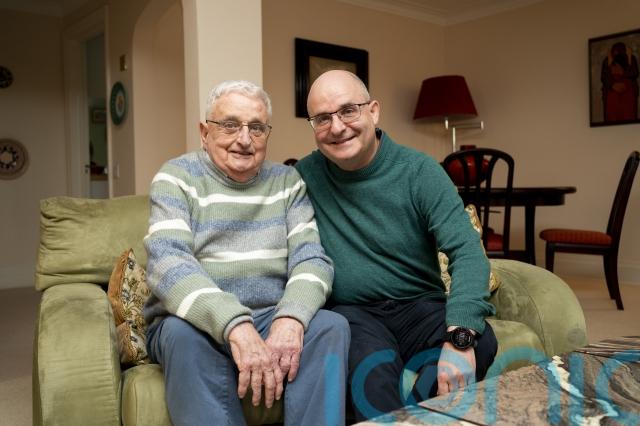
Mr Sved’s son Richard has recently started working with the Holocaust Educational Trust charity to ensure his father’s experience is never forgotten.
Mr Sved said: “It is a relatively recent experience to talk with Richard, but it is encouraging for me to have him along.
“It is so comforting for me to think that Richard will be there to continue this.”
Aware of the life his father had led, Richard found it difficult to talk about the Holocaust for some time.
He told PA the shift came when his father began sharing his experiences in the last 10 to 15 years.
Richard said: “I feel immense pride that he’s doing that and I’m aware that he won’t be able to do it forever, and that somebody else needs to tell the story.
“The other feeling of pride stems from his mother, my grandmother, and how proud I am of her and what she did, because neither he, nor I, nor my brother and my sister would be here without what she did, so I would like to honour her memory, too.”
He added: “I do feel it’s a sense of duty for me. It’s become a stronger feeling as I’ve got older, I’m now in my 50s, and, increasingly, it’s become an actual, visceral feeling (that) the pain of what happened has gone to the next generation.
“I feel it in my bones, just thinking about it, and I would like to do all I can to make sure it doesn’t happen again.”
Richard said he and a friend visited the site of the Auschwitz concentration camp for the first time recently, which “brought home” the horrors of the Holocaust “in a very real sense”.
He said: “I think it’s really important that it’s preserved, and that it helps the stories to continue to be told.
“The first and the last thing that the guide said to my friend and me was, ‘thank you for coming, because the fact that you’ve come means that the stories will continue to be told’.”

Subscribe or register today to discover more from DonegalLive.ie
Buy the e-paper of the Donegal Democrat, Donegal People's Press, Donegal Post and Inish Times here for instant access to Donegal's premier news titles.
Keep up with the latest news from Donegal with our daily newsletter featuring the most important stories of the day delivered to your inbox every evening at 5pm.

This publication supports the work of the Press Council of Ireland and Office of the Press Ombudsman, and our staff operate within the Code of Practice of the Press Council. You can obtain a copy of the Code, or contact the Council, at www.presscouncil.ie, Lo-call 1800 208 080 or email: info@presscouncil.ie.