Search


05 Feb 2026
Search
05 Feb 2026

Please allow ads as they help fund our trusted local news content.
Kindly add us to your ad blocker whitelist.
If you want further access to Ireland's best local journalism, consider contributing and/or subscribing to our free daily Newsletter .
Support our mission and join our community now.
To continue reading this article, you can subscribe for as little as €0.50 per week which will also give you access to all of our premium content and archived articles!
Alternatively, you can pay €0.50 per article, capped at €1 per day.
Thank you for supporting Ireland's best local journalism!


Interest rates have been held at 3.75% as the Bank of England said the UK economy will grow at a slower rate than previously thought, and unemployment will worsen.
The Bank downgraded its growth forecasts for 2026, from 1.2% to 0.9%, and 2027, from 1.6% to 1.5%.
The central bank said it was keeping rates unchanged to make sure that inflation stays around its target level of 2%.
New forecasts from the Bank’s Monetary Policy Committee (MPC) show the rate of Consumer Prices Index (CPI) inflation dropping to the target this year, having previously said this would happen in 2027.
The MPC thinks that measures announced in the Chancellor’s autumn budget will help to slow inflation, particularly a package of support to bring down household energy bills from April.
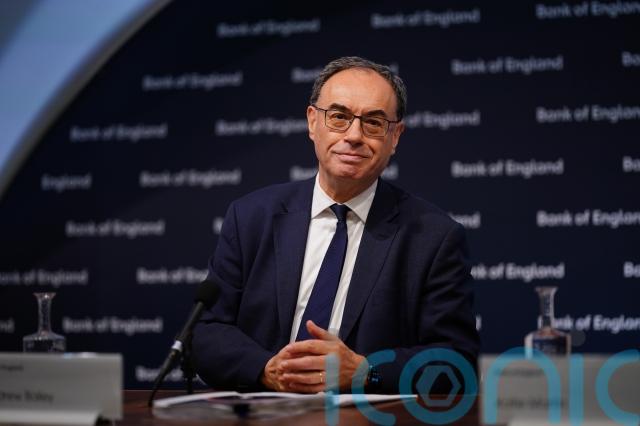
Andrew Bailey, the Bank’s governor, said: “We now think that inflation will fall back to around 2% by the spring. That’s good news.
“We need to make sure that inflation stays there, so we’ve held interest rates unchanged at 3.75% today.
“All going well, there should be scope for some further reduction in the bank rate this year.”
It is also expecting the unemployment rate to rise to 5.3% this year, having said in November that it would peak at 5.1%.
Central banks typically use elevated interest rates to bring down inflation but reduce them if inflation is dropping too quickly or there is a need to stimulate further economic growth.
The Bank has cut interest rates six times over the past 18 months after rates peaked at 5.25%.
It has indicated rates are still “likely” to be reduced further this year despite the latest decision to hold.
Inflation was most recently recorded at 3.4% in December but is set to drop more quickly from April, partly due to the impact of new energy bills support from the budget, which is set to reduce the typical annual household energy bill by £134.
Measures linked to the budget will contribute to a roughly 0.5 percentage point drop in the inflation rate.
Bank officials have also highlighted that slowing wage growth will contribute to the drop in inflation.
The inflation rate is set to remain close to the 2% target through to the end of 2026, but is then set to dip as low as 1.7% in early 2027.
Meanwhile, the Bank’s latest forecasts presented a gloomier picture for UK growth.
It showed that it believes the UK economy grew by 1.4% in 2025, having last predicted growth of 1.5% for the year.
It also downgraded its GDP (gross domestic product) forecasts for 2026, to 0.9% from 1.2%, and 2027, to 1.5% from 1.6%.
Growth is, however, expected to lift above previous guidance to 1.9% in 2028.
Officials from the Bank found that consumer demand for goods and services has been subdued and is expected to remain so “through 2026”, with firms citing rising unemployment and continued concerns over the cost of living.
Supermarkets told the Bank they have seen “modest” volume growth, with consumers cautious about their overall spending and therefore “forgoing treats”.
The Bank’s report highlighted that growth was also dampened by wider pressures in the UK labour market.
In November, the Bank predicted that unemployment would peak at 5.1%. But on Thursday, it said this is now expected to rise as high as 5.3%.
The unemployment rate is then expected to steadily decline to 5.2% in 2027 and 5.1% in 2028.
It had previously forecast rates of 5% and 4.8% for 2027 and 2028 respectively.

Subscribe or register today to discover more from DonegalLive.ie
Buy the e-paper of the Donegal Democrat, Donegal People's Press, Donegal Post and Inish Times here for instant access to Donegal's premier news titles.
Keep up with the latest news from Donegal with our daily newsletter featuring the most important stories of the day delivered to your inbox every evening at 5pm.

This publication supports the work of the Press Council of Ireland and Office of the Press Ombudsman, and our staff operate within the Code of Practice of the Press Council. You can obtain a copy of the Code, or contact the Council, at www.presscouncil.ie, Lo-call 1800 208 080 or email: info@presscouncil.ie.